<h2>History of Wedding Rings: From Ancient Egypt to Modern Times</h2>
The Beginning: Ancient Egypt and the Circle as Infinity
The earliest known wedding rings come from ancient Egypt, around 3000 BCE. Archaeologists have found rings made from braided reeds, hemp, and leather buried with mummies in Egyptian tombs. These weren't gold or silver; they were organic materials that didn't survive well, which explains why intact specimens are rare in the archaeological record.
The Egyptians chose a circle for a reason that still resonates today. A circle has no beginning and no end, which made it a natural symbol for eternal love. The open center of the ring was also significant; it represented a doorway or portal to the unknown future a couple would share. This symbolic framework became the foundation for every wedding ring tradition that followed.
What's particularly interesting is that the Egyptians wore the ring on the fourth finger of the left hand. They believed this finger contained the vena amoris, the "vein of love," which ran directly from that finger to the heart. Anatomically, there's no such vein, but the idea was so compelling that it persisted through Greek and Roman culture and remains the default placement in many countries today.
Greece and Rome: From Hemp to Iron
The Greeks adopted the Egyptian ring tradition around the 8th century BCE but added their own twist. They began using more durable materials, including ivory, bone, and eventually metals. Greek rings often featured carved images of Eros, the god of love, or the couple themselves locked in an embrace.
It was the Romans, however, who turned the wedding ring into something closer to what we recognize today. By the 2nd century CE, Roman citizens were exchanging iron rings during marriage ceremonies. Iron was chosen for its strength, which symbolized the durability of the bond. These were plain bands without gemstones or decoration. The Romans called the ring annulus pronubus, and the act of giving it was a public declaration that the woman was no longer available.
Roman rings also introduced one of the most enduring designs in jewelry history: the fede ring. "Fede" comes from the Italian phrase mani in fede, meaning "hands in faith." These rings showed two right hands clasped together in a handshake, a gesture of trust and agreement. Fede rings became popular across medieval Europe and are still produced today by jewelers who specialize in historical reproduction.
The Romans also started the tradition of giving two rings: a gold ring worn in public to show status, and an iron ring worn at home for everyday life. This dual-ring concept foreshadowed the modern engagement ring plus wedding band set, though the logic was different. For Romans, the iron ring was the one that actually mattered for the marriage contract.
Medieval Europe: The Church Blesses the Ring
When Christianity spread across Europe, wedding rings were absorbed into religious ceremony. By the 4th century, the Church formally included the ring exchange in the marriage rite. A bishop or priest would bless the ring before placing it on the bride's finger, which added a layer of spiritual significance to what had been largely a civil or cultural practice.
During the Middle Ages (roughly 500-1500 CE), wedding rings became more ornate. Gold replaced iron as the preferred metal among the wealthy. Rings featured engravings of religious figures, Latin inscriptions, and occasionally small gemstones. A popular inscription from this period was "Pensées moi" (think of me) in Old French, carved on the inside of the band where only the wearer could see it.
The 13th century saw a shift in ring placement. Pope Innocent III decreed that wedding rings should be placed on the ring finger during the actual ceremony, and then moved to the thumb, then the index finger, and finally back to the ring finger while reciting "In the name of the Father, the Son, and the Holy Spirit." This ritual persisted in some Eastern Orthodox ceremonies until modern times.
Posy rings became fashionable in 15th-century England. These were gold bands inscribed with short poems or romantic phrases on the inside. Surviving examples include messages like "Love conquers all things" and "I have found the one my soul loves." The British Museum holds a collection of over 300 posy rings, making it one of the largest archives of medieval romantic jewelry in the world.
The 16th Century: Diamonds Enter the Picture
The first recorded diamond engagement ring was given in 1477 by Archduke Maximilian of Austria to Mary of Burgundy. This is the moment when wedding and engagement rings began to diverge into two separate traditions. Maximilian's ring featured thin, flat diamonds set in the shape of the letter "M," which was both a romantic gesture and a display of enormous wealth.
At this time, diamonds were incredibly rare in Europe. The only known sources were riverbeds in India, and the supply was limited to what traders could transport along the Silk Road. A diamond ring in the 15th century cost the equivalent of a small farm. The association between diamonds and marriage proposals was born not from any inherent romantic quality of the stone, but from its scarcity and cost, which made it a powerful status symbol.
During the 16th and 17th centuries, the tradition of giving a diamond ring spread slowly through European royalty and aristocracy. Ordinary people continued to exchange plain gold or silver bands. The gap between what wealthy families could afford and what common people wore was enormous and would persist for centuries.
The Victorian Era: Sentimental Jewelry Changes Everything
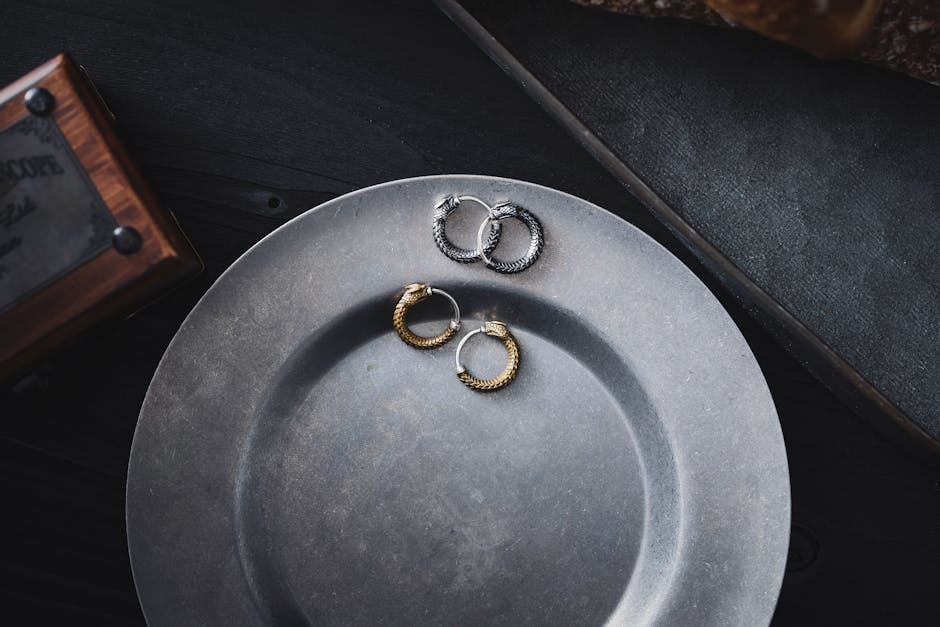
Queen Victoria's marriage to Prince Albert in 1840 had an outsized influence on wedding jewelry. Victoria chose a gold band with a serpent design, the snake being a symbol of eternal love in Victorian symbolism. The ring featured rubies for passion, diamonds for eternity, and emeralds for hope. Overnight, serpent rings became the must-have engagement style across Britain and its colonies.
The Victorian era also introduced "acrostic jewelry," where the first letter of each gemstone spelled out a word. A ring set with Lapis lazuli, Opal, Verdelite (tourmaline), and Emerald would spell "LOVE." This clever approach let couples embed hidden messages in their rings, and surviving Victorian acrostic rings are now valued at $5,000 to $20,000 at auction depending on the stones and craftsmanship.
Victorian mourning jewelry is another fascinating subcategory. When Prince Albert died in 1861, Victoria wore black for the rest of her life and popularized rings made from jet (a black fossilized wood) or featuring lockets containing a loved one's hair. While not wedding rings per se, this tradition influenced how people thought about jewelry as a vessel for personal memory and emotion.
The 20th Century: The Diamond Ring Becomes Universal
The biggest shift in wedding ring history happened in the 1930s and 1940s, driven by De Beers and their advertising agency N.W. Ayer. In 1947, De Beers launched the "A Diamond Is Forever" campaign, which explicitly linked diamond engagement rings to romantic commitment. The slogan was deliberately chosen to discourage people from reselling their diamonds, which would have created a secondary market and undercut De Beers' pricing control.
Before this campaign, only about 10% of engagement rings in the United States contained diamonds. By the end of the 1960s, that number had risen to 80%. The campaign is widely considered one of the most successful advertising strategies in history, and it fundamentally changed what people expected from a proposal.
Platinum also became the dominant metal for engagement settings during this period. Platinum had been used in jewelry since the early 1900s, but its use expanded dramatically after World War II when new refining techniques made it more affordable. White gold emerged as a less expensive alternative, and the "white metal look" became the default for engagement rings in Western countries.
Wedding Ring Traditions Around the World
While the Western diamond-and-gold-band model gets the most attention, wedding ring traditions vary enormously across cultures.
In India, traditional Hindu weddings don't use finger rings at all. Instead, the groom places a mangalsutra, a black-beaded necklace with a gold pendant, around the bride's neck. In some South Indian communities, women wear toe rings called bichiya as the primary symbol of marriage. Finger rings have become more common in urban Indian weddings due to Western influence, but they sit alongside, rather than replace, older traditions.
Jewish wedding ceremonies use a plain gold ring with no stones, no engravings, and no cuts in the metal. The smooth, unbroken circle symbolizes the hope for an unbroken marriage. During the ceremony, the groom places the ring on the bride's right index finger, which differs from the Western left-ring-finger custom. After the ceremony, many women move it to the ring finger of their left hand for everyday wear.
Chinese wedding traditions historically involved the "three golds" or san jin: a gold ring, gold necklace, and gold earrings given by the groom's family. Gold is culturally significant in Chinese tradition as a symbol of prosperity and good fortune. In recent decades, diamond engagement rings have become popular among younger Chinese couples, particularly in urban areas, but gold remains the traditional choice for the wedding band itself.
In Nordic countries like Sweden and Norway, it's common for both men and women to wear a plain gold or silver engagement ring, followed by a matching wedding band at the ceremony. Some Norwegian couples exchange three rings: one for engagement, one for marriage, and one for the birth of their first child. This three-ring tradition is less common now but still practiced in rural communities.
Modern Trends: Where Wedding Rings Are Headed
The 21st century has brought several notable shifts in how people approach wedding rings.
Matching wedding bands for both partners have become increasingly common. Where men's wedding bands were once plain and understated while women's featured diamonds, many couples now choose identical or complementary designs. This reflects broader changes in how people think about equality in relationships.
Alternative metals have gained significant market share. Titanium, tungsten carbide, and ceramic rings now account for roughly 25% of men's wedding band sales in the United States. These materials are harder than gold, more scratch-resistant, and significantly cheaper. Tungsten carbide rings typically cost between $50 and $300, compared to $500 to $2,000 for a comparable gold band.
Lab-grown diamonds have disrupted the market since becoming commercially viable around 2016. A lab-grown diamond costs 40-60% less than a mined diamond of equivalent quality, and they are chemically identical. In 2024, lab-grown diamonds accounted for approximately 35% of all diamond engagement ring sales in the U.S., up from less than 5% in 2018.
Non-diamond engagement rings are also gaining ground. Sapphires, moissanite, and colored gemstones like morganite and aquamarine have all seen increased demand. Part of this is economic, as these stones cost less than diamonds, but there's also a cultural component: younger couples are less interested in following a tradition invented by a 1940s advertising campaign.
Customization has become easier and more affordable thanks to computer-aided design (CAD) and 3D printing. Couples can now work with jewelers to design unique rings that combine elements from different historical traditions. A modern couple might choose a Roman-style fede design set with lab-grown diamonds and engraved with a Victorian-era posy message.
What 4,000 Years of History Tells Us
Looking at the full arc of wedding ring history, a few patterns stand out. The basic idea, a circle exchanged as a symbol of commitment, has remained remarkably stable for millennia. What changes is everything else: the materials, the designs, the ceremony, the cultural meaning layered on top. Every generation reinvents the wedding ring to fit its own values and circumstances.
The wedding ring has been made from reeds, iron, gold, platinum, and titanium. It's been plain, engraved, jeweled, and serpentine. It's been worn on the left hand and the right hand, on the ring finger and the index finger. It's been a legal contract, a religious sacrament, a status symbol, and a personal expression. Through all of these changes, the core idea persists: a small circle of metal that says "I chose you."
Comments