The History of Jade in Chinese Culture (and Why It's Not What Most Westerners Think)
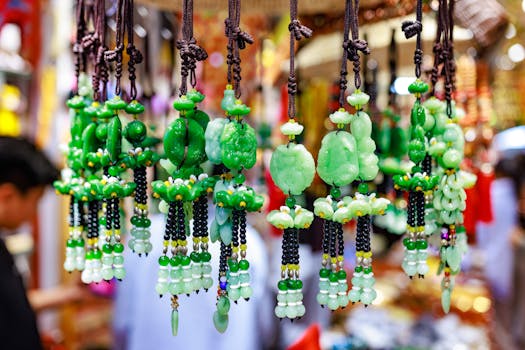
Ask a Westerner to picture jade, and they'll probably imagine a translucent green bangle in a Hong Kong window, or a carved pendant at a museum gift shop. Green. Shiny. Expensive. Maybe they've heard that Chinese people have loved jade for thousands of years. That part is true. But almost everything else in that mental picture is wrong — or at least, only tells a fraction of the story.
Two stones, one name
The first thing to understand is that "jade" isn't a single mineral. It's two completely different minerals that happen to look similar enough that people spent centuries confusing them. Nephrite is a calcium magnesium silicate. Jadeite is a sodium aluminum silicate. They have different crystal structures, different chemical compositions, and different physical properties. Nephrite is slightly softer (6 to 6.5 on the Mohs scale) and tougher — meaning it's harder to break. Jadeite is harder (6.5 to 7) but more brittle.
Here's the part that surprises most people: for roughly 7,000 years of Chinese history, the jade everyone was talking about was nephrite. Jadeite didn't show up in any significant quantity until the late 1700s, when it started arriving from Burma through Yunnan province. The Qing Dynasty court went crazy for it, and within a few generations, jadeite had almost entirely displaced nephrite in the popular imagination. Today when someone says "jade" in a commercial context, they almost always mean jadeite. But that's a very recent development in a very long story.
The Chinese word 玉 (yù) doesn't map cleanly onto either mineral anyway. It's a cultural category, not a geological one. Historically, the word has been applied to anything considered precious, smooth, and morally significant — including materials that aren't jade at all by modern definitions. Some ancient "jade" artifacts turn out to be serpentine, bowenite, or even quartz when you test them in a lab. The Chinese weren't wrong about their own culture. They just had different criteria for what counted.
The Liangzhu proof
If you want to see how old the jade story really is, go to the Liangzhu site in Zhejiang province. The archaeological remains there date to roughly 3400 BCE, and they include thousands of jade objects — cong tubes, bi discs, axes, pendants. These weren't casual decorations. The scale of production, the consistency of the forms, and the fact that some elite burials contained hundreds of jade items all point to a sophisticated culture where jade was central to religion, politics, and social hierarchy.
The cong is particularly interesting: a square tube with a circular hole through it. Nobody knows exactly what it represented, but the consensus among archaeologists is that it connected the square earth with the circular heaven. The bi disc — a flat circle with a hole in the center — probably symbolized the sky. These shapes persisted for thousands of years. You can find cong and bi forms in burials from the Shang Dynasty (1600–1046 BCE) and the Zhou Dynasty (1046–256 BCE), long after Liangzhu itself had collapsed.
The craftsmanship is remarkable given the tools available. Nephrite is tough. You can't just chip away at it like flint. The Liangzhu artisans probably used abrasives — quartz sand, maybe garnet — with bamboo or stone tools, grinding for days or weeks to produce a single piece. Some of the finer carvings have thread-thin lines that would challenge modern equipment without rotary tools.
The Confucian makeover
Jade had religious significance for a long time. Then Confucius (551–479 BCE) got hold of the concept and gave it an ethical framework that stuck for two and a half thousand years. The key passage comes from the Liji (Book of Rites): "The gentleman compares virtue to jade." Confucius listed eleven qualities of jade and mapped each one to a human virtue. Its smoothness was benevolence. Its translucence was intelligence. Its sharp edges (which don't cut) was justice. Its consistency was loyalty.
This wasn't just poetic metaphor. It became the basis for a social system. The type of jade you wore, its color, its quality, and how you wore it — all of it communicated your rank, your education, and your moral standing. Han Dynasty officials wore jade pendants that were supposed to chime softly as they walked, the idea being that a gentleman's movements should be measured and harmonious. If your jade was clanking around, you were walking too fast or too aggressively. There was literally a soundtrack to good behavior.
The imperial family took this further. The emperor's seal was traditionally made from the Heshibi, a legendary jade disc that had passed through the hands of multiple states during the Warring States period. Losing the seal meant losing the Mandate of Heaven. Jade burial suits — constructed from hundreds of jade plaques wired together with gold or silver thread — were reserved for the highest-ranking nobility. The belief was that jade could preserve the body. It didn't work, obviously, but the suits themselves are extraordinary technical achievements. The one belonging to Prince Liu Sheng of Zhongshan (died 113 BCE) contains 2,498 jade pieces.
The jadeite revolution
Everything changed in the late 1700s. Jadeite from Burma's Kachin State started flowing into China through the border town of Ruili. The Qianlong Emperor (reigned 1735–1796) was an enthusiastic collector, and imperial patronage gave jadeite a legitimacy it had previously lacked. Within the court, jadeite was seen as more vibrant, more "alive" than nephrite. The best pieces had a translucency and color intensity that nephrite couldn't match — particularly the intense green that the Chinese called 帝王绿 (imperial green).
But jadeite's real explosion came in the 20th century, and it was driven not by emperors but by money. In the 1970s and 1980s, Hong Kong and Taiwan became the centers of the jadeite trade. Dealers from both places flooded into Burma to buy rough stone at the mines. Auctions in Hong Kong turned into media spectacles. A single top-grade jadeite bangle could sell for more than a house. The market developed its own grading system — based on color, translucency, texture, and clarity — that was entirely separate from the mineralogical definitions used in the West.
Here's where it gets genuinely wild: a piece of top imperial green jadeite can sell for over $27 million at auction. Christie's sold a jadeite bead necklace in 2014 for $27.44 million. Meanwhile, a comparably sized piece of nephrite — the material that actually built Chinese jade culture — might sell for a few hundred dollars. The entire economic structure of the jade market is upside down relative to the historical record. The mineral that Chinese civilization used for seven millennia is the budget option. The newcomer that showed up 250 years ago is the luxury product.
What jade actually means in China today
Walk through any city in China and you'll see jade everywhere. Not just in jewelry shops — in temple offerings, in grandparents' homes, in the trinkets people keep in their pockets. The cultural association between jade and moral purity hasn't disappeared, even if most younger people would roll their eyes if you tried to explain Confucius's eleven virtues. There's still a vague, persistent feeling that jade is "good" in a way that other gemstones aren't. Parents give jade pendants to children. People buy jade when they get a promotion. There's a saying: 黄金有价玉无价 — "Gold has a price, jade is priceless." The literal meaning is about market value. The cultural meaning is that jade connects you to something older and bigger than a price tag.
The jade market in Myanmar, which supplies virtually all of the world's gem-quality jadeite, has its own dark side. The mines in Kachin State have been linked to environmental destruction, drug trafficking, and funding for armed ethnic groups. The military junta controls the most lucrative mining concessions. A 2015 report by Global Witness estimated the jade trade was worth $31 billion annually — nearly half of Myanmar's GDP — yet very little of that money reached ordinary citizens. This is the reality behind those pretty green bangles in the shop windows.
Nephrite, by contrast, has a much smaller and less controversial market. Most of it comes from British Columbia in Canada and Xinjiang in China. It's used for carvings, beads, and smaller jewelry pieces. There's no equivalent of the imperial green frenzy. Nephrite collectors tend to be people who appreciate the material's history and toughness rather than its investment potential.
Why the Western picture is so limited
There's nothing wrong with associating jade with green bangles and carved pendants. The problem is thinking that's all there is. The jade story in China spans seven thousand years, covers two different minerals, intersects with philosophy, politics, economics, and geology, and is still evolving today. Reducing it to "green stone, Chinese people like it" is like summarizing the history of wine as "fermented grape juice, French people drink it."
The nephrite-versus-jadeite distinction matters because it tells you which era of Chinese history you're looking at. Nephrite is ancient China. Jadeite is late imperial and modern China. Both are "real" jade. Both matter. But they're telling very different stories about very different worlds.
And honestly, that's what makes jade interesting. It's not just a pretty stone. It's a mirror that reflects whatever culture is holding it.
Comments