Fossil Gemstones Guide: Ammonite, Orthoceras &..
June 2, 2026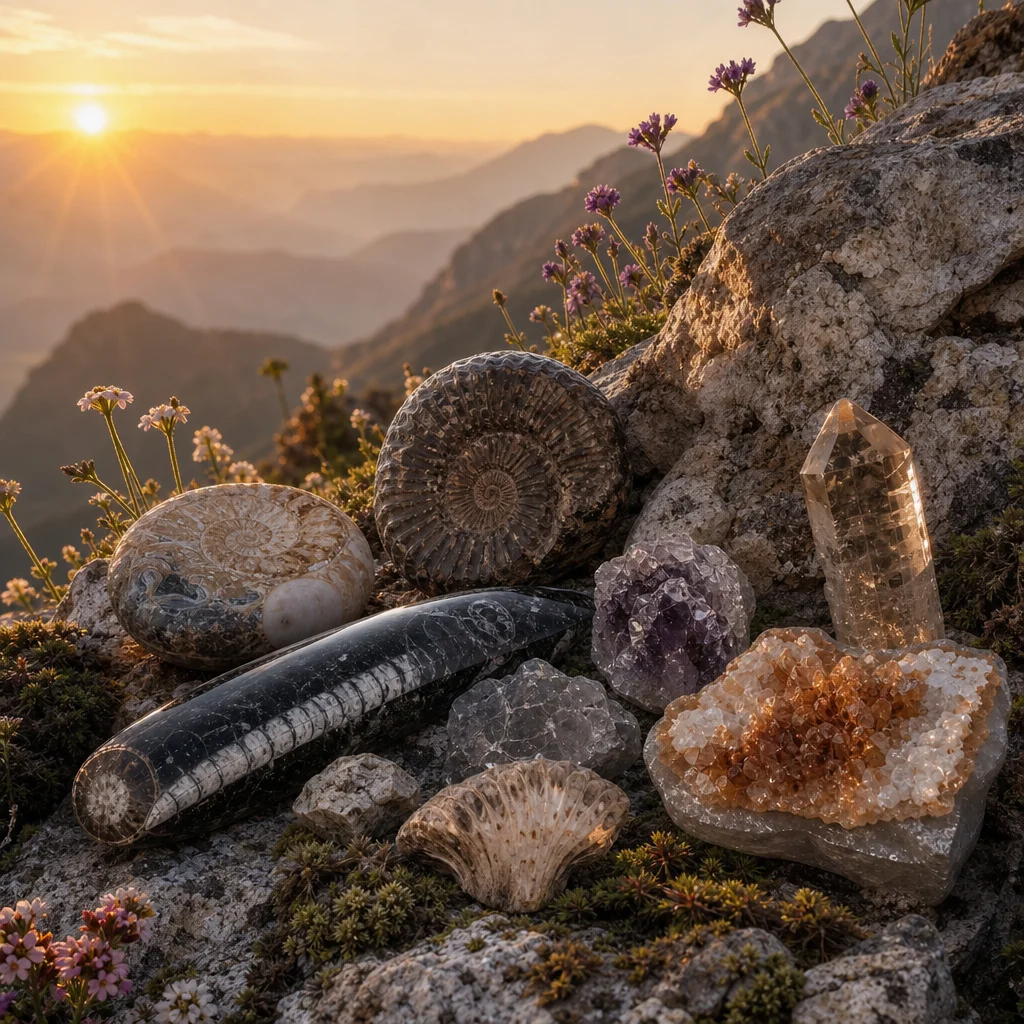
What Makes a Fossil a Gemstone?
Most fossils are scientific specimens preserved in museums and university collections — fragile, valuable for their information rather than their beauty. But some fossils cross the line into the world of gemstones and jewelry. This happens when a fossilized organism produces material that's not only scientifically interesting but visually stunning, durable enough to cut and set, and available in sufficient quantity for the gem and jewelry trade.
Fossil gemstones occupy a unique space — they're simultaneously geological specimens, biological artifacts, and wearable art. When you wear an ammonite pendant or an orthoceras ring, you're literally carrying a piece of Earth's biological history with you. The age of most fossil gemstones ranges from tens of millions to hundreds of millions of years, which gives them a depth of significance that newly mined crystals simply can't match.
Let's explore the most popular and commercially important fossil gemstones, how they formed, what makes each one special, and what to consider if you're looking to add them to your collection or jewelry box.
Ammonite and Ammolite: The Iridescent Treasure
What Are Ammonites?
Ammonites were marine cephalopods — related to modern squids, octopuses, and nautiluses — that lived from the Devonian period (about 400 million years ago) until the Cretaceous-Paleogene extinction event 66 million years ago, the same catastrophe that wiped out the dinosaurs. They were abundant, diverse, and globally distributed, which is why ammonite fossils are found on every continent.
An ammonite's shell was divided into chambers by thin walls called septa. As the animal grew, it added new chambers to the front of the shell, sealing off the older ones behind it. The shell was typically coiled in a planispiral (flat spiral) shape, though some species had straight, helical, or irregular coiling patterns. Sizes ranged from less than a centimeter to over two meters in diameter for the largest species.
Ammonite Fossils in Jewelry
Most ammonite fossils used in jewelry come from Madagascar and Morocco. These are typically polished cross-sections or whole specimens that have been cut to reveal the internal chamber structure — the suture patterns where septa meet the shell wall. These patterns, called "suture lines," create intricate, fractal-like designs that look almost hand-carved but are entirely natural.
Colors range from warm browns and creams to occasional gray and reddish tones, depending on the mineral replacement in the shell chambers. Calcite, pyrite, and various silicate minerals commonly fill the chambers, creating interesting contrasts between the shell wall and the chamber fill.
Ammolite: The Gem-Grade Ammonite
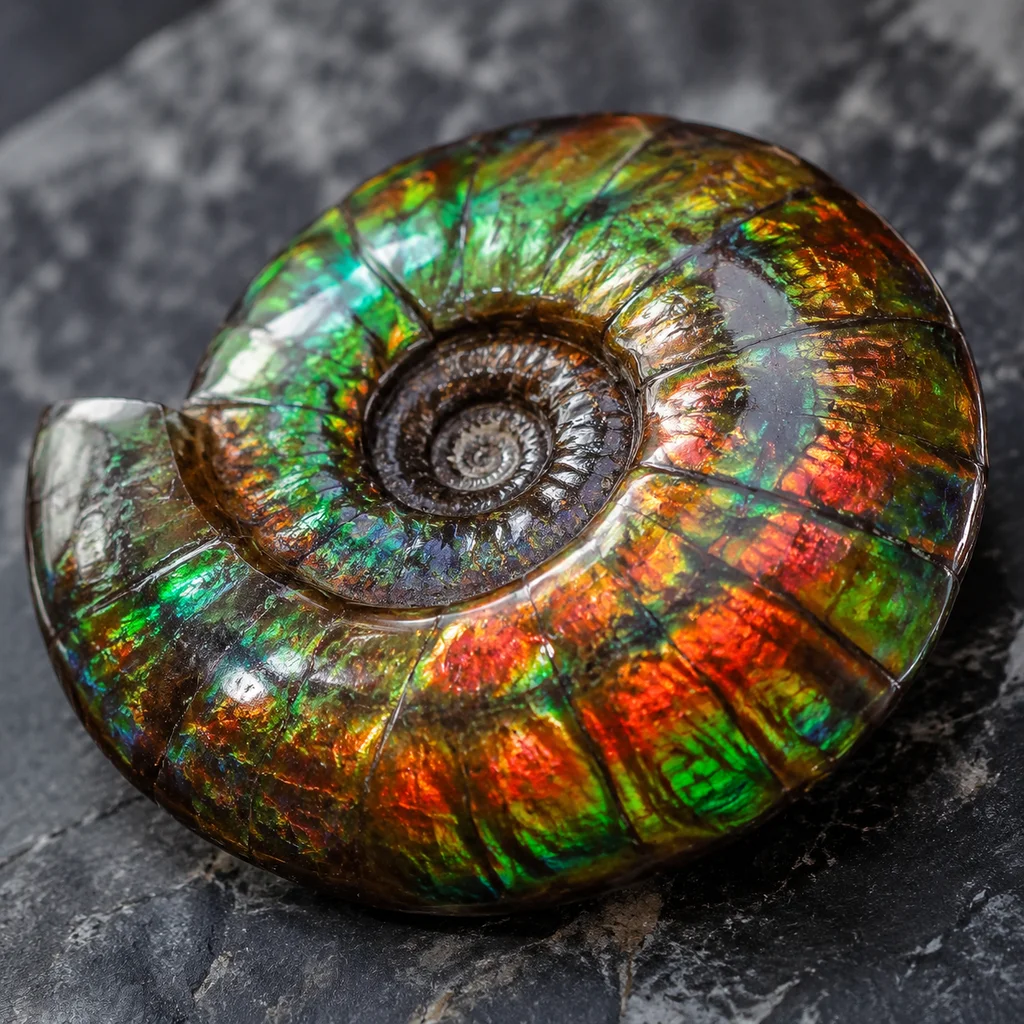
Ammolite is the gemstone-grade version of fossil ammonite — specifically, the iridescent nacre (mother-of-pearl) layer of the shell that has been preserved and mineralized. Ammolite comes exclusively from the Bearpaw Formation in Alberta, Canada, where specific geological conditions allowed the thin nacreous layer of the shell to be preserved as a gem-quality mineral coating.
The iridescence of ammolite is caused by thin-film interference — the same optical effect that creates the rainbow colors in soap bubbles and oil slicks. Microscopic layers of aragonite and conchiolin in the fossilized shell create conditions where different wavelengths of light are reflected at different angles, producing vivid greens, reds, blues, golds, and purples that shift as you move the stone.
Ammolite is one of the rarest gemstones in the world. The layer of gem-quality nacre is typically only 0.5 to 0.8 millimeters thick, so ammolite is almost always cut as thin cabochons and set in protective settings (often with a clear spinel or synthetic corundum cap to protect the fragile surface). The Korite International company is the primary commercial miner of ammolite in Alberta.
Because the nacre layer is so thin and fragile, ammolite is not suitable for rings that take daily wear. Pendants, earrings, and brooches in protective bezel settings are the best applications. Avoid exposure to water, chemicals, and direct impact.
Orthoceras: The Straight Cephalopod
While ammonites had coiled shells, their relatives the orthoceratids had straight, conical shells — think of a long, tapered horn made of stone. Orthoceras lived during the Ordovician period, roughly 450 million years ago, making them significantly older than most ammonites. The name means "straight horn" in Greek, which is an accurate description.
Orthoceras fossils used in jewelry come primarily from Morocco, where they're abundant in the Ordovician-age limestone deposits of the Anti-Atlas Mountains. These fossils are black or dark gray with subtle lighter markings — the shell has been replaced by black calcite or chert, giving the polished fossils a sleek, dark appearance.
In jewelry, orthoceras is typically cut as cabochons, tumbled stones, or whole polished specimens set into pendants and earrings. The segmented internal structure of the shell creates a distinctive banded pattern visible in cross-sections — alternating dark and slightly lighter bands that mark the original chamber walls.
Orthoceras scores about 3.5 to 4 on the Mohs scale, so it's relatively soft and should be worn in protected settings. The black color makes it versatile for pairing with both silver and gold settings, and it has a bold, masculine aesthetic that appeals to many wearers.
Jet: The Victorian Mourning Gem
Jet is one of the oldest gemstones in human history, with a story that spans from Jurassic-era forests to Victorian England's most elaborate mourning jewelry. Jet is not a mineral — it's a geological form of lignite, a precursor to coal, formed from ancient wood (likely from Araucaria-like conifer trees) that was buried under sediment and subjected to intense pressure over millions of years.
The finest jet in the world comes from Whitby, on the Yorkshire coast of England. Romans mined Whitby jet, but it reached its peak of popularity during the Victorian era, when Queen Victoria wore jet jewelry following the death of Prince Albert in 1861. Jet became the standard material for mourning jewelry — black, somber, and appropriate for the elaborate mourning customs of Victorian society.
Jet is lightweight (it will float in water, which is a useful identification test), has a velvety matte to semi-glossy black luster when polished, and can be carved into intricate designs. It takes a beautiful polish and was historically used for beads, cameos, rosaries, and elaborate parures (matching sets of necklace, earrings, bracelet, brooch).
Genuine Whitby jet is increasingly scarce as the original deposits are largely exhausted. Imitations are common — glass (called "French jet" in Victorian times), vulcanite (vulcanized rubber), gutta-percha, and modern plastics are all used to simulate jet. Genuine jet is warmer to the touch than glass, lighter, and will produce a brown streak when rubbed across unglazed ceramic.
Amber: Fossil Tree Resin
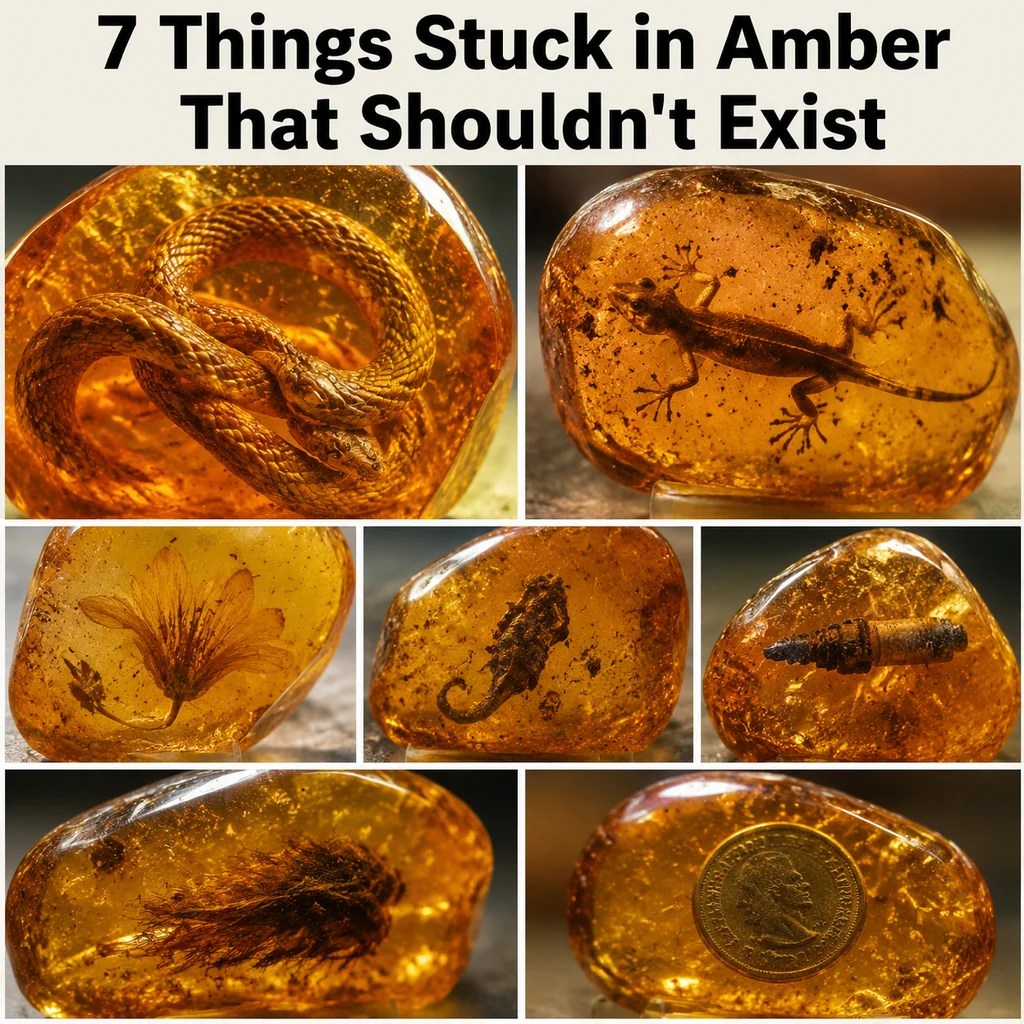
Amber isn't technically a fossil of a living organism — it's fossilized tree resin. But it often contains actual fossils (inclusions) trapped in the resin millions of years ago: insects, spiders, plant material, and occasionally small vertebrates like lizards or frog fragments. These inclusions make amber one of the most scientifically valuable fossil materials because they preserve soft tissues and three-dimensional structures that don't survive in standard fossilization.
Amber forms when tree resin is buried under sediment, undergoes polymerization and hardening over millions of years, and eventually becomes a stable, hard material. The age of commercial amber ranges from about 30 million to over 300 million years, depending on the deposit.
The most significant commercial amber sources are the Baltic region (Baltic amber, 30-50 million years old, from Eocene-era forests), the Dominican Republic and Mexico (25-30 million years old, often with insect inclusions), and Myanmar (Burmese amber, about 100 million years old, from Cretaceous-era forests). Burmese amber is scientifically significant because its Cretaceous age means the inclusions include dinosaurs-era organisms — feathers, baby birds, and other Mesozoic life forms have been found preserved in Burmese amber with astonishing detail.
For jewelry, amber scores 2 to 2.5 on the Mohs scale — very soft. It's warm to the touch, lightweight (will float in saturated salt water), and develops a beautiful warm luster when polished. Amber should never be exposed to heat, chemicals, or prolonged sunlight, all of which can damage or degrade it. Perfume, hairspray, and alcohol-based products are particularly harmful.
Imitation amber is widespread — plastics, glass, copal (young, incompletely fossilized resin), and reconstituted amber (amber chips pressed together with resin) are all common. Genuine amber produces a static charge when rubbed, smells of pine when heated gently, and floats in saturated salt water. UV light can also help identify genuine amber — real amber fluoresces a characteristic pale blue-white or yellowish under long-wave UV.
Petrified Wood: Stone That Was Once Alive
Petrified wood forms when trees are buried rapidly by volcanic ash, sediment, or mud, and the organic material is gradually replaced by silica minerals (typically chalcedony or opal) through a process called permineralization. The replacement happens molecule by molecule, preserving the tree's growth rings, cellular structure, and sometimes even bark texture in stone.
The result is a stone that looks exactly like wood but is actually solid quartz. The colors of petrified wood vary depending on the trace minerals present during fossilization — iron produces reds and yellows, manganese produces purple, carbon produces black, and copper produces green-blue hues. The most colorful and visually striking specimens come from the Petrified Forest National Park region in Arizona, where Triassic-era trees (about 225 million years old) were preserved with exceptional mineralization.
Petrified wood used in jewelry is typically cut as cabochons or tumbled into beads. It scores 7 on the Mohs scale (it's essentially chalcedony), making it one of the more durable fossil gemstones and suitable for daily-wear rings and bracelets. The visible growth rings and wood grain patterns make each piece unique and immediately recognizable.
Fossil Coral (Agatized Coral)
When coral colonies are buried and the calcium carbonate skeleton is gradually replaced by silica (chalcedony/agate), the result is agatized or silicified coral. This preservation process can retain the original coral structure — the polyp cups, branches, and colony patterns — while transforming the material into hard, colorful chalcedony.
The most famous agatized coral comes from Florida, particularly the Tampa Bay area and the Ichetucknee River region. Florida's agatized coral is typically 20-40 million years old (Miocene epoch) and displays beautiful patterns of cream, gray, brown, and sometimes pink or orange against a darker matrix. It's become Florida's official state stone.
Agatized coral scores 6.5 to 7 on the Mohs scale and is durable enough for most jewelry applications. The coral patterns create natural, organic designs that make each cabochon a miniature landscape.
Buying and Collecting Fossil Gemstones
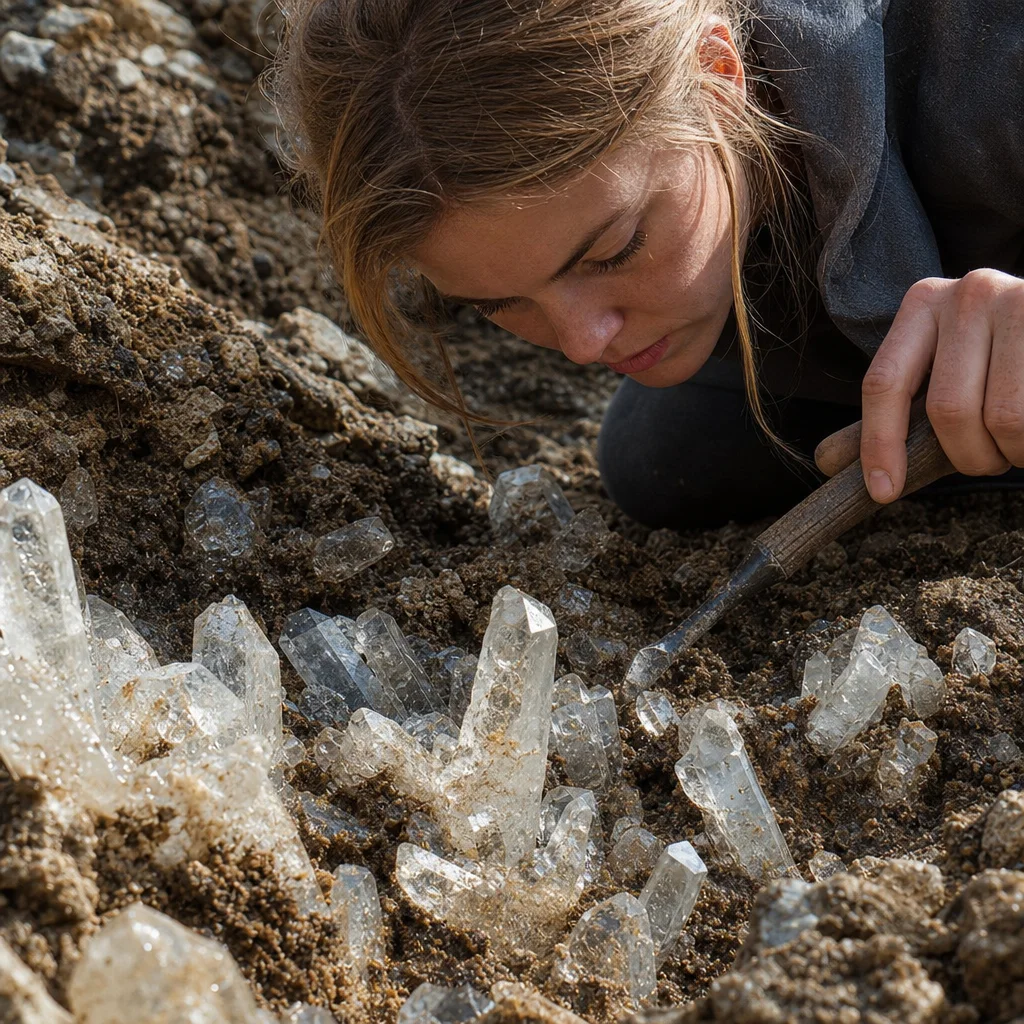
When shopping for fossil gemstones, there are a few things to keep in mind:
Authenticity: Fossil gemstones are frequently imitated or simulated. Ammolite is among the most commonly faked — triplets (a thin ammolite layer sandwiched between a dark backing and a clear synthetic top) are legitimate products but should be clearly labeled. Watch for plastic resins, glass imitations, and reconstituted materials being sold as genuine fossil.
Provenance: Knowing where a fossil gemstone comes from adds to its value and interest. Ammonites from Madagascar, ammolite from Alberta, orthoceras from Morocco, jet from Whitby, Baltic amber from the Baltic region — each locality has its own story and quality characteristics.
Treatment Disclosure: Most fossil gemstones are stabilized or treated in some way. Ammonite fossils are routinely polished and sometimes coated with resin to protect the surface. Amber is frequently heated to improve clarity or pressed to create larger pieces. These treatments are standard in the industry but should be disclosed.
Size and Quality: Fossil gemstones are natural products with natural variations. Inclusions, repairs, and fillings are common. Higher prices command better preservation, more complete specimens, and more vivid color (in the case of ammolite and amber).
Frequently Asked Questions
How can I tell if amber is real?
Three quick tests: (1) Rub it — real amber produces static electricity that attracts small particles like lint. (2) Heat a needle and touch it to an inconspicuous spot — real amber smells like pine resin, plastic smells acrid. (3) Drop it in a saturated salt water solution (about 1 tablespoon salt per cup of water) — real amber floats, most plastics sink.
Is ammolite the same as ammolite gemstone?
Yes, ammolite is the commercial gemstone name for iridescent fossil ammonite shell from Alberta, Canada. The term "ammolite" specifically refers to the gem-grade material, while "ammonite" refers to the broader fossil. Not all ammonites are ammolite — only those from the specific Canadian deposits with preserved iridescent nacre qualify.
Can I wear fossil gemstones every day?
It depends on the specific fossil. Petrified wood (Mohs 7) and agatized coral (6.5-7) are durable enough for daily wear. Amber (2-2.5), jet (3-4), and orthoceras (3.5-4) are soft and better suited for occasional wear in pendants or earrings. Ammolite is extremely fragile and should only be worn in protective settings for special occasions.
Frequently Asked Questions
What is the difference between ammonite and orthoceras?
The primary difference between these ancient marine animals is their shell shape. Ammonites feature coiled, spiral shells similar to today's nautilus. In contrast, Orthoceras had long, straight, conical shells. At SagStone, our artisans carefully hand-polish both prehistoric fossils to reveal their stunning geometric chambers, setting them into artisan jewelry that carries millions of years of Earth's history.
Comments