What Is Fluorescence in Minerals (and Why Some Glow Under UV Light)
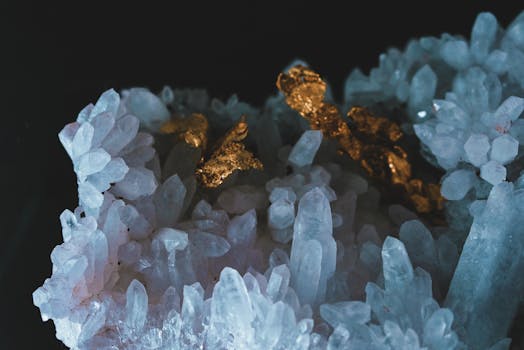
Walk into any mineral show and you'll eventually find someone hunched over a dark box, staring at rocks through a viewing port. Inside the box, an ultraviolet lamp is on, and the rocks are doing something impossible under normal light: they're glowing. Bright greens, pinks, blues, and whites erupt from stones that look dull and ordinary seconds before. This is mineral fluorescence, and once you've seen it in person, regular rocks feel like they're hiding something from you.
The basic mechanism: absorbing and releasing light
Fluorescence happens when a material absorbs light at one wavelength and then emits light at a longer wavelength. In minerals, this means ultraviolet radiation (which is invisible to our eyes) gets absorbed by certain atoms within the crystal structure, and some of that energy comes back out as visible light. The emitted light is always lower energy than what went in, which is why you never get a mineral that absorbs blue light and fluoresces UV — it only works in one direction.
The key player here is the electron. When a UV photon hits an impurity atom (called an activator) lodged inside the mineral's crystal lattice, it knocks an electron up to a higher energy state. The electron doesn't stay there long. It drops back down almost immediately, and when it does, it releases a photon of visible light. The color you see depends on how far the electron falls. A bigger drop means a higher-energy photon — bluer light. A smaller drop means a redder or more yellowish glow.
This whole process takes nanoseconds. The moment you switch off the UV lamp, the fluorescence stops. If the glow lingers after the light goes away, that's something different entirely — phosphorescence — but most fluorescent minerals are strictly "light on, glow on; light off, glow off."
Activators: the trace elements doing the work
Pure minerals almost never fluoresce. The effect depends on trace impurities — activators — sitting inside the crystal structure in tiny amounts, sometimes just a few parts per million. The activator element determines the color. Manganese is probably the most common activator and is responsible for the red and pink fluorescence you see in calcite from Franklin, New Jersey. Europium, a rare earth element, produces bright blue fluorescence in fluorite. Uranium (even in microscopic amounts) causes a vivid green glow in minerals like autunite and torbernite. Chromium gives corundum a red fluorescence under shortwave UV.
Some activators are so consistent that mineral collectors use fluorescence color as a quick identification tool. A green-fluorescing calcite is almost certainly manganese-activated. A blue-fluorescing fluorite probably has europium in it. This isn't foolproof, but it's a decent starting point when you're sorting through a pile of unidentified specimens.
Not all UV light is the same
Mineral collectors typically work with two types of ultraviolet light: longwave (365 nm) and shortwave (254 nm). Some minerals respond to both, some only to one, and the same mineral can produce completely different colors depending on which wavelength hits it. Calcite from Franklin fluoresces red under shortwave UV but may show a weaker, different response under longwave. Willemite, found in the same deposits, fluoresces bright green under shortwave UV.
Midwave UV (around 312 nm) is sometimes used too, though it's less common. A small number of minerals respond only to midwave, making it a niche but useful tool for serious collectors. There's also the question of intensity — a cheap 395 nm LED flashlight labeled "UV" is actually near-UV, and many fluorescent minerals won't respond to it at all. Real mineral fluorescence work demands proper 365 nm longwave or 254 nm shortwave lamps, usually the filtered kind that blocks visible light so you only see the fluorescence.
The Franklin and Sterling Hill deposits
If you want to see fluorescence at its most extreme, the abandoned zinc mines of Franklin and Sterling Hill in Sussex County, New Jersey are the place. Geologists have identified over 80 fluorescent mineral species from these two locations alone, which is more than any other known deposit on Earth. The site is sometimes called the "Fluorescent Mineral Capital of the World," and it earned that title honestly.
The deposits formed roughly 1.0 to 1.1 billion years ago through a sequence of metamorphic and hydrothermal events that concentrated zinc, manganese, and iron in unusual quantities. The specific combination of host rocks and trace elements created the conditions for spectacular fluorescence. Willemite, calcite, clinohedrite, hardystonite, and esperite all occur here, and many specimens contain multiple fluorescent species in the same piece — so you might see green willemite, red calcite, and blue hardystonite all glowing from different parts of a single rock.
The Sterling Hill Mining Museum still lets visitors collect on the mine dump, and it's one of the few places on Earth where you can walk out with a bucket of genuinely world-class fluorescent material. It's not cheap, but the experience of cracking open a rock under UV and seeing three different colors light up from a single stone is worth the trip.
Quenchers: why some minerals refuse to glow
Not every mineral with the right activator actually fluoresces. Some have trace elements called quenchers that absorb the energy before it can produce visible light. Iron is the most common quencher. A calcite specimen with plenty of manganese will fluoresce red — unless it also contains enough iron to suppress the effect entirely. This is why some mineral dealers gently heat or irradiate specimens to reduce the quencher effect, though that's a controversial practice in collecting circles.
Quenchers explain one of the more frustrating aspects of mineral fluorescence: two specimens of the same mineral from the same locality can behave completely differently under UV. One calcite glows like a traffic signal, the other sitting right next to it does absolutely nothing. The chemistry is nearly identical, but one has slightly more iron, or slightly less manganese, and that's enough to make the difference.
Practical uses beyond looking cool
Fluorescence isn't just a party trick for mineral collectors. Geologists use it in ore prospecting — scheelite, an important tungsten ore, fluoresces bright blue under shortwave UV, which makes it much easier to spot in the field than trying to identify it by eye. During World War II, the U.S. Geological Survey actually deployed portable UV lamps to locate scheelite deposits for tungsten production. Tungsten was critical for armor-piercing ammunition, so a glowing rock had real strategic value.
In the oil industry, drilling mud is sometimes treated with fluorescent dyes. When UV light is shone down a wellbore, the pattern of fluorescence helps engineers locate fractures and determine where fluid is flowing. Gemologists use fluorescence to distinguish natural diamonds from synthetic ones — most natural diamonds fluoresce blue under UV due to trace boron, while many synthetics don't, or they fluoresce in a different pattern.
Common fluorescent minerals you might actually own
You don't need to visit a mine to find fluorescent minerals. If you own any calcite, fluorite, or willemite specimens, there's a decent chance at least one of them fluoresces. About 15% of all known mineral species exhibit some degree of fluorescence, though many are so weak you need a dark room and a good lamp to see it.
Some surprising minerals fluoresce too. Opal from some Australian deposits shows a faint green glow. Apatite from parts of Mexico fluoresces yellow under longwave UV. Even some amber specimens fluoresce blue-white. Scapolite from Afghanistan and Pakistan often shows a strong orange or pink fluorescence that's hard to miss. And if you have a green fluorite from England's famous Blue John mine, it probably fluoresces blue under shortwave UV — the same europium activation found in many fluorites worldwide.
If you're getting into mineral fluorescence, buy a decent filtered longwave lamp first (they're cheaper than shortwave). Around 30-40% of fluorescent minerals respond to longwave. Then, if you're hooked, upgrade to shortwave — it's more expensive because 254 nm mercury lamps require special filter glass, but you'll unlock the other 60-70% of fluorescent species that only respond to that wavelength.
What fluorescence tells us about the Earth
Beyond being visually striking, fluorescence is a window into trace element chemistry that would otherwise be invisible. When a mineral glows a specific color under UV, it's telling you exactly which activator atoms are present in its crystal lattice, and often at concentrations far too low for standard chemical analysis to detect easily. This makes fluorescence a genuinely useful analytical tool, not just a gimmick.
The fact that fluorescence exists at all is a reminder that minerals are chemically complex. They're not just SiO₂ or CaCO₃ — they're intricate structures with trace elements woven in, defects, substitutions, and vacancies that give each specimen its own character. Two pieces of fluorite can look identical under white light but tell completely different stories under UV. One of them is europium-activated, the other isn't, and that difference reflects something about the fluid from which they crystallized, hundreds of millions of years ago.
That, more than anything, is why mineral collectors keep coming back to their UV lamps. Every rock has a hidden dimension, and fluorescence is one of the few ways to see it.

Comments