Staurolite Fairy Stones: The Cross-Shaped Minerals People Find in the Dirt
Staurolite Fairy Stones: The Cross-Shaped Minerals People Find in the Dirt
Meta description: Staurolite fairy stones form natural cross shapes in the ground. Learn what they are, where to find them in Virginia and Georgia, and why people call them fairy stones.
What staurolite actually is
Staurolite is a reddish-brown to dark brown mineral that crystallizes in metamorphic rock, usually in regions where mountains formed hundreds of millions of years ago. It has a hardness of about 7 to 7.5 on the Mohs scale, which puts it roughly alongside quartz. You can scratch glass with it, and it will scratch glass right back at you.
The name comes from the Greek word "stauros," meaning cross. That name exists for a reason. Staurolite frequently grows in twin crystals that intersect at 60 or 90 degree angles, producing shapes that look like crosses. The 60-degree twins are more common. The 90-degree ones are rarer, and collectors get excited about them.
These cross-shaped twins form during metamorphism, when heat and pressure cause the mineral to grow in intersecting directions simultaneously. It is a structural accident of geology, not something carved by water or shaped by humans. When you pick one up and it fits perfectly in the crook between your thumb and index finger, it feels like it was made for your hand. I think that physical fit is a big part of why people have been attaching meaning to them for centuries.
Where the name "fairy stone" comes from
The folklore around fairy stones goes back a long way in the southern Appalachian region. Local legends say that the tiny crosses were the tears of fairies who cried when they heard the news of Christ's death. The fairies supposedly wept so much that their tears crystallized into stone and sank into the earth. There is also a version where the crosses are gifts left behind by woodland spirits for people who find them.
I have read a few different versions of this story, and they all share the same basic idea: something small and magical left these crosses in the ground as a gesture. Whether you take the folklore seriously or not, it is easy to see how someone walking through the woods in 1820s Virginia, bending down to drink from a creek, and finding a perfect cross-shaped stone in the gravel would feel something about it. The shape is too specific to ignore.
In crystal and mineral collecting circles, people sometimes call staurolite crosses "fairy crosses" interchangeably. Both terms refer to the same mineral.
Fairy Stone State Park in Virginia
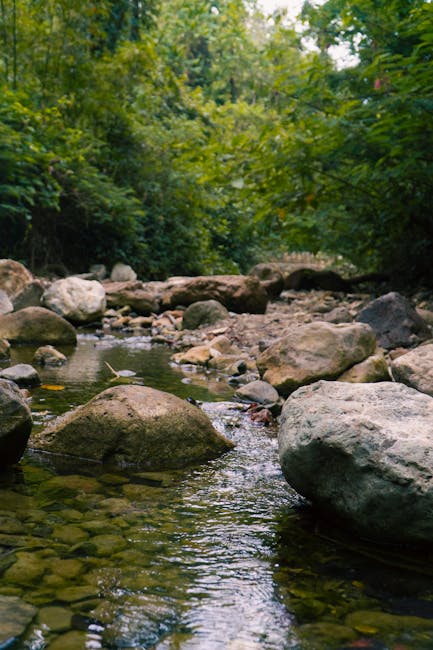
If you want to look for fairy stones yourself, Fairy Stone State Park in Patrick County, Virginia is the most famous spot in the United States. The park sits in the Blue Ridge Mountains and covers about 4,500 acres with a 168-acre lake, hiking trails, and campgrounds. But the main draw for a lot of visitors is the hunting.
The park has a designated fairy stone hunting area near the lake shoreline. You do not need any special equipment. People walk along the banks, flip over rocks, sift through the gravel, and dig shallow holes with small garden trowels. Rangers at the visitor center will show you what to look for if you have never found one before. I have heard that the best time to search is after heavy rain, when fresh gravel has been washed down from the hillsides.
Park rules allow visitors to take up to 15 fairy stones per person per day. The park store sells small mesh bags for carrying your finds. Admission to the park costs $7 per vehicle on weekdays and $8 on weekends as of 2025.
Fairy stones in Georgia and other states
Virginia is not the only place you can find staurolite. The mineral occurs across the southern Appalachian region, including parts of northern Georgia, North Carolina, Tennessee, and Alabama. In Georgia, the best-known collecting spots are in the Blue Ridge area of Fannin and Union counties, where metamorphic rock formations similar to those in Virginia contain staurolite-bearing schist.
Some collectors also report finding fairy stones in New Mexico, where staurolite occurs in the Pecos district near Santa Fe, and in Switzerland's Glarus Alps. The Swiss specimens tend to be darker and more opaque than the Virginia material. I think the Virginia stones have a warmer tone that makes them more visually appealing for display and jewelry use.
The quality of cross twins varies a lot between locations. Some sites produce mostly single crystals with no twinning at all. Others yield partial crosses where only one arm formed. Finding a complete, well-formed cross takes patience and a bit of luck.
What people believe fairy stones mean
In modern crystal and spiritual practices, people associate fairy stones with protection, luck, and grounding. Some carry them as pocket stones. Others set them on altars or wire-wrap them into pendants. I have seen them sold in metaphysical shops ranging from $3 for small fragments to $40 or more for complete, well-formed crosses.
The most common belief is that fairy stones bring comfort during times of grief or transition, which connects back to the original folklore about tears. Whether you view that as meaningful symbolism or just a nice story, the stones themselves are genuinely unusual geological specimens. A naturally occurring cross shape is rare in the mineral world, and I think that rarity is what keeps people interested in them long after the folklore has faded into background context.
If you are curious about finding your own, start with Fairy Stone State Park. It is the most reliable location in the US, the staff are helpful, and even if you do not find a perfect cross, flipping rocks by a mountain lake is not a bad way to spend an afternoon.


Comments