Dioptase: The Rarest Green Crystal
May 31, 2026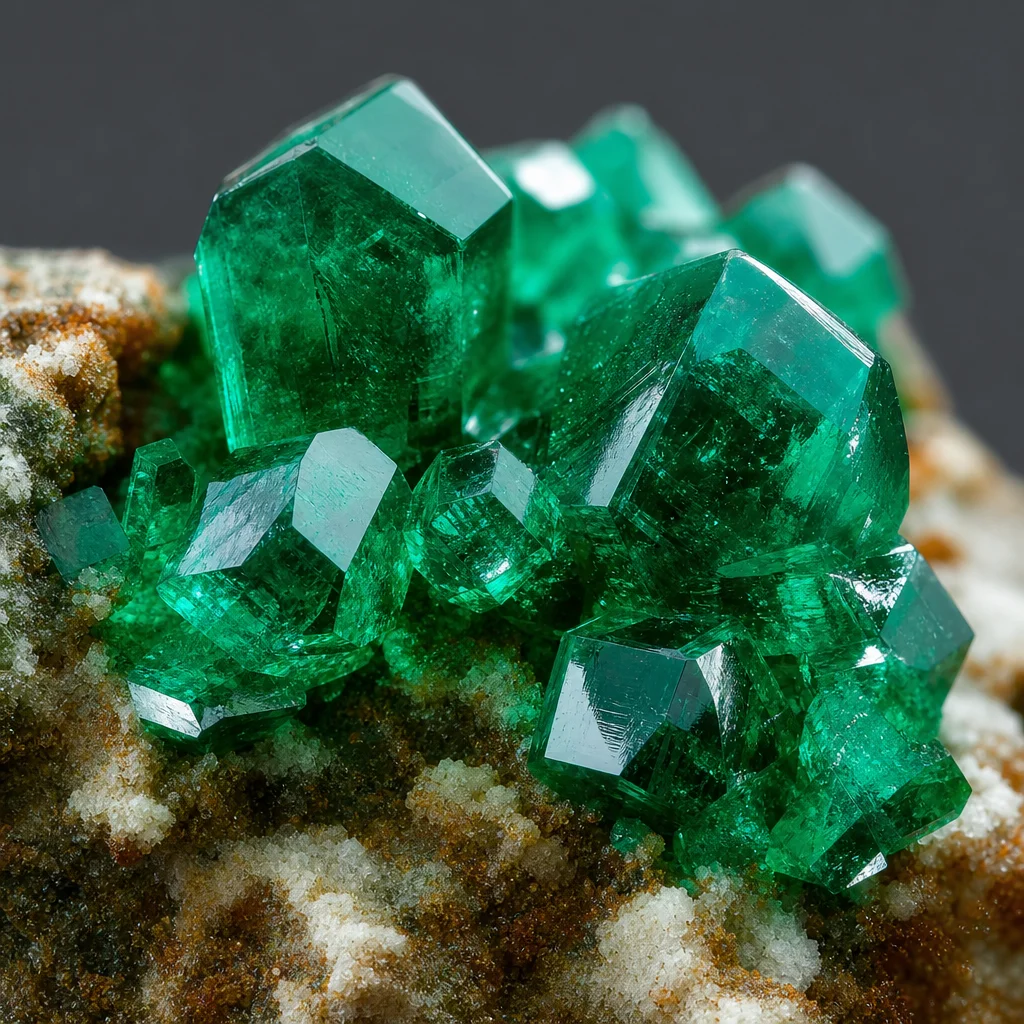
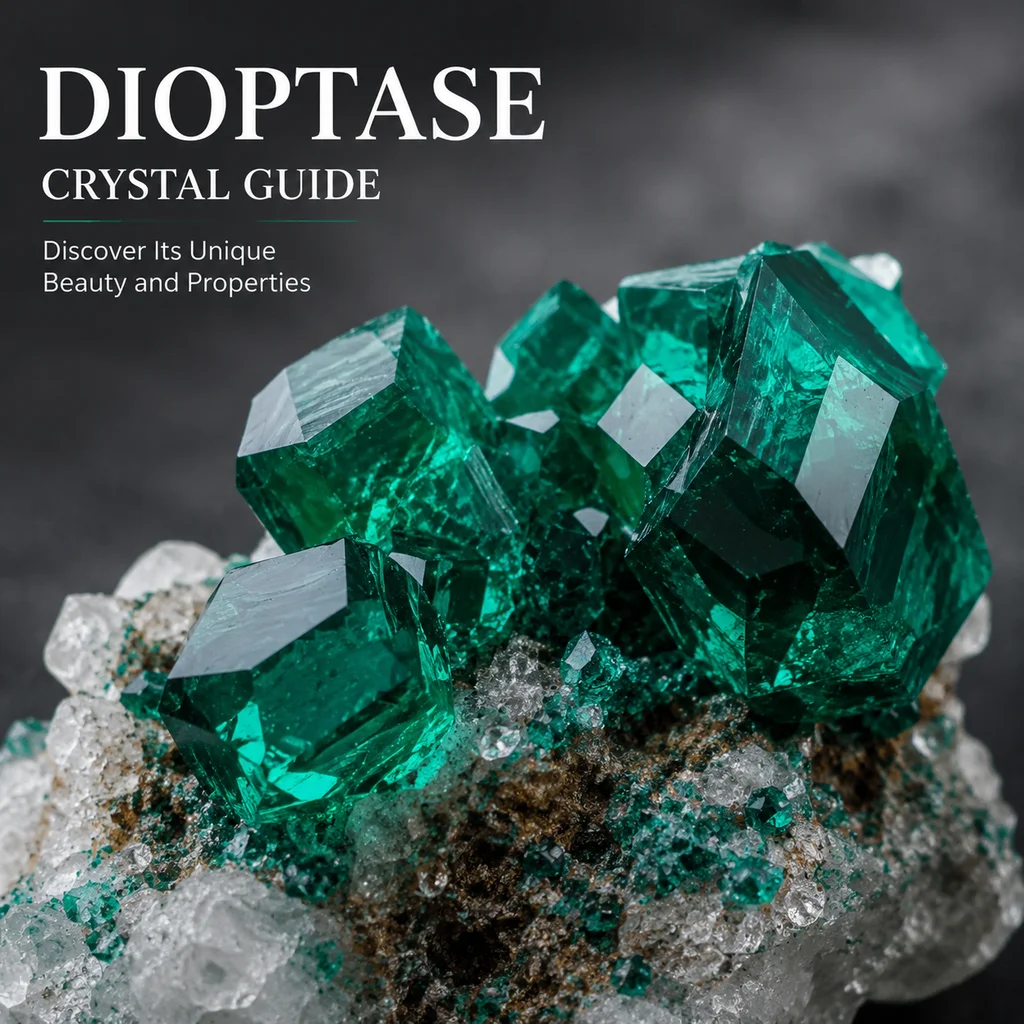
If you've spent any time browsing mineral collections online, chances are you've seen dioptase without knowing its name. Those intense, almost impossibly green crystal clusters that look like miniature emerald forests? That's dioptase. And the story behind why you rarely encounter it in jewelry shops is just as fascinating as the stone itself.
What Is Dioptase? The Chemistry Behind the Color
Dioptase is a hydrous copper cyclosilicate with the chemical formula CuSiO₃·H₂O. That copper content is the entire reason this mineral looks the way it does. When light hits a dioptase crystal, the Cu²⁺ ions in its crystal structure absorb certain wavelengths and reflect a deeply saturated green that rivals genuine emerald. In fact, dioptase's color is so vivid that unscrupulous dealers have historically tried to pass it off as emerald to unsuspecting buyers.
The name comes from the Greek words dia (through) and optazein (to see), referring to the mineral's visible cleavage planes when you hold it up to light. Those internal planes create a subtle transparency that gives well-formed dioptase crystals a luminous quality photographs struggle to capture.
On the Mohs hardness scale, dioptase sits around 5. That's harder than fluorite but softer than apatite. The real problem isn't hardness, though — it's the mineral's perfect rhombohedral cleavage. Dioptase splits cleanly along specific planes, which means a slight knock can fracture a perfect crystal into pieces. Combine that with a specific gravity of about 3.3, and you have a stone that is genuinely tricky to work with in jewelry.
Where Does Dioptase Come From?
The two most significant sources of dioptase are worlds apart, both geographically and geologically.
The Democratic Republic of Congo
The most famous dioptase specimens come from the copper mining regions of the Democratic Republic of Congo, particularly around the town of Lubumbashi in Katanga Province. Here, dioptase forms in the oxidized zones of copper deposits, where groundwater has interacted with primary copper sulfide ores over millions of years. The Congolese specimens are known for producing large, well-formed prismatic crystals up to several centimeters in length, often arranged in radiating clusters on a matrix of dolomite or calcite.
Mining conditions in the region make specimen extraction challenging. Many of the finest dioptase specimens are recovered by artisanal miners working in hand-dug trenches, which means supply is unpredictable and quality varies enormously from batch to batch.
Kazakhstan
The Altai Mountains in eastern Kazakhstan produce dioptase that looks noticeably different from the Congolese material. Kazakh dioptase tends to form smaller crystals with a slightly more blue-green hue, and specimens are often found in association with other secondary copper minerals like malachite, azurite, and chrysocolla. The classic locality is near the town of Ridder, where dioptase occurs in cavities within altered volcanic rocks.
Other Notable Localities
Smaller deposits exist in Namibia (specifically the Kaokoveld region), Arizona in the United States, and parts of Chile. However, these localities rarely produce specimen-grade material in significant quantities. The Namibian dioptase is particularly interesting because it sometimes forms as microscopic inclusions within quartz, creating a green quartz that can be mistaken for prasiolite at first glance.
Why You Won't Find Dioptase in Most Jewelry Shops
There are three main reasons dioptase is almost never set into jewelry, and understanding them tells you a lot about how the gem trade works.
First, the cleavage issue. Dioptase has perfect cleavage in three directions. This means that any pressure applied to the wrong angle — the kind of pressure a ring experiences every time you set your hand on a table — will cause the stone to split. A jeweler could carefully set a dioptase crystal into a protective bezel, but the stone remains vulnerable to chipping at the edges.
Second, the sensitivity to heat. Dioptase contains water molecules in its crystal structure (that H₂O in the formula isn't just decorative). When heated above roughly 200°C, the water escapes and the crystal structure collapses, leaving behind a dull, opaque, worthless mess. This rules out virtually all standard jewelry manufacturing processes, including soldering near the stone and many casting techniques. It also means you should never wear dioptase jewelry in hot environments — a car dashboard in summer could theoretically damage it.
Third, scarcity. Fine dioptase specimens are genuinely rare. Unlike amethyst or citrine, which are mined by the ton, dioptase occurs in small pockets within specific geological environments. When a mine in the Congo produces a good pocket of dioptase, those specimens are typically snapped up by mineral collectors willing to pay premium prices. The idea of cutting them into calibrated gemstones for mass-market jewelry strikes most dealers as absurd.
Dioptase in a Collection: What to Look For
For mineral collectors, dioptase sits in that sweet spot where beauty and rarity intersect. Here's what separates a mediocre specimen from a museum-quality one.
Crystal size: Individual crystals larger than 1 cm are considered significant. Anything over 2 cm moves into genuinely rare territory. The largest known dioptase crystals reach about 3-4 cm, and those specimens command five-figure prices at mineral shows.
Color intensity: The best dioptase is a pure, saturated green without any brownish or bluish secondary tones. Under strong daylight, it should look like glass-smooth emerald. Specimens with a slightly blue shift tend to come from Kazakh deposits, while Congolese material usually leans purer green.
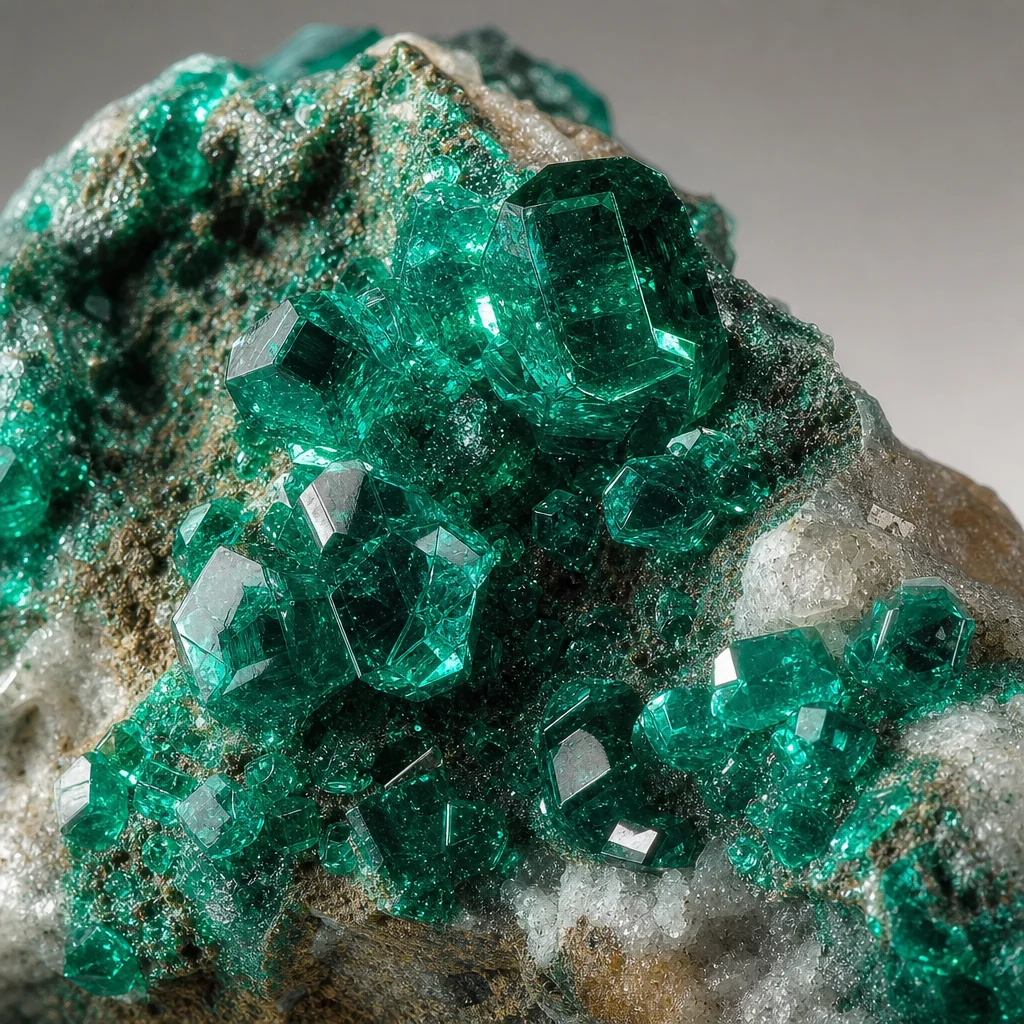
Matrix contrast: Dioptase on white calcite or dolomite creates a dramatic visual contrast that photographs well and displays beautifully. Specimens on darker matrices can still be excellent, but they don't have the same visual pop.
Damage: Because of the perfect cleavage, virtually all dioptase specimens have at least some micro-damage. A specimen with completely intact crystal terminations is worth significantly more than one with chips and breaks. Examine photos carefully under magnification if you're buying online.
Caring for Dioptase
If you acquire a dioptase specimen — whether a loose crystal, a small cluster, or a rare piece of jewelry — the care requirements are straightforward but non-negotiable.
Keep it away from direct sunlight for extended periods. While dioptase isn't as light-sensitive as some minerals (like kunzite or amethyst, which can fade), prolonged UV exposure can gradually alter surface chemistry. Store it in a cool, dry place, ideally wrapped in a soft cloth or housed in a padded specimen box with a lid.
Cleaning should be done with a soft dry brush only. No water, no ultrasonic cleaners, no chemical dips. Remember — this is a mineral that dissolves in acid and can be damaged by prolonged moisture exposure. A quick blast of compressed air (from a distance) can remove dust from deep crystal crevices without risking any contact damage.
Avoid temperature fluctuations. Moving dioptase from an air-conditioned room to a hot car trunk creates thermal stress that can exploit those cleavage planes. If you need to transport a specimen, wrap it in bubble wrap inside an insulated container.
Dioptase vs. Other Green Minerals
Because of its striking color, dioptase is frequently confused with several other green minerals. Knowing the differences saves you from overpaying or buying a mislabeled specimen.
Emerald: Emerald is beryl (Be₃Al₂Si₆O₁₈) colored by chromium or vanadium, while dioptase is a copper silicate. Emerald is significantly harder (Mohs 7.5-8) and has hexagonal crystal forms. Dioptase forms trigonal crystals with a more elongated, prismatic habit. The easiest distinguishing feature is cleavage — emerald has poor to indistinct cleavage, while dioptase's perfect cleavage is visible to the naked eye on broken surfaces.
Malachite: Both are copper minerals, and both are green, but the similarity ends there. Malachite is a copper carbonate with banding patterns (concentric rings or stripes), while dioptase is a copper silicate that forms distinct individual crystals. Malachite's green is typically more mottled and variegated, while dioptase is a uniform, saturated green throughout each crystal.
Prasiolite (Green Amethyst): Prasiolite is heat-treated amethyst, and its green is usually much paler and more yellow-green than dioptase's intense blue-green. Prasiolite is also much harder (Mohs 7) and is commonly cut into faceted gems, something you'll essentially never see with dioptase.
Chrome Diopside: This is probably the closest lookalike in terms of color saturation, but chrome diopside is a pyroxene mineral that forms different crystal shapes and has two directions of cleavage at roughly 87° to each other. Dioptase's trigonal crystals are distinctive once you've seen both.
What Dioptase Costs and Where to Buy
Small dioptase specimens (2-3 cm across with several small crystals) typically start around $30-50 from reputable mineral dealers. Mid-range specimens with larger crystals or better aesthetics run $100-300. Top-tier pieces with crystals over 1.5 cm, excellent color, and attractive matrix can easily reach $500-2000, with exceptional museum-quality specimens going much higher.
When buying dioptase, stick to established mineral dealers who specialize in fine specimens rather than the general crystal market. Because dioptase is genuinely rare, the risk of encountering fakes or misidentified material is real. The most common substitution is green glass or dyed calcite, neither of which would fool anyone who has handled genuine dioptase. More subtly, small specimens of demantoid garnet or green tourmaline have occasionally been mislabeled as dioptase by inexperienced sellers.
Mineral shows are often the best place to buy dioptase because you can examine specimens in person. The annual Tucson Gem and Mineral Show, Munich Mineral Show, and Sainte-Marie-aux-Mines in France all regularly feature dioptase dealers with excellent selections.
Frequently Asked Questions
Is dioptase expensive?
Compared to common crystals like amethyst or quartz, yes — fine dioptase is genuinely rare and commands collector-level prices. Small display specimens start around $30, while exceptional pieces can cost thousands. The rarity and fragility keep supply limited and demand steady among mineral collectors.
Can I wear dioptase as jewelry?
It's possible but not recommended for everyday wear. A carefully bezel-set dioptase pendant, stored in a protective box and worn occasionally, could last years. But rings, bracelets, and anything exposed to daily wear risk cleavage damage. The heat sensitivity also rules out many jewelry repair scenarios.
How can I tell if my dioptase is real?
Check the crystal form (trigonal prisms with rhombohedral terminations), test hardness (Mohs ~5, scratches glass but is scratched by a knife), and examine cleavage surfaces. Genuine dioptase has perfect rhombohedral cleavage that creates flat, reflective internal planes visible in good light.
Why is dioptase green?
The green color comes from copper ions (Cu²⁺) in the crystal structure. When light interacts with these copper atoms, wavelengths in the green portion of the spectrum are reflected while other wavelengths are absorbed. This is the same basic mechanism that colors malachite and turquoise, though the specific crystal structure of dioptase produces a distinctly different shade of green.
Frequently Asked Questions
Can dioptase go in water?
Because dioptase sits at a 5 on the Mohs hardness scale, it is relatively soft and sensitive. We do not recommend soaking your dioptase jewelry in water for long periods, as it can eventually degrade the stone's surface. To safely clean your handcrafted SagStone dioptase pieces, simply wipe them gently with a soft, slightly damp microfiber cloth and avoid harsh chemical cleaners or ultrasonic machines.
Comments