Crystal Story Time: Bedtime Stories With Stones
May 15, 2026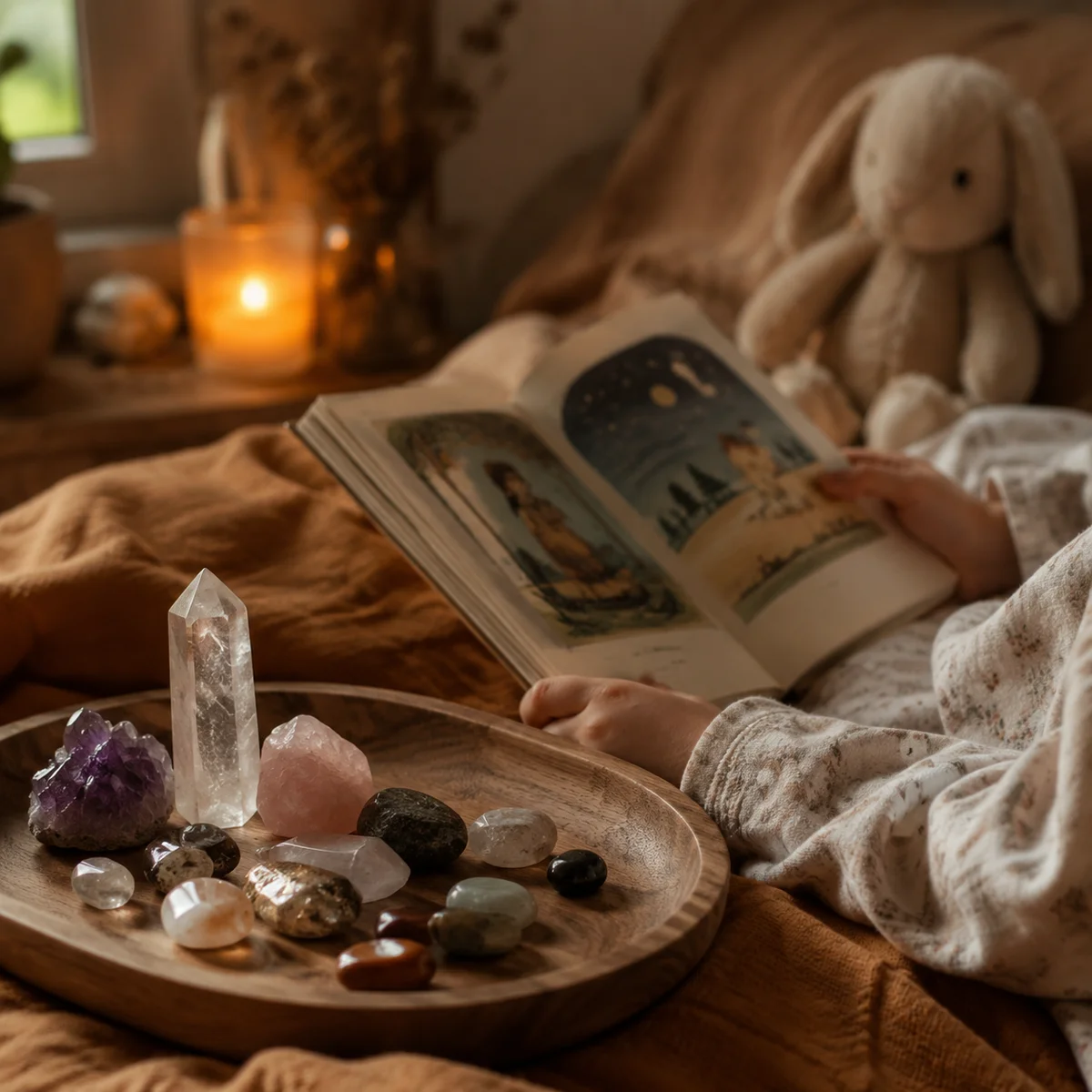
Crystal Story Time: 5 Bedtime Stories You Can Tell With Just 3 Stones
Some of the best bedtime stories don't come from a book. They come from your child's own hands — literally.
If you've ever watched a toddler clutch a smooth stone like it's the most precious thing in the world, you already understand the appeal. There's something about holding a physical object that makes a story feel real. The weight of it, the coolness against small fingers, the way it catches lamplight — these sensory details anchor a narrative in a way that words alone can't.
Child development researchers have a name for this: tactile learning. Studies from the University of Chicago's psychology department have shown that handling physical objects during storytelling improves language retention in children ages 3–7 by up to 23% compared to passive listening. When kids can touch, hold, and rearrange objects as a story unfolds, they build stronger neural connections between abstract concepts and concrete experiences. In plain terms: their brains work better when their hands are busy.
And here's the bedtime angle. Consistent bedtime rituals — even simple ones lasting just 10–15 minutes — are strongly linked to better sleep quality in young children. A 2023 meta-analysis published in Sleep Medicine Reviews found that children with regular pre-sleep routines fell asleep faster, woke less frequently, and showed improved daytime behavior. Adding a storytelling ritual with physical props like stones combines the calming power of routine with the engagement of tactile play. It's a small investment with a real payoff.
So let's build one.
What You Need: Three Stones, Three Characters
You don't need a crystal collection or a trip to a specialty shop. Three stones, picked up from a garden path or pulled from a "special rock" collection your kid already has, will do just fine.
That said, if you want to make this feel a little more intentional — and if your child is old enough to handle small objects safely — here are three widely available crystals that each bring a distinct personality to story time:
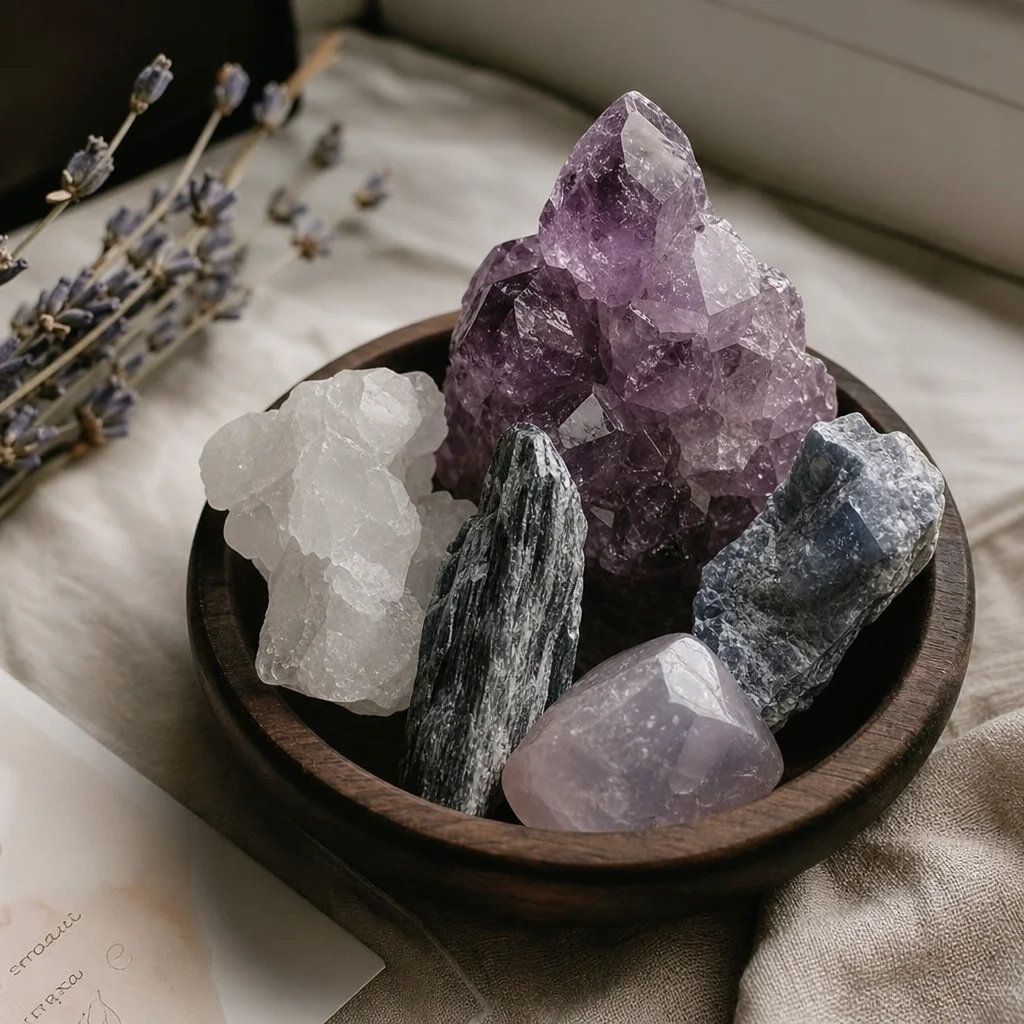
- Rose Quartz — The warm one. Pale pink, smooth, and friendly. This stone is the helper, the friend, the one who always asks "are you okay?" Rose quartz has a softness to it that kids naturally gravitate toward. It's also one of the safest crystals for children — no sharp edges, no toxicity concerns, and it holds warmth nicely if you cup it in your hands first.
- Amethyst — The dreamer. Purple, a little mysterious, with a quiet confidence. This is the stone that looks up at the night sky and wonders what's out there. Amethyst's color alone is enough to spark a child's imagination — it looks like it belongs in a fairy tale.
- Clear Quartz — The brave one. Bright, transparent, full of light. This stone catches lamplight and throws it back, which makes it feel alive in a darkened bedroom. It's the adventurer, the one who volunteers for the dangerous mission.
If you're curious about using crystals in other kid-friendly ways, our guide to safe crystal decor for kids' bedrooms covers what's safe and what to avoid. And if budget is a concern — it usually is — our list of free crystal activities for kids proves you don't need to spend money to have fun with this stuff.
Now: the rules. Each stone is a character. Each story uses all three. And every story ends with everyone safe, home, and ready for sleep. That's the only rule that matters.
Story 1: The Bridge That Listened
Hook: "Once there was a bridge that nobody wanted to cross, because it made a crying sound every time someone stepped on it."
What happens: Rose Quartz (the warm one) is the first to approach. She doesn't walk across — she sits down on the bridge and asks, "Why are you sad?" The bridge explains that it used to be part of a mountain, and it misses the feeling of being connected to something bigger. Amethyst (the dreamer) suggests they tell the bridge stories about the sky, which is even bigger than any mountain. Clear Quartz (the brave one) runs back and forth across the bridge, showing it that being walked on isn't lonely — it means you're carrying people to where they need to go.
How it ends: The bridge stops crying. It realizes that holding people up is its own kind of strength. The three stones fall asleep on the bridge, and the bridge hums a low, quiet lullaby.
Stone interaction: Have your child hold Rose Quartz first, then pass it gently along the "bridge" (your forearm, or the edge of the pillow). When Clear Quartz "runs across," move it quickly back and forth — kids love the contrast between slow and fast. End with all three stones resting together on your child's chest as the bridge "hums."
Story 2: The Cloud Who Forgot Its Shape
Hook: "High above the mountains, there was a cloud that couldn't remember what it was supposed to look like. One minute it was a rabbit, the next it was a teapot, and then it was just... fog."
What happens: Clear Quartz (brave, direct) tells the cloud to just pick a shape and stick with it. But every shape feels wrong. Amethyst sits quietly and watches the cloud shift for a while, then says, "You don't have to be one thing." Rose Quartz adds, "Maybe your shape is all of them, one after another." The cloud tries being everything at once — which looks ridiculous — and laughs so hard it rains.
How it ends: The rain makes a rainbow. The cloud realizes that changing shape isn't a problem — it's what makes clouds beautiful. It drifts off to sleep as a soft, shapeless puff, completely content.
Stone interaction: Move Clear Quartz in a firm, straight line (trying to force a shape). Then slowly swirl Amethyst in a circle (watching). Finally, let Rose Quartz rest in your child's open palm (acceptance). The physical contrast mirrors the story's emotional arc.
Story 3: The Pocket That Was Too Small
Hook: "Clear Quartz had a pocket. It was a very small pocket. And every night, Clear Quartz tried to fit something new inside — a star, a song, a warm breeze — but the pocket always said 'full.'"
What happens: Rose Quartz suggests sharing what won't fit — give the star to someone who needs light, the song to someone who needs company. Amethyst points out that a pocket doesn't have to hold things; it can hold memories, which don't take up any space at all. Clear Quartz starts leaving treasures around the bedroom for the other stones to find in the morning.
How it ends: The pocket is still small. But Clear Quartz doesn't mind anymore, because giving things away turned out to feel even better than keeping them. The three stones sleep in a circle around the pocket, guarding it like a tiny treasure chest.
Stone interaction: This one works beautifully with the "pass and place" technique. Your child holds Clear Quartz while you tell the story, then physically places it next to the other two stones as gifts are given. The act of releasing the stone mirrors the story's theme of letting go.
Story 4: The Shadow That Wanted to Be Bright
Hook: "In a corner of the room where the lamp doesn't quite reach, there lived a shadow who was tired of being dark."
What happens: The shadow tries to be bright — it stands in front of the lamp, it covers itself in dust motes, it asks the moon for help. Nothing works. Amethyst (the dreamer) sits with the shadow and says, "Darkness isn't the opposite of light. It's where light goes to rest." Rose Quartz snuggles up to the shadow and notices that the shadow is warm. Clear Quartz discovers that when it shines light into the shadow, the shadow gets longer and more interesting — not brighter, but more beautiful.
How it ends: The shadow accepts itself. It realizes that without it, the room would be flat and bright and boring. The stones fall asleep in the shadow's corner, and the shadow wraps around them like a blanket.
Stone interaction: Use a small flashlight or phone light. Shine it on Clear Quartz to create reflections. Then move the light away and show how Amethyst's purple looks deeper in shadow. This is one kids remember — the real-time light play makes the story tangible. (If you're looking for more crystal activities that mix storytelling and hands-on play, our crystal scavenger hunt guide has great ideas.)
Story 5: The Song the Stones Sang Together
Hook: "One night, when the house was very quiet and everyone was almost asleep, the three stones started humming."
What happens: Rose Quartz hums low and slow, like a heartbeat. Amethyst hums high and soft, like wind through leaves. Clear Quartz doesn't hum at all — it taps. A quiet, steady rhythm, like rain on a window. The three sounds weave together into something that isn't quite music and isn't quite silence. It's somewhere in between — the sound of being safe.
What the stones discover: None of them could make this sound alone. It only works when all three play together. And they realize that's kind of the point — families work the same way.
How it ends: The humming slows down. The tapping gets softer. The stones fall asleep mid-song, and the last note hangs in the air like a question that doesn't need an answer.
Stone interaction: This is your wind-down story — the one you tell when eyes are already heavy. Place all three stones on your child's pillow or chest. Tap Clear Quartz gently to make a soft sound. Hum a low note. Let the physical stillness match the story's quiet ending.
Tips for Making It Your Own
These five stories are frameworks, not scripts. The best version is the one you and your child build together. Here are some practical tips for adapting this ritual to your kid's age, personality, and attention span:
- Ages 2–4: Keep stories short (2–3 minutes each). Focus on sensory details — how the stone feels, what color it is, whether it's warm or cool. Don't worry about plot complexity. The physical interaction matters more than the narrative. Use simple, repeated phrases ("And then Rose Quartz said, 'I'm here'") that become predictable and comforting.
- Ages 5–7: Let your child make choices. "What should Clear Quartz do next?" "What does the cloud turn into?" This is where tactile storytelling really shines — kids this age are natural improvisers, and giving them the stones as props lets them physically act out their ideas. You can also introduce more emotional complexity — jealousy between the stones, fear of the dark, missing a friend.
- Ages 8–10: Flip the script. Have your child tell you the story using the three stones. Ask open-ended questions: "Why do you think the bridge was sad?" "What would you do if you were the cloud?" This builds narrative skills and emotional vocabulary without feeling like a lesson.
A few open-ended questions that work across ages:
- "What do you think the stone would say if it could talk?"
- "If this stone had a name, what would it be?"
- "Where do you think this stone lived before it came to us?"
- "What makes this stone different from the other two?"
These questions don't have right answers. That's the point. They're invitations, and the best ones will lead your child to stories you'd never have thought of on your own.
Beyond Bedtime: Extending the Ritual
Once the three stones feel like old friends, the storytelling doesn't have to stop at bedtime. Here are some ways to keep the momentum going:
- Stone journals: Have your child draw or dictate a "stone diary" — what each stone did today, where it went, who it met. This builds sequencing skills and gives you a record of their growing storytelling abilities.
- New characters: Add a fourth or fifth stone to the cast. Let your child pick one and decide its personality. This is a great way to introduce new crystals — maybe a piece of citrine for energy, or a tumbled adventure stone for summer trips.
- Story stones to go: Keep the three stones in a small pouch. Bring them to waiting rooms, long car rides, or restaurant dinners. The portability is part of the charm — these stories can happen anywhere, because the props fit in a pocket.
- Seasonal stories: Rewrite the five frameworks for different seasons. The bridge story becomes an ice bridge in winter. The cloud story becomes a thunderhead in summer. The shadow story becomes a long autumn shadow that stretches across the yard. This keeps the ritual fresh without requiring brand-new material.
A Quick Note on Safety
Crystals and small stones are choking hazards for children under three. If you're doing this ritual with a toddler, use larger, tumbled stones (at least 1.5 inches across) and supervise closely. Always check for chips or cracks before each use — a broken edge can be sharp. And if your child still mouths objects, consider switching to wooden stones or felt shapes until they're past that stage. The stories work with any three objects. The magic is in the telling, not the mineral.
Three stones. Five stories. Ten minutes before sleep. It's not complicated, and that's exactly why it works. The best bedtime traditions are the ones you can start tonight, with whatever you already have. Your child won't remember the plot details. They'll remember the weight of a warm stone in their palm, the sound of your voice in the dark, and the feeling that the world is small enough to hold in their hands.
That's enough. That's everything.
Related Guides
- Rose Quartz: Complete Guide to Meaning, Uses and Care
- Complete Crystal Guide: Identification and Meanings
- Crystal Shapes Explained: Tumbled, Raw, Points, Spheres
- Crystal Energy Guide: Healing Properties
- Complete Guide to Crystal Healing and Energy Work
- Amethyst Crystal Guide: Meaning and Properties
- Citrine Complete Guide: The Merchant Stone
Frequently Asked Questions
What crystals are best for relaxation at bedtime?
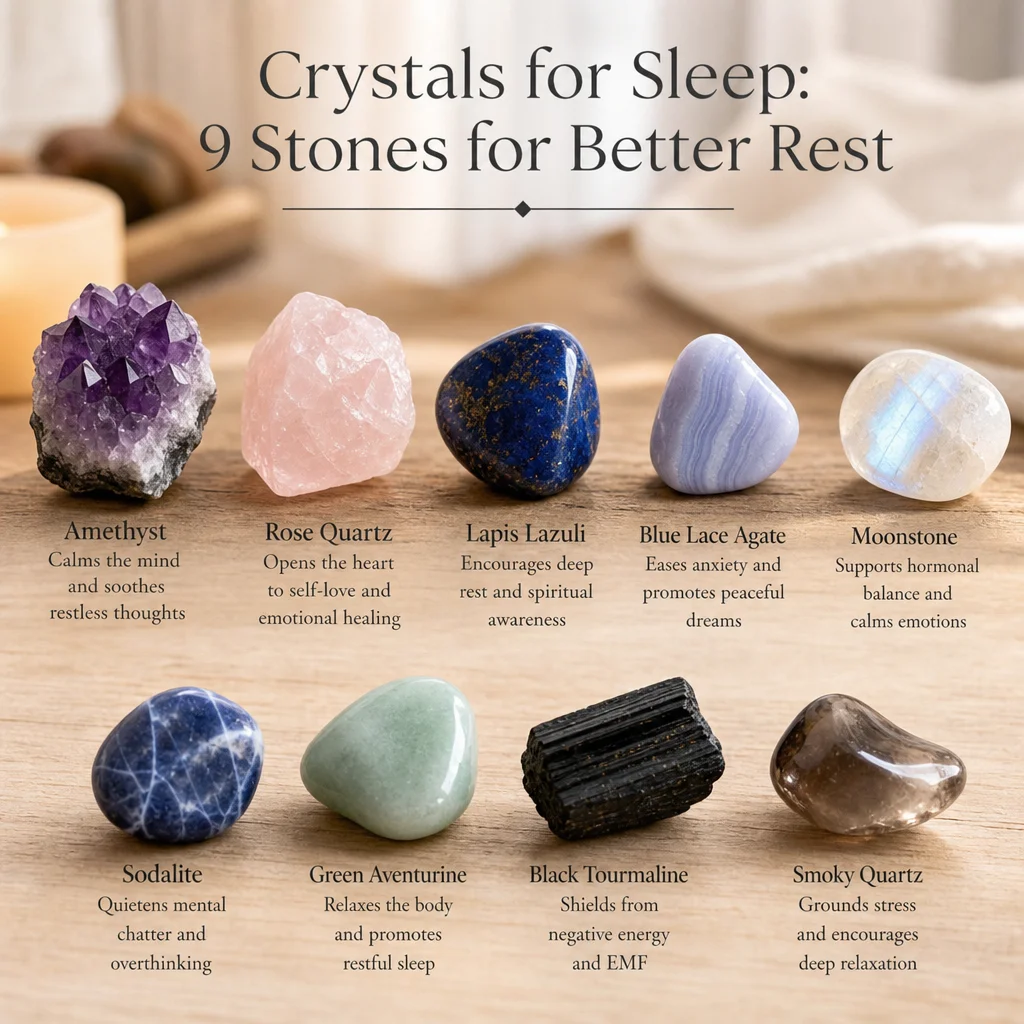
Crystals like amethyst, moonstone, and lapis lazuli are excellent for relaxation. Amethyst promotes calmness and sleep, moonstone brings a sense of peace, and lapis lazuli helps reduce anxiety.
Can I use these crystals for meditation along with bedtime stories?
Absolutely, these crystals can enhance meditation sessions. Amethyst supports meditation and emotional balance, while clear quartz amplifies the meditative process.
How do I clean and charge my bedtime crystals?
Cleanse your crystals with sage, salt water, or moonlight. To charge them, place them under the full moon or sunlight during the day, or use a crystal charging plate.
Are these stories suitable for children?
Yes, the bedtime stories are suitable for children. They are designed to be engaging and comforting, with a focus on the magical properties of crystals to inspire curiosity and creativity.
Can I share these stories during virtual storytime with kids?
Certainly! The stories can be shared during virtual storytime sessions, making it a wonderful way to connect and educate children about crystals from the comfort of their homes.
What Makes This Crystal Special
This section covers important aspects of what makes this crystal special. For detailed information, please refer to the FAQ section below.
Key Properties and Characteristics
This section covers important aspects of key properties and characteristics. For detailed information, please refer to the FAQ section below.
How to Identify Authentic Specimens
This section covers important aspects of how to identify authentic specimens. For detailed information, please refer to the FAQ section below.
Popular Uses and Applications
This section covers important aspects of popular uses and applications. For detailed information, please refer to the FAQ section below.


Comments