Crystal shows and gem fairs: a survival guide for first-time vendors
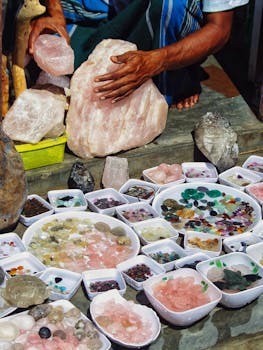
Your first crystal show is going to be chaotic, exhausting, and probably not as profitable as you hope. That's normal. Almost nobody kills it at their first show. The vendors who do well at crystal shows aren't the ones with the best stones — they're the ones who showed up prepared, knew what to expect, and didn't make the expensive mistakes that catch first-timers off guard.
This guide covers the practical stuff that nobody tells you until you've already learned it the hard way.
Picking the right show
Not every crystal show is worth your time and money. A table fee of $150 for a show that draws 200 casual browsers is very different from a $150 fee for a show that draws 2,000 serious collectors. The problem is that show organizers rarely publish attendance numbers, and the ones they do publish are often inflated.
Here's how to evaluate a show before you commit:
Check the show's history. A show that has run for 5+ years in the same location with the same promoter is a safer bet than a first-year event. Long-running shows have established attendee bases. New shows are gambles — sometimes they take off, sometimes nobody shows up.
Look at the vendor mix. If half the vendors are selling jewelry and you're selling rough specimens, the audience might not match your product. Look for shows where your type of product is represented but not saturated — you want to be one of 3-5 crystal vendors, not one of 30.
Consider the price point match. A show in a wealthy suburb with $300+ designer mineral specimens will have a different buyer profile than a weekend market in a college town where most sales are under $30. Price your inventory for the audience that actually shows up, not the audience you wish showed up.
Ask other vendors. Crystal communities on Facebook, Reddit, and Discord are full of people willing to share their experiences with specific shows. Search the show name plus "vendor" or "exhibitor" — you'll usually find someone who has done it before.
Booth setup: it matters more than you think
Your booth is your store for the weekend. A cluttered table with everything piled on one level looks like a yard sale. A well-organized display with height variation and good lighting looks like a business. Buyers notice the difference, and it affects both sales volume and the prices you can charge.
Bring a tablecloth that reaches the floor. This hides your storage boxes and supplies underneath. Black or dark blue cloth works well for most crystals because it provides contrast. White cloth works if your stones are mostly dark. Avoid busy patterns — they compete visually with the crystals.
Create vertical height. Use risers, small boxes, or tiered display stands to get some pieces above table level. Eye-level items sell better because they're the first things people see. Put your best pieces at standing eye height, mid-range items on the table surface, and lower-priced items in bins or trays at waist height.
Bring your own lighting. Venue lighting is almost never adequate for showing crystals. Two battery-powered LED strip lights (the kind that stick to the underside of shelves) cost $15 each and make a dramatic difference. Clip-on LED lights work too. Position them so they illuminate your display without creating glare on the crystals or shining in customers' eyes.
Have a mirror available if you're selling any wearable crystal jewelry. A small handheld mirror or a 12-inch mirror on a stand lets customers see how a pendant looks on them. This one item noticeably increases jewelry conversion rates at in-person events.
Pricing and signage
Every single item needs a visible price. If someone has to ask "how much is this?" for every piece they pick up, they will stop picking things up and leave your booth. Handwritten prices on sticky notes or masking tape look amateurish. Printed price tags — even simple ones you make at home on cardstock — look professional and suggest that your prices are firm and thought-through.
Small adhesive price dots (the kind used at garage sales) are cheap and work fine for lower-priced items under $20. For pieces over $20, use a slightly larger tag or a small tent card next to the item. For anything over $100, include a brief description card with the stone name, origin if known, weight, and any notable features.
Group items by price range. Have a clearly marked section for items under $15, another for $15-50, and another for $50+. This helps customers self-select and prevents the awkward situation where someone falls in love with a $150 specimen and then discovers it's way over their budget.
Payment: cash and cards
Bring a card reader. Square, Stripe, and PayPal all offer free readers that plug into your phone. Set it up and test it before the show — don't figure out the app at 9am on your first morning. Accept Apple Pay, Google Pay, and contactless tap. In 2026, roughly 60-70% of transactions at craft fairs are card or contactless, and that number keeps going up.
Bring cash anyway. Some people still prefer cash, and card readers occasionally lose signal in convention centers and hotel ballrooms. Start with $100 in small bills: 20 ones, 10 fives, 5 tens, 1 twenty. Replenish from your cash sales throughout the day.
Have a simple pricing strategy that makes math easy. Price things at round numbers or numbers that end in 5 — $15, $20, $25, $35, $50. Avoid prices like $17 or $23 unless you have a specific reason. Round numbers speed up transactions and reduce awkward change-making.
Inventory management at shows
Bring more inventory than you think you need, but not double. For a two-day show, a good rule is to bring enough stock to sell through 60-80% of your table if things go well. If you sell out completely, you left money on the table. If you go home with 90% of your inventory, you either overstocked or priced too high.
Keep your most expensive pieces (anything over $100-150) in a locked display case or behind the table. Most crystal show theft is opportunistic — someone pockets a small piece when the vendor is distracted. Expensive items in a glass case both protect them and make them feel more valuable to serious buyers who ask to see them.
Track your sales. Write down every sale as it happens — item, price, cash or card. A simple notebook column works. This tells you at the end of the day what sold, what didn't, and whether your pricing was right. It also helps you plan inventory for future shows.
Understanding your customers
Crystal show attendees generally fall into three categories, and you'll meet all of them:
Collectors know their stuff. They'll pick up a piece, check the terminations, look for damage, ask about the locality, and negotiate. They want specifics — mineral name, exact dimensions, weight, formation type. Price matters to them, but quality and rarity matter more. If you can speak their language (knowing that "phantom quartz" means visible growth zones, or that a "Japan law twin" is a specific crystal formation), they'll respect you and likely become repeat customers.
Casual buyers are there for the experience. They want something pretty to put on their desk, give as a gift, or add to a beginner collection. They respond to visual displays and friendly conversation. They rarely negotiate. Price is a factor, but they're more likely to impulse-buy a $20-40 piece that catches their eye than to carefully evaluate a $150 specimen.
Resellers are buying to stock their own shops or online stores. They want bulk pricing and consistent quality. They'll ask "what's your wholesale price?" or "do you offer volume discounts?" Decide in advance whether you're willing to discount for bulk — 15-20% off for orders over $200 is a common starting point. Some vendors refuse to wholesale at shows, and that's a valid choice. Just have your answer ready.
Day one vs. day two strategy
The first day of a two-day show usually has higher foot traffic and more serious buyers. Hold your prices firm on day one. The people who show up early are often repeat attendees who know what things cost and will buy if the price is fair.
The second day is slower. Attendance typically drops 20-40% from day one. This is when you start thinking about clearance. If you have pieces that haven't moved, consider marking them down 10-20% for the last few hours. Some vendors put out a "show special" sign on day two — it creates urgency and gives people a reason to buy now instead of going home to "think about it."
Don't slash prices on day one. If you do, the resellers and experienced collectors will notice and either buy your discounted stock to resell or avoid you entirely because they think your initial prices are inflated.
Networking: it's half the value
The vendors next to you and across the aisle are potential allies, not competitors. Talk to them during slow periods. Ask where they source their material. Ask which shows they do and which ones they skip. Exchange Instagram handles or business cards. Vendor-to-vendor relationships lead to bulk buying opportunities, shared booth costs at future shows, and referrals ("I don't carry much moldavite, but the guy two rows down has great pieces").
Befriend the show organizers too. They decide booth placement, and returning vendors who are easy to work with get better spots. Show up on time, follow the rules, and don't complain about minor inconveniences. It matters more than you'd think.
Collect customer contact information. A simple sign-up sheet ("Join our mailing list for show dates and new arrivals") or a QR code linking to your Instagram or email list captures people who liked your stuff but didn't buy today. A customer who gives you their email is worth significantly more than a one-time sale — they'll buy from you online, come to your next show, and tell their friends.
Security: protect your investment
Crystal shows are generally safe environments, but theft happens. Keep expensive pieces in locked cases or behind you. Don't leave your booth unattended — if you need a bathroom break, ask the vendor next to you to watch your table and return the favor. Most vendors are happy to do this.
Count your cash regularly. Do a quick count at lunch and at the end of each day. If you're doing high volume, consider keeping only $50-100 in the cash box and moving larger bills to a money belt or secure bag under the table.
At the end of the day, pack your valuable inventory first and put it in your car before breaking down your display. The most vulnerable moment is during teardown when you're distracted and your remaining stock is sitting out.
The post-show follow-through
Within 48 hours of the show ending, send an email or post on social media thanking people who visited and mentioning your next show date. If you collected email addresses, add them to your mailing list and send a brief welcome message with a link to your online shop.
Review your sales data. What sold? What didn't? What price points moved fastest? This information is gold for planning your next show and your online inventory. A lot of vendors never do this and end up making the same mistakes repeatedly.
The first show is a learning experience. Expect to make mistakes. Expect to be slow at setup and teardown. Expect to forget something important. Every experienced vendor at that show made the same mistakes at their first one. The difference is they came back and did it better the second time. That's the whole game.

Comments