Crystal Journaling Guide: Visualize Anxiety
May 16, 2026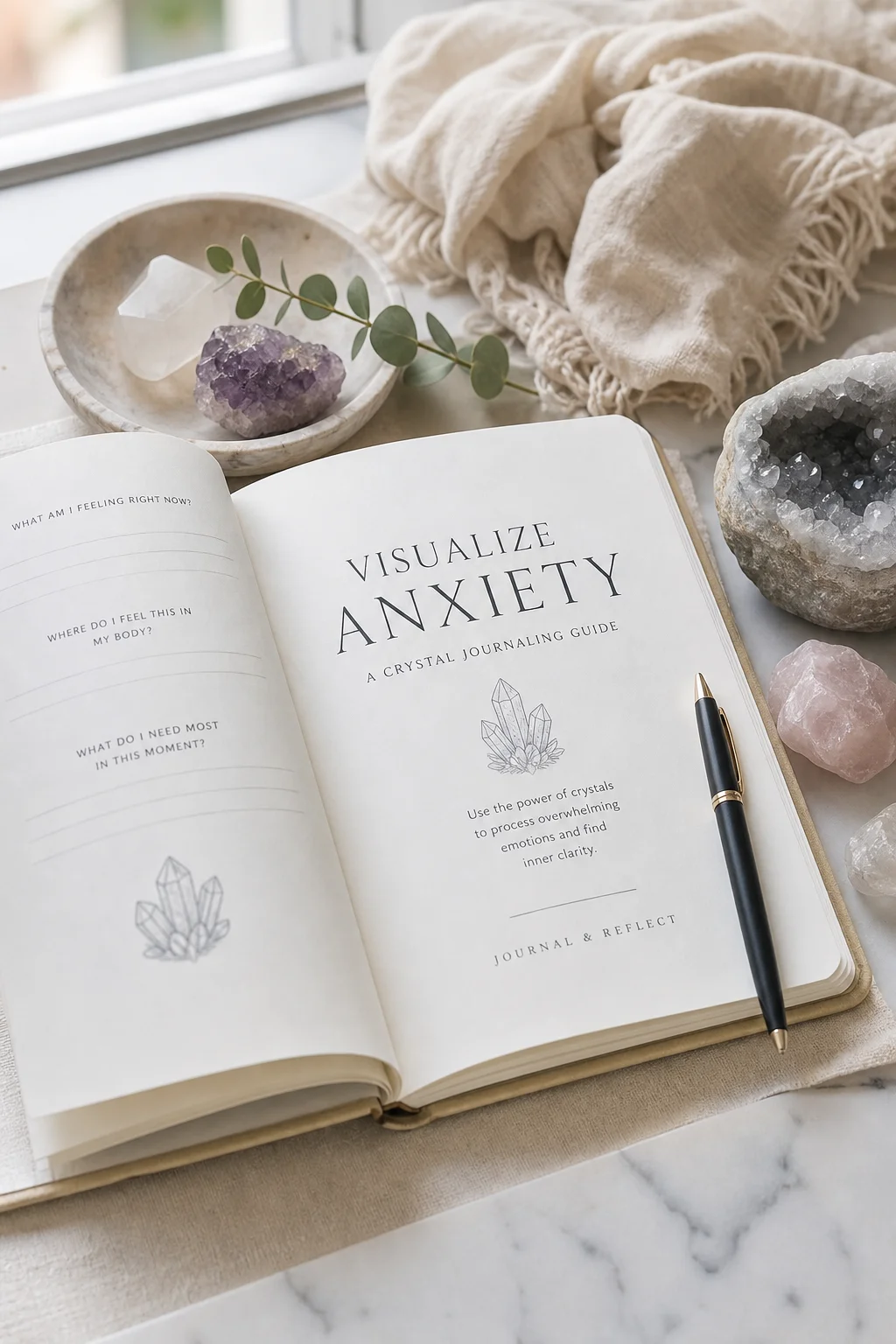
I Started Because My Therapist Told Me To Visualize My Anxiety — And I Couldn't
My therapist said something that stuck with me during our third session: "You need to visualize your anxiety. Give it a shape, a color, a texture. Then you can work with it."
I went home, opened my journal, and stared at a blank page for twenty minutes. Visualization doesn't come naturally to me. I'm not a visual thinker. When I close my eyes and try to "picture" something, I get static — like a TV tuned to a dead channel. So my therapist's homework felt impossible before I even started.
That same week, I was rearranging the small collection of crystals on my bookshelf — nothing fancy, just a few pieces I'd picked up over the years at gem shows and flea markets. I picked up a piece of lepidolite and turned it over in my hand. The purple-gray surface caught the light, and for some reason, I started describing it in my head. Cool. Smooth. Dense. The color of a bruise healing.
That night, I grabbed my journal and wrote about the lepidolite. Not about my anxiety — just about the rock. How it felt. What color it was. Where the fractures ran through it. And somewhere around the third paragraph, I realized I was actually writing about how my anxiety felt without trying to. The crystal gave my brain something concrete to latch onto when abstract visualization failed.
That was the beginning. Not some dramatic spiritual awakening — just a practical workaround for a brain that doesn't do well with "close your eyes and picture a peaceful meadow." Over the next six weeks, I built a system around this accident, and it changed how I process stress in a way that three years of therapy journaling hadn't managed. If you've ever struggled with traditional journaling for anxiety, or if you're curious about how crystal journaling works in practice, this is the full breakdown of what I did, what worked, and what was a waste of time.
What Crystal Journaling Actually Is (And What It Isn't)
Let me be clear about something upfront: crystal journaling is not just setting a pretty rock next to your notebook and hoping for the best. I tried that version. It doesn't do anything meaningful.
Crystal journaling is the practice of using a specific crystal as a sensory anchor while you write. You hold it, observe it, describe it — and that physical engagement with something tangible quiets the part of your brain that panics at a blank page. It's similar to how fidget tools help with focus, but with an added layer: different crystals have different textures, weights, temperatures, and visual characteristics that naturally evoke different emotional responses.
A rough, dark tourmaline feels protective and grounded. A smooth, cool rose quartz feels soft and calming. Your brain makes these associations automatically — you don't have to believe in energy fields or chakras for it to work. The crystal becomes a bridge between abstract feelings and concrete language, which is exactly what therapeutic journaling asks you to do.
People who already practice crystal meditation techniques will find journaling is a natural extension — same anchoring principle, just with written output instead of silent observation.
My 6-Week Experiment: The Setup
I treated this like an actual experiment because I needed structure. Vague intentions like "journal more" have never worked for me.
Duration: 6 weeks (42 days)
Frequency: Daily, minimum 10 minutes, no maximum
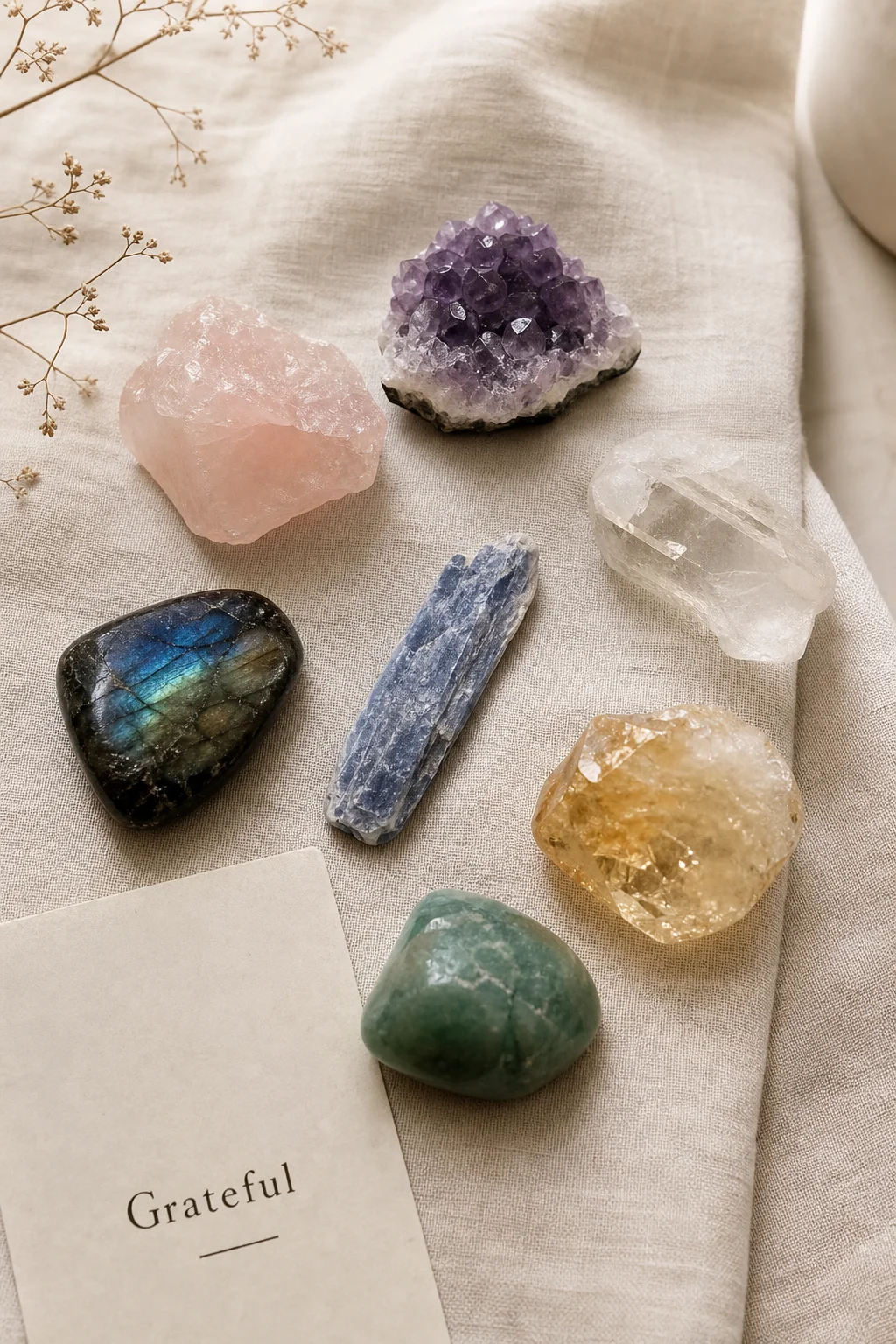
Crystals used: Five specific stones, rotated on a schedule — lepidolite, black tourmaline, citrine, rose quartz, and clear quartz. I chose these based on what practitioners commonly recommend for emotional work in crystal guides, but I was skeptical and wanted to test them myself.
Journal: Physical notebook, unlined. I found lined paper triggered my perfectionism (handwriting had to be neat), while blank pages let me write messily without caring.
Tracking: I rated my anxiety and mental clarity on a 1-10 scale each morning before journaling and each evening after. I also logged which crystal I used and any notable observations.
Rule: No phone during journaling sessions. This was the hardest rule to follow but probably the most important one.
Why This Combination Works: The Science Behind Crystals + Writing
I'm not going to claim crystals have magical properties. What I will say is that the combination of tactile engagement and expressive writing taps into some well-documented psychological mechanisms.
Expressive writing works. Dr. James Pennebaker's research at the University of Texas showed that writing about emotional experiences for 15-20 minutes a day improves immune function, reduces anxiety, and increases working memory. This isn't fringe science — it's been replicated dozens of times since the 1980s.
Somatic anchoring works. Holding an object during emotional processing activates what psychologists call "grounding." Your nervous system has something physical to focus on, which reduces the intensity of overwhelming emotions. Therapists use this technique with trauma patients all the time — holding an ice cube, squeezing a stress ball, feeling the texture of a fabric. A crystal is just a particularly pleasant version of this.
The combination is greater than either alone. Writing without an anchor can spiral — you start journaling about anxiety and accidentally make it worse by ruminating. The crystal gives your hands something to do and your eyes something to rest on when the writing gets intense. It creates a natural rhythm: look at the stone, feel its weight, write, look again, feel, write. That rhythm keeps you engaged without spiraling.
There's also something about the ritual of selecting a crystal, sitting down with it, and committing to the practice. Ritual creates psychological readiness — it tells your brain "we're doing the thing now." People who practice crystal healing meditation report similar benefits from the preparatory ritual itself.
How to Set Up Your Crystal Journal
Here's exactly what you need and how I'd recommend structuring it, based on what worked (and what didn't) during my experiment.
The notebook: Get something you won't feel guilty "ruining." A $2 composition book works better than a $30 leather journal because you won't hesitate to write badly in it. Unlined pages are ideal — they let you draw, write at angles, circle things, make messes.
The crystals: Start with three. You don't need a collection. I'd suggest one dark, grounding stone (black tourmaline or smoky quartz), one light, calming stone (rose quartz or howlite), and one clear, focusing stone (clear quartz or selenite). You can find all of these for under $10 each.
The layout: I divide each journal page into two sections. The top two-thirds is for free writing. The bottom third is for a single reflection prompt — one sentence about what I noticed during the session. This structure kept me from just venting endlessly without extracting any insight.
The routine: Same time, same place, every day. I did mornings before checking my phone. The consistency mattered more than I expected — by week two, my brain started shifting into "journal mode" the moment I sat down and picked up the crystal.
Optional but helpful: A small cloth or mat to place the crystal on when you're not holding it. This sounds unnecessary, but having a designated "crystal spot" on your desk reinforces the ritual aspect and keeps the stone from rolling away mid-sentence.
The 5 Crystals That Actually Shifted My Emotional State
Not every crystal I tried made a noticeable difference. Some felt like I was just holding a rock (which, technically, I was). But these five consistently produced different emotional textures in my writing.
1. Lepidolite — The One That Started Everything
This is the purple-gray mica-rich stone I grabbed by accident that first night. It's surprisingly heavy for its size, and the surface has a subtle shimmer that changes depending on the angle. When I held lepidolite, my writing tended to go deeper faster. I'd start with surface-level observations ("today was stressful") and within minutes be writing about underlying patterns ("I keep creating situations where I feel out of control because familiar anxiety is more comfortable than unfamiliar calm"). Heavy stuff, but it came out naturally.
My theory: lepidolite's weight and cool temperature are physically grounding in a way that light, warm stones aren't. That grounding made it easier to sit with uncomfortable thoughts without fleeing.
2. Black Tourmaline — The Boundary Setter
Black tourmaline is rough, dense, and dark — it looks like a piece of hardened lava. I used it on days when my anxiety was specifically about other people: social obligations, conflict, feeling overwhelmed by demands. Writing with tourmaline, my journal entries shifted from "I'm so anxious about everyone" to "here's specifically what I need to say no to." It produced clearer, more decisive writing.
3. Rose Quartz — The Soft Entry Point
Rose quartz was my "easy day" crystal. Smooth, pink, warm to the touch quickly. On days when I didn't want to journal at all — when even the thought of opening the notebook felt exhausting — rose quartz was the least intimidating option. My writing with it was gentler, more self-compassionate. Less "figure out what's wrong" and more "it's okay that today was hard."
4. Citrine — The Energy Shifter
I was most skeptical of citrine because the crystal community talks about it as a "manifestation" stone, which sets off my BS detector. But I'll admit: journaling with citrine on mornings when I felt stuck in a rut produced noticeably more forward-looking entries. Not magical — just practical. "Here's one small thing I can do today to move forward." It's a warm yellow stone that catches light easily, and I think the visual brightness genuinely influenced my mood.
5. Clear Quartz — The Clarity Tool
Clear quartz was my most-used stone overall, and the one I'd recommend if you could only buy one. It's transparent, which means you can look through it — and I found myself doing this constantly while thinking. There's something about focusing your eyes through a physical object that creates a meditative state without trying. My clearest, most organized thinking happened with clear quartz in hand. For more detailed guidance on selecting stones for specific purposes, check out this guide on how to use crystals in daily practice.
5 Journal Prompts That Actually Worked (With Crystal Pairings)
Blank page prompts like "how are you feeling?" are useless when you're anxious — the answer is just "anxious" and you're done. These five prompts consistently got me past the wall.
Prompt 1: "What does this crystal remind me of?" (Pair with any stone)
Start by describing the crystal — its color, texture, weight, temperature — and follow wherever your associations go. This is how I discovered that lepidolite's purple-gray reminded me of storm clouds, which led to writing about how I always feel most anxious before a deadline, not during.
Prompt 2: "If my anxiety lived in a specific part of my body, where would it be and what would it look like?" (Pair with black tourmaline)
This prompt is adapted from somatic therapy. Holding a grounding stone while doing body-scan writing made the exercise more tolerable. I discovered my anxiety lives in my jaw and manifests as a clenched, grinding sensation — something I'd never noticed before.
Prompt 3: "What would I tell someone I love who felt exactly the way I feel right now?" (Pair with rose quartz)
This one is almost embarrassingly effective. The rose quartz creates a softer context, and the prompt forces self-compassion by proxy. I always write kinder, more constructive advice when I frame it for "someone else."
Prompt 4: "What's one thing I'm avoiding, and what's the smallest possible step toward it?" (Pair with citrine)
Action-oriented writing with an energy-associated stone. This prompt is responsible for at least four actual behavior changes during my experiment, including finally scheduling a medical appointment I'd been putting off for months.
Prompt 5: "What pattern do I keep repeating, and when did it start?" (Pair with clear quartz)
The clarity stone for a clarity prompt. This one produced the deepest insights but also the most resistance — I'd sometimes avoid this prompt for days. When I did it, though, the writing was always worth the discomfort.
How I Tracked Progress (And What The Numbers Showed)
My tracking system was simple: two numbers, twice a day. Morning anxiety (1-10) and mental clarity (1-10) before journaling. Same two numbers after the evening session. I logged them in the back of my journal with the date and which crystal I used.
Here's what the data showed after six weeks:
- Week 1-2: Anxiety scores barely moved (average 7.2 to 6.8). Clarity scores were all over the place. I almost quit.
- Week 3: First noticeable shift. Morning anxiety dropped to an average of 5.9. Clarity scores started stabilizing around 6.5.
- Week 4-5: The improvement accelerated. Average anxiety down to 4.3, clarity up to 7.8. My journal entries were also noticeably longer and more reflective without trying.
- Week 6: Anxiety averaged 3.7 (down from 7.2), clarity averaged 8.1 (up from 4.0). The gap between "anxious morning" and "calm evening" narrowed significantly.
The most interesting finding: which crystal I used didn't dramatically change the numbers, but it changed what I wrote about. Tourmaline sessions produced boundary-setting content. Rose quartz sessions produced self-compassion content. The crystal didn't reduce anxiety by itself — it channeled the journaling in a specific direction.
If you want to go deeper into tracking emotional shifts with crystal work, this crystal journal guide has additional frameworks for documenting your experience.
When Crystals Stop Working (And What To Do About It)
Around week five, something shifted. The crystals didn't feel the same. Not physically — I just didn't get that immediate sense of focus I'd been getting. I'd pick up a stone and feel... nothing.
From what I've read and experienced, this is normal. It's not that the crystals "stopped working." It's that my brain had integrated the ritual so deeply that I didn't need the external anchor as much. The journaling habit had become self-sustaining.
If this happens to you, try switching to a completely different crystal you've never used. The novelty resets the sensory engagement. Or take a few days off from journaling entirely — burnout is real, even with helpful practices.
Where I Am Now: Six Weeks Later
I'm writing this at the end of the six weeks, and honestly, I didn't expect to still be doing it. Most self-improvement experiments I try last about ten days before I lose interest or convince myself they're not working.
What's different this time: I'm not "cured" of anxiety. I still get anxious. But the relationship has changed. Anxiety used to be this vague, all-consuming fog that I couldn't describe or address. Now it has textures and patterns. I can tell the difference between tourmaline-anxiety (boundary-related, other-people-driven) and lepidolite-anxiety (deep, existential, control-related). That distinction alone has made my actual therapy sessions more productive, because I can describe what I'm experiencing instead of just saying "I feel bad."
I've kept the habit going past the six-week mark — not every single day, but most days. The journal is filling up. The crystals are still on my desk. And the blank page doesn't scare me anymore, which was the whole point.
FAQ
Do I need to believe in crystal energy for this to work?
No. I'm still not sure what I believe about crystal energy, and it worked for me. The mechanism is sensory anchoring and ritual, not magic. If believing in energy work enhances your experience, great. If you're a skeptic, the tactile engagement alone does most of the heavy lifting.
How much should I spend on crystals to start?
Under $30 total. You need three small tumbled stones at most. Any crystal shop or online retailer will have rose quartz, black tourmaline, and clear quartz for $5-10 each. Don't buy expensive specimens — you're going to be manhandling these daily.
What if journaling makes my anxiety worse?
This can happen, and it's a sign you might need a different approach. If writing about your anxiety amplifies it, try writing about the crystal instead of about yourself. Describe its appearance, how it feels, what it reminds you of. Keep it external and concrete. If rumination persists, talk to a therapist about whether journaling is right for you right now.
Can I do this digitally instead of on paper?
You can, but I'd recommend trying paper first. There's something about the physical act of handwriting while holding a physical object that creates a feedback loop digital tools can't replicate. If paper really doesn't work for you, use a distraction-free app and keep the crystal next to your keyboard — pick it up whenever you pause to think.
If you want a more structured approach to tracking how lifestyle changes affect your mood, I put together a free calorie calculator that helps you see patterns in your eating habits.
Related Guides
- Crystal Shapes Explained: Tumbled, Raw, Points, Spheres
- Complete Guide to Crystal Healing and Energy Work
- How to Tell if a Crystal Bracelet Is Real or Fake
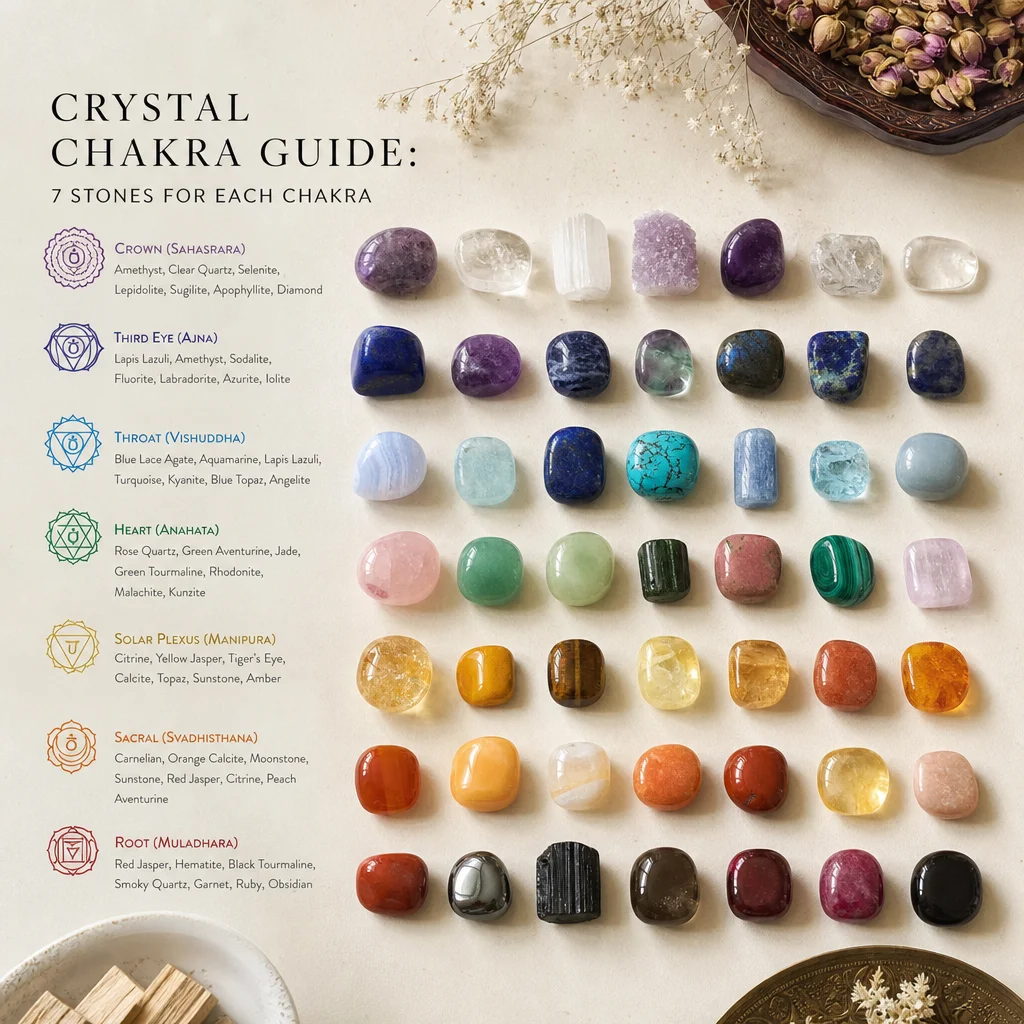
- Chakra Stones: Which Ones Actually Matter
- Crystal Energy Guide: Healing Properties
- Crystal Pricing: 7 Tricks Shops Use to Make You Overpay
- 5 Practical Tests to Tell Real Crystals From Fakes
Frequently Asked Questions
How do you use crystals while journaling?
To practice, simply hold your chosen natural stone in your non-dominant hand or place it on your desk while you write. Set a specific intention for your handcrafted SagStone piece before starting. As you write, pause occasionally to feel the texture of the crystal. The physical weight of the artisan stone acts as a tactile anchor, grounding your mind and easing anxious thoughts instantly.

Comments