Crystal jewelry for the office: professional but not boring

Office dress codes are not what they used to be
Ten years ago, "office jewelry" basically meant pearl studs and a thin gold chain. Anything beyond that was considered unprofessional. The rules have loosened considerably since then, but "loosened" does not mean "anything goes." The line between expressing personal style and looking like you came from a music festival is still real, and crossing it at work has consequences.
The tricky part is that "appropriate" means different things depending on where you work. A creative agency in Austin has a completely different standard than a law firm in Chicago. So before getting into specific recommendations, let's establish the baseline: your jewelry should never be the first thing someone notices about you in a professional setting. If a colleague remembers your necklace before they remember what you said in the meeting, something is wrong.
Conservative offices: the tightrope walk
In law, finance, consulting, and government, the jewelry standard leans minimal. Not because these industries hate creativity — they just associate understated presentation with judgment and reliability. Fair or not, that is the reality.
Earrings: Studs are your best friend. Small crystal studs under 6mm — think white sapphire, clear quartz, or a tiny moonstone — are almost invisible from a distance but catch light up close. Pearl studs are the gold standard here and have been since the 1980s. They are impossible to get wrong. Avoid anything that dangles, swings, or makes noise when you move. Hoops wider than 1 inch are generally a no in conservative settings.
Necklaces: A single pendant on a thin chain is fine. The pendant should be small enough to fit under a blazer collar without poking out awkwardly. A 4 to 8mm crystal on an 18-inch chain is the sweet spot. Avoid anything with multiple stones, large geometric shapes, or spikes. Think "my grandmother would approve" and you are probably in the right zone.
Rings: One statement ring on your non-dominant hand is acceptable. A single crystal cabochon in a simple bezel setting works. Stackable rings are fine if you limit them to two. Three or more rings start reading as intentional style rather than accidental choice, which in a conservative office reads as "not paying attention to the dress code."
Bracelets: This is where people mess up the most. A crystal bracelet that clinks against your desk while you type is a fast track to annoying your cube neighbor. Bangle stacks are worse — imagine the sound of three metal bangles hitting a keyboard tray 200 times a day. If you must wear a bracelet, make it a thin, snug fit that does not move. Or skip it entirely and put your jewelry energy into earrings instead.
Creative offices: you have more room, but there are still limits
In design, advertising, tech startups, media, and fashion, the rules relax significantly. You can wear larger pieces, bolder colors, and more layered looks. But "relaxed" is not the same as "nonexistent." Showing up to a client presentation wearing a crystal the size of a small egg is still going to raise eyebrows, even at a creative agency.
The practical test: if your jewelry interferes with your work — catching on headphones, getting tangled in a lanyard, making it hard to type, or distracting during video calls — it is too much for any office. The medium is not the problem. The scale is.
Creative offices are also where colored stones really shine. A chunky amethyst pendant, a rose quartz ring, or a pair of lapis lazuli studs all work in environments where self-expression is part of the culture. You can also layer more freely — two or three thin necklaces in complementary stones reads as intentional styling rather than carelessness.
Stone colors that work everywhere
If you want to wear crystal jewelry but are not sure which colors are safe for your particular office, there is a reliable hierarchy.
Level 1 — Virtually invisible: Clear quartz, white sapphire, diamond (if your budget allows), and pearl. These are neutral in every context. They catch light without adding color. No one in any office will question them.
Level 2 — Subtle color: Light blue (aquamarine, blue lace agate), soft peach (rose quartz, morganite), pale green (peridot, jade), and gray (labradorite, moonstone). These add a hint of color without demanding attention. They work in conservative and creative offices alike.
Level 3 — Noticeable but manageable: Amethyst (purple), citrine (yellow), and garnet (dark red). These are bold enough to be conversation starters but small enough in stud form to stay professional. Keep the stone size under 8mm and you are fine almost everywhere.
Level 4 — Proceed with caution: Bright turquoise, bright red (ruby, red coral), emerald green, and anything neon or iridescent. These work in creative offices and casual Fridays but will get looks in a board meeting. Not necessarily bad looks — just looks. Decide if that is what you want.
The "one statement piece" rule
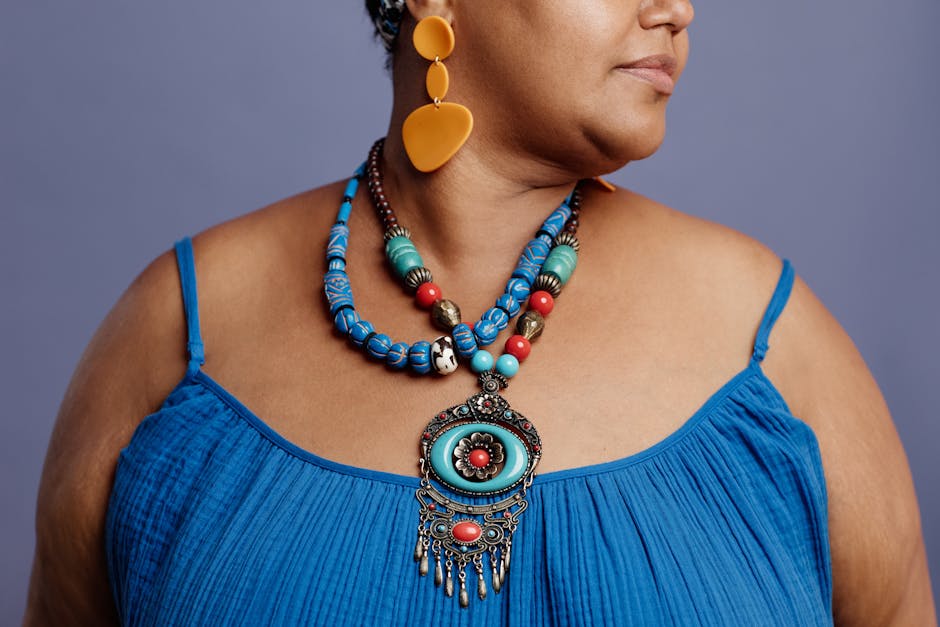
This is probably the most useful guideline for office jewelry of any kind, crystal or not: pick one piece to be your focal point and keep everything else quiet. If you are wearing a bold crystal pendant, wear small stud earrings and no bracelet. If you have statement crystal earrings, skip the necklace or wear a barely-there chain. If you are stacking crystal rings, keep your earrings simple.
The reason this works is about visual balance. When every piece of jewelry is competing for attention, nothing stands out and the overall effect is chaotic. When one piece leads and the rest support it, you look intentional and put-together. This is not a fashion rule someone invented to be controlling. It is just how human visual processing works.
Crystal jewelry for men at work
Men's crystal jewelry in professional settings is more common than it used to be, but it still requires some thought. The most widely accepted option is a bead bracelet — specifically 8mm or 10mm beads on an elastic cord. Black obsidian, tiger's eye, and matte onyx are the mainstream choices. They read as masculine and understated, which is the combination most men are going for in an office.
A single crystal bead on a leather cord is another option, though it leans more casual. For something more formal, a small crystal set in a tie tack, cufflinks, or a signet ring is about as conservative as it gets while still incorporating stone into your look.
The main thing to avoid is anything that could be read as costume jewelry. Large pendants, multiple bracelets, and stones with obvious New Age associations (like raw crystals dangling from hemp) will get different reactions depending on your office culture. In a tech startup, no one cares. In a traditional corporate environment, it might affect how seriously people take you. That is an unfair reality, but it is a real one.
Practical tips that actually matter
Some jewelry advice is subjective. Some is just logistics. Here is the logistical stuff.
Take your jewelry off before washing your hands. Crystal settings — especially sterling silver bezels — do not like repeated exposure to soap and water. The stone gets cloudy, the metal tarnishes faster, and the setting loosens over time. A quick on-and-off at the sink adds years to the life of your pieces.
Keep a small jewelry dish at your desk. The number one way people lose earrings and rings at work is by setting them on a bare desk and then accidentally sweeping them into the trash while cleaning up. A small dish or tray costs almost nothing and solves this completely.
If you are on video calls all day, remember that your jewelry is magnified. A 6mm stud that looks tiny in person can look like a disco ball on a webcam. Test your setup before an important meeting — open your camera app, check how your jewelry looks at the distance you normally sit, and adjust if needed.
Finally, match your jewelry metal to your other accessories. If your belt buckle is silver and your watch is gold, your crystal jewelry in either metal will clash with one of them. This is not about being matchy-matchy. It is about not having three different metal tones competing on your upper body at the same time.
Comments