First-Time Crystal Fair Vendor Guide
May 16, 2026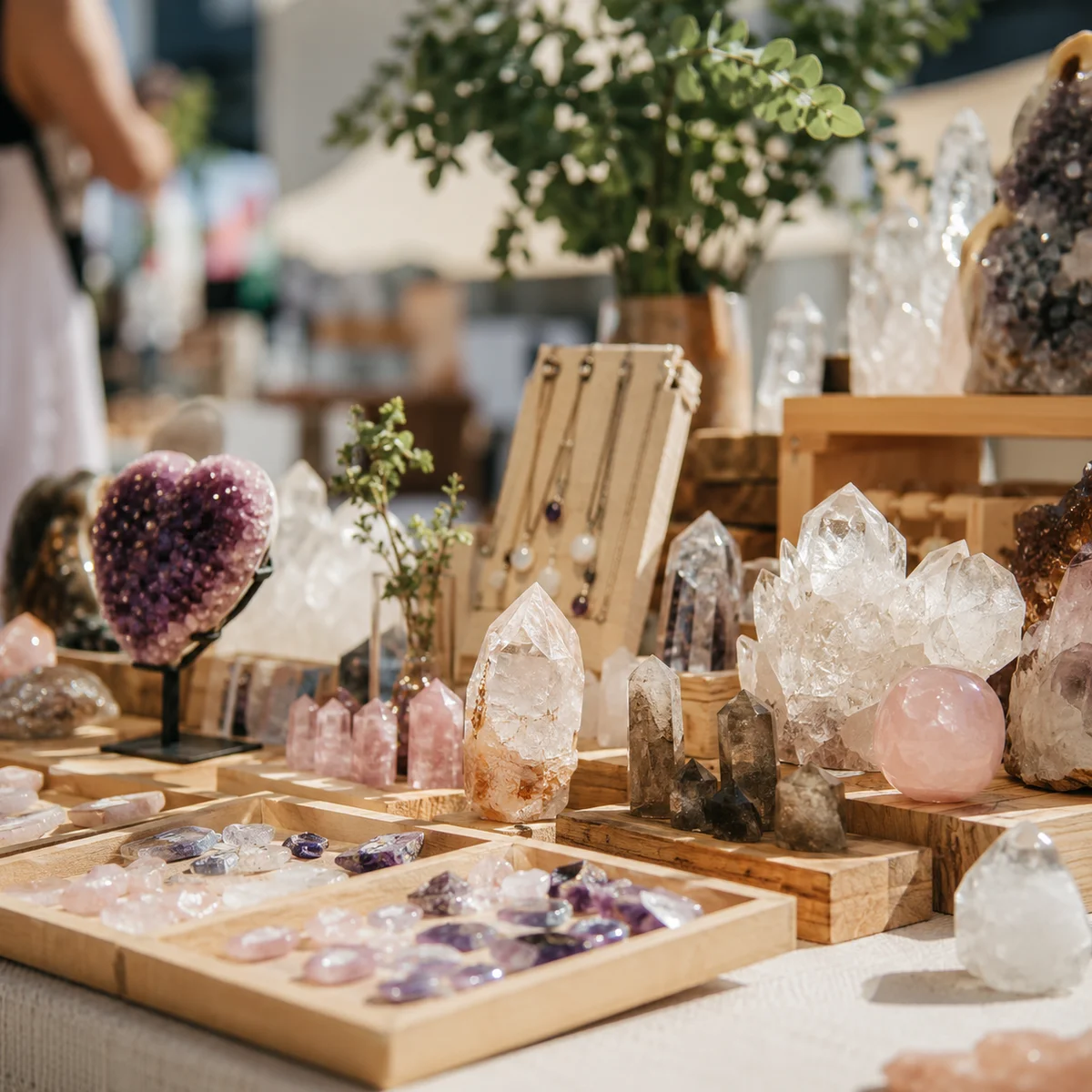
What I Learned Selling Crystals at My First Gem and Mineral Fair (A Vendor's Guide)
I signed up for my first gem and mineral fair on a Tuesday night impulse, paid a $125 booth fee, and then lay awake until 3 AM wondering what I'd gotten myself into. Six weeks later, I drove a stuffed Honda Civic into a fairground parking lot at 5:45 in the morning, balanced three Rubbermaid tubs on a dolly, and set up a table full of crystals I'd been collecting and cleaning for months. Here's everything that went right, wrong, and sideways — so you can skip a few of my mistakes if you're thinking about doing the same thing.
Why I Decided to Vendor (And Why It Took Me So Long)
I'd been buying crystals at shows for about four years. Every time I walked the aisles as a customer, I'd catch myself mentally rearranging people's booths. Their labels are too small. That amethyst cluster is lost in that clutter. Why is everything the same price? I had opinions. Strong ones. And a growing personal collection that was starting to look more like inventory than a hobby.
The push came from a friend who vends at craft markets. She told me: "You already have the stock. You already know the community. The booth fee is cheaper than a weekend of therapy. Just do it." So I did.
Picking the Right Show
Not all gem fairs are built the same. The first thing I learned is that there's a big difference between a small local mineral club show and a large regional gem expo. My first show was a two-day event put on by a regional lapidary society. Booth fees ranged from $50 for a half table to $300 for a corner double booth. I went with a standard 6-foot table for $125, which felt like a reasonable entry point.
Here's what I wish someone had told me: ask the organizer about foot traffic before you commit. Some shows are mostly wholesale buyers who show up on Friday morning and leave by noon. Others are packed with families and casual shoppers on Saturday afternoon. My show had about 800 attendees over the weekend, which the organizer described as "medium." I later learned that's pretty good for a first-time vendor. Don't start with a 10,000-person mega show. You will be overwhelmed.
If you're thinking about attending a show as a customer first to get a feel for the vibe, I wrote a beginner's guide to crystal shows that covers what to expect from the buyer's side. Honestly, I wish I'd done that before I vended. Walking a show as a vendor is a completely different animal.
The Money: What It Actually Cost Me
Let me break down my expenses, because nobody ever does this honestly:
- Booth fee: $125 (standard 6-foot table, two days)
- Display materials: ~$85 (velvet tray liners, small easels, risers, a folding tablecloth, battery-powered LED lights, price tags)
- Inventory I sold: Roughly $400 retail value across ~75 pieces
- Packaging: $20 (glassine bags, tissue paper, small cardboard boxes for larger pieces)
- Gas and food: $35
Total out of pocket before sales: about $265. I walked away with $620 in revenue and $355 in profit. Not life-changing money, but honestly more than I expected for my first time. And I'm including my display materials as a one-time cost — I'll reuse all of that.
If you want to understand how I priced my pieces — and how to avoid the trap of underpricing out of fear — check out my crystal pricing guide. The short version: most of my pieces landed between $8 and $35, with a handful of larger specimens priced at $50 to $75. The sweet spot was $12 to $22. Anything under $8 barely felt worth the transaction, and anything over $50 required the buyer to really want that specific piece.
What I Brought (And What I Wish I'd Brought)
I spent two weeks assembling my setup. Here's what worked:
- Black velvet tray liners. These made even my cheaper tumbled stones look expensive. Best $18 I spent.
- Acrylic risers in three heights. Elevation makes a huge difference. Flat tables look like garage sales. Tiered displays look like a real business.
- A folding chair. Sounds obvious. I almost forgot it.
- Clear price tags on every single piece. No exceptions. People are too shy to ask prices, and if they have to ask, half the time they'll just walk away.
- My phone with a card reader. About 60% of my sales were card. If you're cash-only in 2026, you're leaving money on the table.
- Water, snacks, and ibuprofen. You will stand for 10 hours. Your back will file a formal complaint.
What I wish I'd brought: a second tablecloth to cover my storage tubs underneath (they were visible and looked messy), a small hand mirror so customers could hold pieces up to the light, and better signage. My hand-written "Crystals & Minerals" sign was functional but looked amateur. Next time I'm ordering a printed banner.
If you're looking for display inspiration beyond the basics, I put together some crystal display ideas that work just as well for vendor tables as they do for home shelves. The principles are the same: contrast, height variation, and breathing room between pieces.
Setup Day: The 5 AM Reality Check
Vendor setup started at 6 AM. I arrived at 5:45 because I'm the kind of person who gets anxious about being late to things that start early. The fairground was already half-full with vendors hauling crates and arguing about outlet access. The energy was chaotic but friendly. A woman two booths down loaned me a power strip within five minutes of meeting me. That's the vibe of gem shows, honestly — competitive but surprisingly communal.
It took me about 90 minutes to set up my table the way I wanted. The hardest part was deciding what to leave in the tub. I brought too much. Way too much. I had probably 120 pieces and room to display maybe 75 well. The rest sat in boxes under the table, which I'd periodically swap in as pieces sold. That rotation strategy actually worked pretty well — the table looked fresh each time I swapped. But next time I'm bringing 80 pieces max. Editing is a skill.
Pro tip: take a photo of your booth setup. You will rearrange things fifty times during the day as pieces sell. Having a reference photo helps you reset when your table starts looking chaotic. Also, the photo is useful for social media posts and for remembering what worked next time.
The Customers: Who Buys Crystals at a Fair
I expected two types of buyers: serious collectors looking for specific specimens, and crystal-healing enthusiasts shopping by intention. I was wrong. The majority of my customers fell into a third category I hadn't considered: people buying gifts.
Probably 40% of my sales were someone picking up a piece and saying something like, "My sister would love this" or "This reminds me of my mom." These buyers didn't know carnelian from citrine. They didn't care about matrix or termination points. They wanted something pretty, reasonably priced, and easy to explain. "It's rose quartz — the love stone" was enough context for them. I sold a lot of rose quartz and amethyst to this group.
The serious collectors were my smallest group, maybe 15% of buyers, but they spent the most per transaction. One man spent $140 on three mineral specimens and asked detailed questions about locality and whether I knew the mine source. I knew the answer for two of the three, which felt good. If you're curious about where crystals actually come from and how they end up at shows, this article about crystal mining covers the supply chain better than I can.
The crystal-healing buyers were somewhere in between. They knew their stones, they cared about energy and intention, and they were the most fun to talk to. They also tended to buy multiples — three or four smaller pieces rather than one big one. Tumbled stones at $5 each, palm stones at $10 to $15, and raw clusters at $18 to $25 were the bread and butter.
Mistakes I Made (Learn From My Pain)
Mistake #1: I didn't bring enough small bags. People buying three tumbled stones don't want to carry them loose. I ran out of glassine bags by midday Saturday and had to use ziplock sandwich bags from the food vendor next door. Not my finest moment. Now I keep 200 small bags in my kit.
Mistake #2: I priced too many things at $5. At first glance, cheap seems like a good strategy — get people to buy something, anything. But $5 items attracted a lot of looky-loos who'd pick things up, put them down, and move on without buying. The $12 to $18 price point attracted more decisive buyers. I'm not saying don't have affordable options. I'm saying don't make them the center of your table.
Mistake #3: I sat down too much. When foot traffic slowed between 11 AM and noon on Saturday, I sat in my chair and scrolled my phone. Bad idea. People walking by see you disengaged and keep walking. The vendor across from me stood the entire day, greeted everyone who made eye contact, and outsold me by probably 2:1. Standing and being warm — not pushy, just present — makes a real difference.
Mistake #4: I didn't protect my inventory well enough between shows. I tossed everything back into tubs at the end of day one, and two of my smaller selenite towers got chipped in transit. Selenite is soft. I knew that. I just got lazy. If you want a full rundown on what not to do with your stones, my guide on crystal storage mistakes covers the common ways people accidentally ruin their own inventory. Read it before your first show.
The Surprising Parts
A few things caught me off guard, in a good way:
The community among vendors was warmer than I expected. Crystal people are genuinely nice. Several experienced vendors came over during slow periods, gave me honest feedback on my display, and one even sent a customer my way because she didn't have what they were looking for. The woman who loaned me the power strip? She's been vending for twelve years and gave me a list of five shows to apply to. That kind of generosity is common in this space.
The other surprise was how much people wanted the story behind each piece. Whenever I could tell someone where a crystal came from — "This labradorite was mined in Madagascar" or "I picked up this cluster at a rock swap in Tucson" — their interest level visibly increased. Story sells. If you're just putting rocks on a table with prices, you're doing it the hard way. Talk about where things come from. People connect with that.
And here's one I didn't see coming: my shadow box display was the conversation starter of the weekend. I brought one of those crystal shadow box displays with a curated selection of small specimens arranged by color gradient. People stopped to look at it even when they weren't planning to buy. Several of them ended up buying individual pieces from it. It worked like a magnet. I'm making three more for my next show.
Timing and Pacing: How the Days Actually Felt
Saturday was the busy day. Doors opened to the public at 9 AM, and there was a solid rush from 9:30 to 11:00. Then it died down until about 1:00 PM, picked back up from 1:00 to 3:30, and tapered off. The show closed at 5 PM. I made about 70% of my total revenue on Saturday.
Sunday was slower but steadier. Fewer total people, but the ones who came were serious buyers. Sunday customers spent more per person and asked better questions. The show ran 10 AM to 4 PM on Sunday. I used the last hour to offer small discounts on remaining inventory, which moved another $90 worth of product.
If you're deciding whether to do one day or two, do both. The second day has lower pressure and you'll learn a ton from observing what did and didn't sell on day one.
What I'd Do Differently Next Time
- Better signage. A printed banner with my name or brand. Something people can remember and find later.
- A QR code. Link to an Instagram page or online shop. Several people asked if I sold online and I had nothing to point them to.
- Less inventory, more curation. Eighty well-chosen pieces beat 120 random ones.
- A helper. Even just for the first two hours of setup and the lunch rush. Handling transactions, answering questions, and reorganizing the display simultaneously is a lot for one person.
- Bring a dolly with pneumatic wheels. The fairground parking lot was gravel. My cheap folding dolly almost didn't make it.
- Pack a warmer layer. The building had heating, but by 5 PM it got cold. Several vendors were shivering during teardown.
Should You Do It?
If you've got a decent collection, some basic display skills, and the ability to be friendly to strangers for eight hours straight — yes. Even if you break even financially, the experience is worth it. You'll learn more about what people actually want in one weekend than you will from months of online research. You'll meet other vendors, get connected to the show circuit, and probably come home with a few trades from neighboring booths (I left with a gorgeous fluorite octahedron that I traded for a cluster I'd paid $12 for — best deal of the weekend).
Start small. Pick a local show with reasonable booth fees. Don't over-invest in your first setup. Go in with the attitude that you're there to learn, not to get rich. The money will follow if you pay attention to what works and what doesn't.
And if nothing else, you'll have a really good answer next time someone asks you what you did over the weekend.
{"slug": "crystal-fair-vendor-guide-first-time", "title": "What I Learned Selling Crystals at My First Gem and Mineral Fair (A Vendor's Guide)", "category": "Crystal Adventures", "tags": ["crystal fair", "gem show vendor", "selling crystals", "crystal business", "mineral show tips"], "meta_description": "A first-person guide to selling crystals at your first gem and mineral fair — booth costs, display tips, pricing strategies, mistakes to avoid, and what real customers actually buy.", "word_count": 2467}Related Guides
- Selenite: Beautiful But Fragile Care Guide
- How to Tell if a Crystal Bracelet Is Real or Fake
- Crystal Pricing: 7 Tricks Shops Use to Make You Overpay
- Complete Guide to Crystal Healing and Energy Work
- 5 Practical Tests to Tell Real Crystals From Fakes
- 15 Creative Ways to Display and Store Your Crystal Collection
- Crystal Energy Guide: Healing Properties
Frequently Asked Questions
How do I effectively display my crystal jewelry at a fair?
Optimize your display by grouping similar items, using LED lighting to highlight crystal colors, and ensuring each piece is showcased on a clean and visually appealing background. This will attract and engage potential buyers.
What are the best selling crystal jewelry pieces at fairs?
The most popular crystal jewelry pieces at fairs typically include necklaces, bracelets, and earrings in colors like rose quartz, citrine, and malachite. Incorporate these popular types into your collection for increased sales.
How can I market my crystal jewelry effectively at a fair?
Use social media posts, flyers, and interactive sessions to educate and engage attendees. Offer samples or free readings to create a memorable experience that encourages sales. Don't forget to collect email addresses for future marketing.
What are some common mistakes to avoid as a first-time crystal fair vendor?
Common mistakes include underpriced items, poor product presentation, inadequate marketing, and not understanding your target audience. Invest time in product display, research your customers, and set competitive pricing to avoid these pitfalls.
Understanding the Basics
This section covers important aspects of understanding the basics. For detailed information, please refer to the FAQ section below.
Key Factors to Consider
This section covers important aspects of key factors to consider. For detailed information, please refer to the FAQ section below.
Step-by-Step Instructions
This section covers important aspects of step-by-step instructions. For detailed information, please refer to the FAQ section below.
Common Mistakes to Avoid
This section covers important aspects of common mistakes to avoid. For detailed information, please refer to the FAQ section below.
Comments