Cleopatra's emerald mines: the real story behind the legend
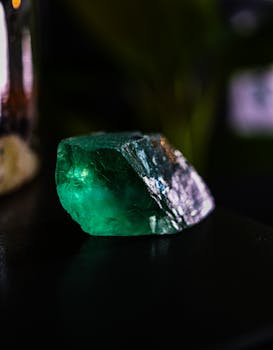
The phrase "Cleopatra's emerald mines" has a good ring to it. It conjures images of a powerful queen overseeing vast underground operations, workers hauling gleaming green crystals from deep shafts, and the wealth of ancient Egypt pouring out of the eastern desert in the form of gemstones. The reality is more complicated and, in some ways, more interesting than the marketing suggests.
Cleopatra VII did own emerald mines. The mines were real, the location is known, and archaeological evidence confirms that emerald extraction in the area dates back to long before her reign. But calling them "Cleopatra's emerald mines" is a label applied retroactively, mostly by 19th and 20th-century writers and gem dealers looking for a romantic origin story. The mines were not Cleopatra's personal project. They were state-run operations that existed before she was born and continued operating after she died.
Where the mines were located
The emerald mines of ancient Egypt are located in the Wadi Sikait region of the Eastern Desert, roughly 350 kilometers south of Cairo and 40 kilometers inland from the Red Sea coast. The area is harsh, dry, and mountainous. Summer temperatures regularly exceed 40 degrees Celsius. There is no permanent water source. The landscape is a mix of granite mountains, sandy wadis, and scattered thorny vegetation that barely survives the heat.
Despite these conditions, the Wadi Sikait region was one of the world's primary sources of emeralds for nearly two thousand years. The mines operate in a geological zone where the right combination of heat, pressure, and mineral-rich fluids produced beryl crystals, some of which were green enough to qualify as emeralds. The ancient miners did not have modern geological knowledge, but they knew where to dig. They followed veins of pegmatite rock and extracted crystals from open pits and narrow tunnels carved into the hillsides.
Mining before Cleopatra
The earliest evidence of emerald mining at Wadi Sikait dates to the Ptolemaic period, roughly the 3rd century BC, which means mining began about 250 years before Cleopatra was born. Some evidence suggests that mining may have started even earlier, during the Pharaonic period, though this is harder to confirm. The Ptolemaic dynasty, a Greek family that ruled Egypt after Alexander the Great's death, recognized the commercial value of the emerald deposits and organized systematic extraction.
The Ptolemies were practical administrators. They taxed the mines, appointed overseers, and regulated the trade. Emeralds from Wadi Sikait were sold within Egypt and exported to markets across the Mediterranean. The stones were valued for their color, which ranged from pale green to deep, almost bluish green. Roman writers later described Egyptian emeralds as the finest in the world, a claim that was partly genuine appreciation and partly the usual ancient tendency to rank whatever was nearby as the best of everything.
The Roman period peak
The real golden age of the Egyptian emerald mines was the Roman period, which began after Rome annexed Egypt in 30 BC, following Cleopatra's defeat by Octavian (the future Augustus). Under Roman administration, the mines at Wadi Sikait were expanded significantly. The Romans brought organizational efficiency, engineering skill, and a strong appetite for luxury goods. Pliny the Elder, writing in the first century AD, described Egyptian emeralds in detail and noted that the best stones came from the mines near the Red Sea.
Pliny also recorded something important: the miners at Wadi Sikait were not Egyptians. They were brought in from elsewhere, possibly from Nubia or other regions to the south. The work was grueling and the conditions were brutal. Miners worked the narrow tunnels by lamplight, chipping away at rock with iron tools. The temperature underground was only slightly cooler than on the surface. Dust and rock fragments were a constant hazard. There is no reliable estimate of how many miners died in the Wadi Sikait operations over the centuries, but the mortality rate was likely high.
Roman demand for emeralds was enormous. Emerald rings, necklaces, and earrings were standard items of personal adornment for wealthy Romans. The emperor Nero reportedly watched gladiatorial fights through a large emerald, using it as a corrective lens. (This story is probably apocryphal, but it shows how emeralds were associated with Roman elite culture.) The mines at Wadi Sikait produced enough emeralds to satisfy a significant portion of this demand for several centuries.
What was actually being mined
Here is where the story gets complicated. Many of the stones that ancient writers called "emeralds" were probably not emeralds by modern mineralogical standards. The ancient world did not distinguish clearly between emerald, green beryl, and peridot (olivine). All three minerals occur in similar geological settings, and all three are green. To a Roman miner or merchant, a green stone that looked nice was an emerald.
Modern analysis of surviving ancient Egyptian "emeralds" suggests that a significant percentage were actually green beryl, which is the same mineral as emerald (beryllium aluminum cyclosilicate) but with lower chromium content and therefore a paler color. Peridot, a completely different mineral (magnesium iron silicate), was also common in the region and was almost certainly mixed in with emerald shipments. Some of Cleopatra's famous emeralds, in other words, were probably peridot or pale green beryl that would not qualify as emeralds today.
This does not diminish the historical importance of the mines. The stones were valued in their own time for what they were, and the ancient classification system was simply different from the modern one. But it does complicate the romantic image of "Cleopatra's emeralds." Some of those stones were emeralds. Some were not. The miners probably did not care about the distinction.
What archaeologists found
Wadi Sikait has been the subject of serious archaeological investigation, most notably by a team led by Joan Oller Guzmán from the Polytechnic University of Catalonia. In 2018 and 2019, the team conducted extensive surveys and excavations at the site. They found the remains of a substantial mining settlement, including residential buildings, storage facilities, workshops, and a small temple dedicated to the goddess Isis.
The settlement was larger than previously thought. It housed not just miners but also administrators, guards, and support staff. The presence of the Isis temple suggests that the mining operation had a religious dimension, which is consistent with what we know about ancient Egyptian mining practices. Mining was dangerous and uncertain, and miners often sought divine protection. Temples at mining sites were common throughout the ancient Near East.
The archaeological team also found evidence of the mining techniques used at Wadi Sikait. The miners followed veins of emerald-bearing pegmatite into the mountainside, creating tunnels that in some cases extended dozens of meters underground. The tools were simple: iron chisels, hammers, and wooden wedges. No explosives. No mechanical equipment. The work was done entirely by hand, in temperatures that would be difficult for most modern people to tolerate for more than an hour.
The findings confirmed that Wadi Sikait was a major industrial operation, not a small-scale or informal activity. The scale of the settlement and the sophistication of the mining techniques indicate that the emerald trade was an important part of the Egyptian economy for centuries.
The decline and abandonment
The Wadi Sikait mines went into decline around the 4th century AD, as the Roman Empire weakened and trade routes became less secure. Mining continued on a reduced scale through the Byzantine period, but the quality and quantity of emeralds produced declined. By the 14th century, the mines were abandoned entirely.
The final blow came from the discovery of vastly superior emerald deposits in Colombia by Spanish conquistadors in the 16th century. Colombian emeralds are larger, more deeply colored, and more abundant than Egyptian stones. Once Colombian emeralds entered the European market in significant quantities, there was no economic reason to reopen the Egyptian mines. They had been exhausted by centuries of extraction, and the remaining deposits could not compete with what was coming out of South America.
The Wadi Sikait mines sat abandoned and largely forgotten until European travelers and archaeologists began visiting the site in the 19th century. The 19th-century fascination with ancient Egypt, fueled by Napoleon's Egyptian campaign and the decipherment of hieroglyphics, led to a wave of exploration in the Eastern Desert. Wadi Sikait was identified and mapped, and the "Cleopatra's emerald mines" label was attached, more for marketing purposes than historical accuracy.
Visiting the site today
Wadi Sikait is accessible to visitors, though reaching it requires effort. The site is in a remote part of the Eastern Desert, and there are no paved roads to the mines. Visitors typically travel by four-wheel-drive vehicle from the Red Sea coast, a journey that takes several hours over rough terrain. The Egyptian government has made some efforts to promote the site as a tourist destination, but infrastructure is minimal. There are no visitor centers, no guided tours, and no facilities at the site.
For those who make the trip, the ruins are evocative. The mine entrances are still visible, small dark openings in the hillside. The foundations of the settlement buildings are scattered across the wadi floor. The Isis temple, though partially collapsed, retains enough of its structure to give a sense of what the miners' spiritual life might have looked like. The landscape is stark and silent, and it is not hard to imagine the difficulty of working there in the summer heat.
The "Cleopatra's emerald mines" label persists because it is effective. Tourists are more likely to visit a site associated with Cleopatra than one associated with "Ptolemaic and Roman state-administered beryl extraction operations." But the real story of Wadi Sikait is arguably more compelling than the legend. It is a story about human labor, geological knowledge, and the vast commercial networks of the ancient Mediterranean world. The mines were not one queen's vanity project. They were an industry that employed hundreds of people over many centuries and produced stones that ended up in jewelry collections from Alexandria to Rome to Constantinople.
Cleopatra would have known about the mines. She may have profited from them. She almost certainly wore emeralds extracted from Wadi Sikait. But the mines were older than her, bigger than her, and lasted longer than her. They belong to the history of Egyptian industry, not to the mythology of a single ruler.

Comments