Best Crystals for Scorpio Season
June 3, 2026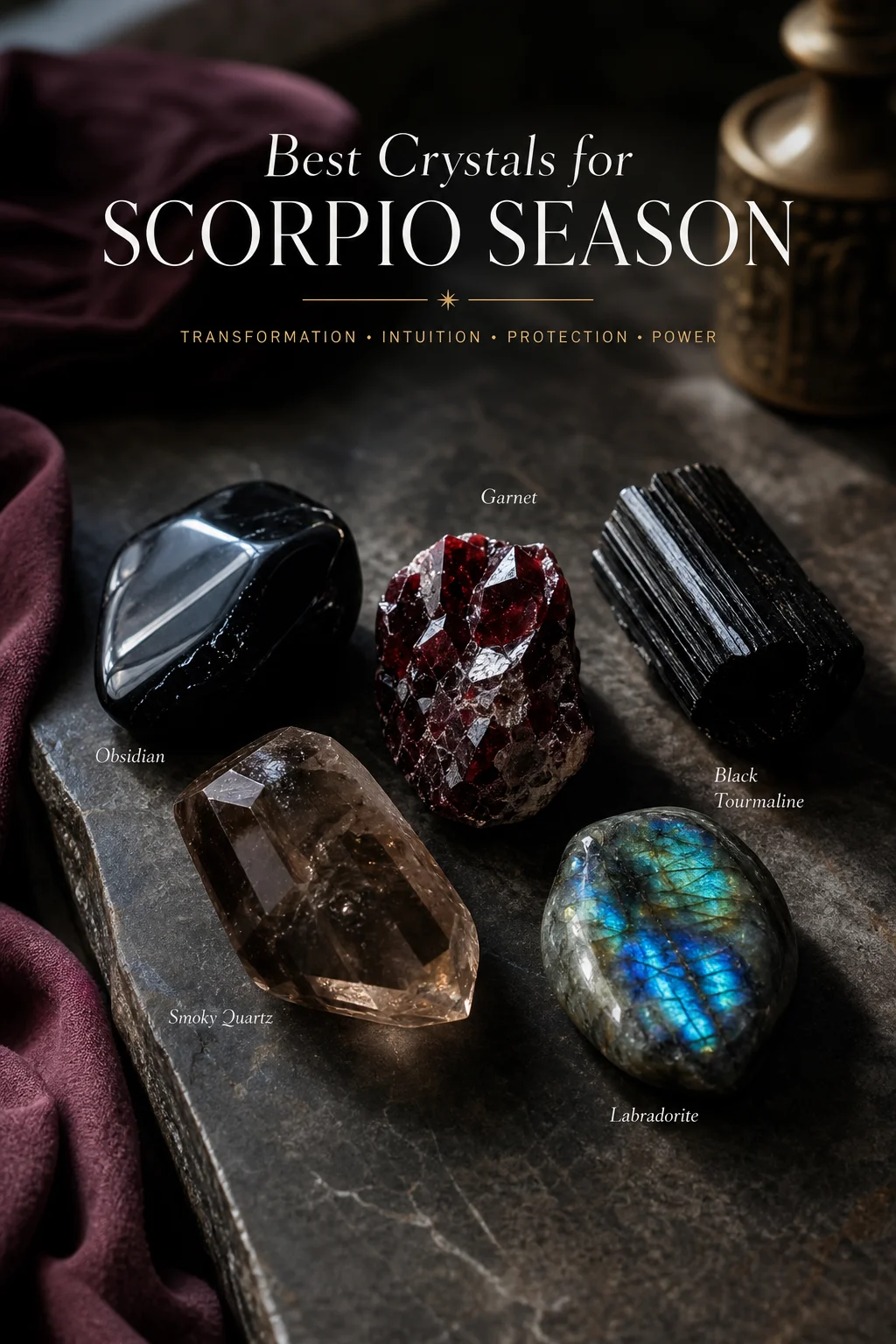
Understanding Scorpio's Seasonal Energy
Scorpio season runs from October 23 to November 21, sitting in the middle of autumn in the Northern Hemisphere. In astrology and crystal collecting traditions, Scorpio is associated with themes of transformation, intensity, depth, and regeneration—the kind of energy that resonates with dark, grounding, and transformative stones. Whether or not you follow astrology, the seasonal timing is significant: as days shorten and temperatures drop in many parts of the world, the visual and emotional shift toward darker, richer colors and more contemplative practices feels natural. The stones traditionally associated with Scorpio season tend to mirror this shift with deep blacks, dark greens, and warm earth tones.
The Top 5 Crystals for Scorpio Season
Topaz: The Scorpio Birthstone
Topaz is the traditional birthstone for November and thus covers the core of Scorpio season. The word "topaz" comes from the Sanskrit "tapas," meaning fire—appropriate for a stone historically associated with warmth and intensity. In its natural state, topaz occurs in a wide range of colors: golden-yellow, blue, pink, reddish-orange, colorless, and rarely green or red. The most common color in nature is actually colorless, with golden and blue being the most commercially significant.
Imperial topaz—a rich golden-orange to pinkish-orange variety—was historically prized in Russia and is the variety most associated with Scorpio season. The color comes from chromium substituting in the crystal lattice, and fine specimens display a warmth that pairs beautifully with autumn wardrobes. Blue topaz, while more commonly available and affordable (most blue topaz on the market is colorless topaz treated by irradiation and heating), carries a cooler energy that contrasts with Scorpio's warm intensity.
Topaz rates 8 on the Mohs hardness scale, making it one of the harder gemstones and suitable for daily-wear rings. It has perfect basal cleavage, however, which means it can split along a specific plane if struck at the right angle. This is a consideration for ring settings—a protective bezel is preferable to a high prong setting for topaz rings.
Citrine: The Golden Scorpio Companion
Citrine's warm golden color naturally aligns with Scorpio season's autumnal energy. As a variety of quartz colored by iron impurities, citrine provides a more accessible alternative to imperial topaz—similar warm tones at a fraction of the price. Most citrine on the market is heat-treated amethyst (heating purple amethyst to 450-500°C drives off the purple color centers and produces yellow to orange tones), but the result is visually indistinguishable from natural citrine for most practical purposes.
For Scorpio season specifically, citrine is often recommended as a pocket stone or meditation companion during the shorter days of late October and November. The warm golden color provides a visual counterpoint to the darkening days, and in crystal collecting practice, citrine is associated with mental clarity and focus—qualities that can feel especially needed during seasonal transitions.
Citrine at Mohs 7 is very durable for bracelets and everyday wear. Clean with soapy water, avoid prolonged sun exposure (which can fade treated material), and store away from harder stones.
Malachite: The Stone of Transformation
Malachite's association with Scorpio season centers on its green banded patterns and its cultural connection to transformation—both themes that align with Scorpio's traditional archetype. Malachite is a copper carbonate mineral (Cu₂CO₃(OH)₂) that forms in botryoidal (grape-like) masses with concentric bands of lighter and darker green. These bands are created by variations in the copper concentration during formation, and each layer represents a slightly different chemical environment.
The vivid green color of malachite comes from copper—specifically, the way copper ions absorb certain wavelengths of visible light. Malachite has been used as a pigment since antiquity (the green paint in Egyptian tomb paintings is often malachite-based), and it remains one of the most visually distinctive ornamental stones available.
Important care notes for malachite: it is relatively soft (Mohs 3.5-4), sensitive to acids (even mild acids like vinegar or lemon juice will react with the copper carbonate surface), and can be damaged by prolonged water exposure. Do not use malachite in direct-contact crystal elixirs—the copper can leach into water, especially acidic water. For jewelry, malachite works best in pendants, earrings, and brooches where it is protected from hard contact. A protective coating (wax or resin) is sometimes applied to malachite cabochons in jewelry to protect the surface.
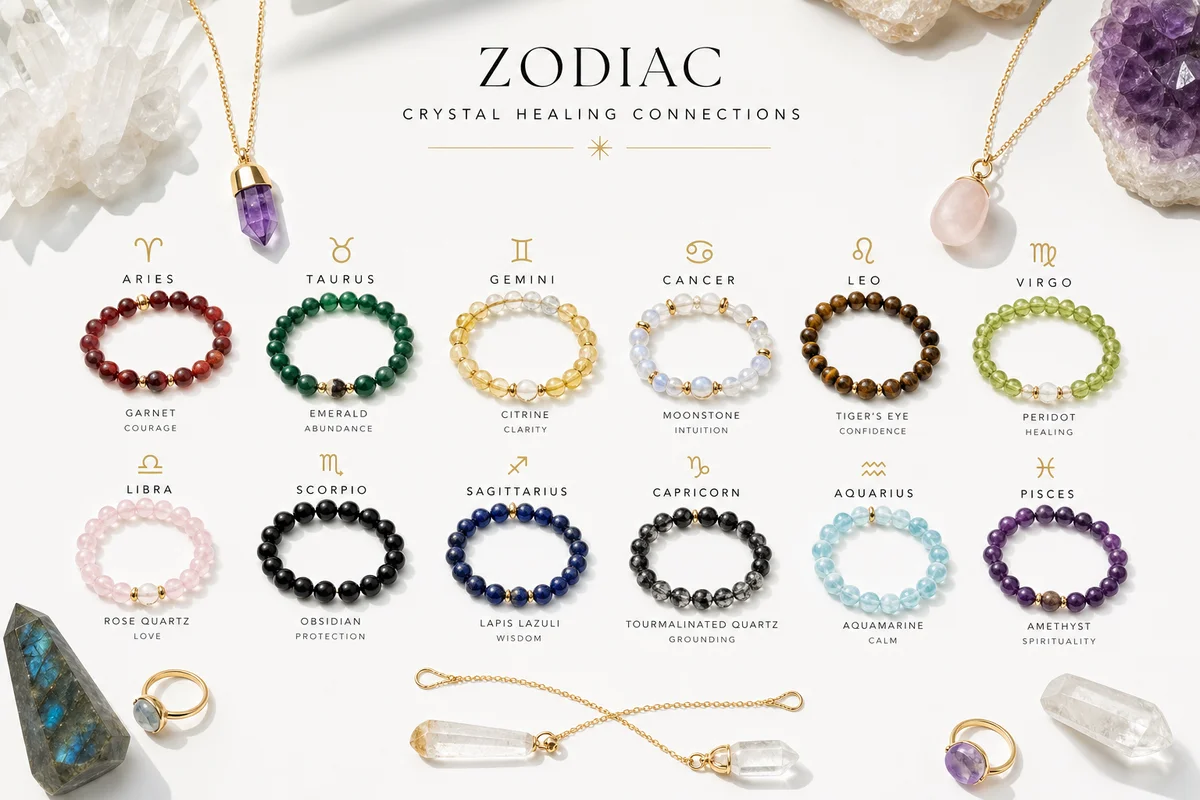
Obsidian: The Deep Grounding Stone
Obsidian is volcanic glass—specifically, it forms when silica-rich lava cools too rapidly for crystals to organize. The result is a natural glass with no crystalline structure (it is technically an amorphous solid rather than a mineral). Obsidian's deep black color and glassy, conchoidal fracture (when broken, it produces curved, shell-like surfaces) have made it one of the most widely used stones in human history—obsidian tools and weapons predate metal by thousands of years.
For Scorpio season, obsidian represents the ultimate grounding and protective stone in crystal collecting tradition. Its dark, opaque quality visually mirrors Scorpio's association with depth and hidden things, while its volcanic origin connects to themes of transformation (lava cooling into solid stone). Rainbow obsidian (which displays iridescent bands when viewed at certain angles, caused by nanoscale inclusions of magnetite) and snowflake obsidian (with white cristobalite inclusions that look like snowflakes) are popular decorative varieties.
Obsidian is technically very hard but brittle—it rates about 5-5.5 on the Mohs scale but can chip or fracture along conchoidal surfaces if struck. Clean with a soft, damp cloth. No water soaking needed and the stone is chemically inert. Handle carved obsidian pieces carefully as thin edges can be surprisingly sharp (obsidian fractures can produce edges sharper than surgical steel, a quality that made it invaluable for ancient tool-making).
Garnet: The Dark Red Stone of Regeneration
Garnet is not a single mineral but a group of related minerals with similar crystal structures but different chemical compositions. The garnet group includes almandine (deep red), pyrope (blood red), spessartine (orange-red), grossular (green, yellow, brown), andradite (green, brown), and uvarovite (emerald green). For Scorpio season, the deep red varieties—almandine and pyrope, and the almandine-pyrope mixture commonly called "red garnet"—are the most relevant.
Red garnet's deep, wine-red to brownish-red color aligns naturally with Scorpio season's darker aesthetic. Garnets are also January's birthstone, which creates a bridge between the end of Scorpio season and the beginning of Capricorn season. The deep red color comes from iron (almandine) or chromium-pyrope substitution in the crystal lattice.
Garnet rates 6.5 to 7.5 on the Mohs scale depending on the variety, making it suitable for all types of jewelry. Red garnets are generally clean (few visible inclusions) and take an excellent polish, producing a warm, rich luster that is particularly attractive in candlelight or low ambient lighting—perfect for the darker days of Scorpio season. Clean with warm soapy water and a soft brush. Ultrasonic cleaners are generally safe for clean garnets.
Building a Scorpio Season Collection
You do not need all five stones to create a meaningful Scorpio season collection. Start with one or two that appeal to you visually and build from there. A popular starting combination is obsidian (for its grounding black) paired with citrine (for its warm golden contrast)—this dark-light pairing mirrors the Scorpio archetype's depth and intensity. Adding malachite for its transformative green creates a three-stone kit that covers black, gold, and green—the three core Scorpio season tones.
For a wearable Scorpio season bracelet, consider combining red garnet beads (8mm), black obsidian beads, and citrine beads on a stretch cord. This trio provides deep red, grounding black, and warm gold in one piece. The garnet adds the birthstone connection, obsidian provides the dark grounding element, and citrine brings the golden warmth that Scorpio season needs.
Seasonal Pairings Beyond Scorpio
These stones work well beyond astrological contexts. The deep, warm color palette of Scorpio season stones is universally appropriate for autumn and winter jewelry and display. A garnet pendant works beautifully with winter sweaters. Obsidian and malachite make striking bookshelf accents during the darker months. Citrine on a desk or windowsill provides visual warmth throughout autumn.
Cleansing and Charging Your Stones During Scorpio Season
Because Scorpio energy revolves around deep emotional transformation, the stones used during this time often absorb heavy, stagnant energies. Stones like black obsidian and malachite are particularly notorious for drawing out toxicity and negative vibrations, making regular cleansing an absolute necessity. Failing to clear your crystals can lead to them becoming energetically saturated, which diminishes their effectiveness and can leave you feeling mentally fatigued. During this intense astrological period, you should aim to cleanse your collection more frequently than usual.
Scorpio is a water sign, making water-based cleansing methods especially potent during late October and November. You can rinse your harder stones (like quartz, obsidian, or garnet) in a natural stream or under running tap water, visualizing emotional debris washing away. For softer, water-soluble stones, try placing them in a bowl of dry brown rice or sea salt. To charge your crystals, leverage the lengthening nights by placing them under the moonlight. The full moon that occurs during Scorpio season is an ideal time to let your stones bathe in lunar rays, balancing the intense, deep-diving Scorpio energy with cooling, reflective light.
Crystal Support for Shadow Work and Meditation
Scorpio season is widely recognized in spiritual practices as the optimal time for shadow work—the process of exploring your subconscious to confront hidden fears, heal old wounds, and release limiting beliefs. Because this internal work requires significant vulnerability and courage, utilizing grounding crystals can provide a necessary energetic anchor. When you delve into deep meditation or reflective journaling sessions, holding a protective stone helps maintain a safe energetic boundary, preventing you from feeling overwhelmed by resurfaced emotions.
To incorporate crystals into your shadow work, begin by creating a quiet, dimly lit space. Hold a piece of smoky quartz or black obsidian in your receiving (non-dominant) hand to absorb and transmute negative energy, while keeping a piece of clear quartz nearby to maintain mental clarity. As you meditate or write down what you wish to transform, visualize the darker stone pulling dense emotional blockages out of your aura. For added stability, place a piece of red garnet near your root chakra (at the base of your spine) to keep you securely tethered to the physical present while you explore your psychological depths.
Frequently Asked Questions
Can I use these Scorpio crystals during other seasons?
Yes. Crystal selection is personal and seasonal associations are guidelines, not rules. If deep red garnet speaks to you in July, wear it in July. The seasonal framework is useful for building a collection with variety, not for restricting when you use specific stones.
Is black obsidian the same as onyx?
No. Black obsidian is volcanic glass (amorphous, no crystal structure). Black onyx is a variety of chalcedony (microcrystalline quartz). They look similar—both are black and opaque—but are completely different materials with different properties. Obsidian is slightly softer, more brittle, and has a glassier luster. Onyx is harder and more durable for daily jewelry wear.
What is the most affordable way to start a Scorpio season crystal kit?
Tumbled stones are the most budget-friendly option. Black obsidian tumbles run $2-5, citrine tumbles $3-8, and red garnet tumbles $5-10. A mixed Scorpio-season stretch bracelet with these three stones typically costs $15-25. Malachite and imperial topaz will be the most expensive items—consider them as upgrades rather than starting points.
Frequently Asked Questions
How can crystals help with Scorpio's intense emotional energy?
Scorpio season often brings deep emotional shifts and heightened intuition. Crystals like Labradorite and Smoky Quartz act as energetic anchors, grounding your spirit while providing a protective shield. Wearing these natural stones in handcrafted jewelry allows their stabilizing properties to stay close to your aura, helping you navigate emotional depths with clarity and calm.
What is the best crystal jewelry to wear for Scorpio season?
For Scorpio season, Malachite and Black Tourmaline jewelry are exceptional choices. An artisan-crafted pendant or ring keeps these transformative stones directly touching your skin, maximizing their grounding benefits. At SagStone, we design our natural crystal pieces to beautifully support your spiritual journey through Scorpio's transformative waters while offering daily emotional balance.
Comments