Benitoite: California's Rare Blue Sapphire Im...
June 5, 2026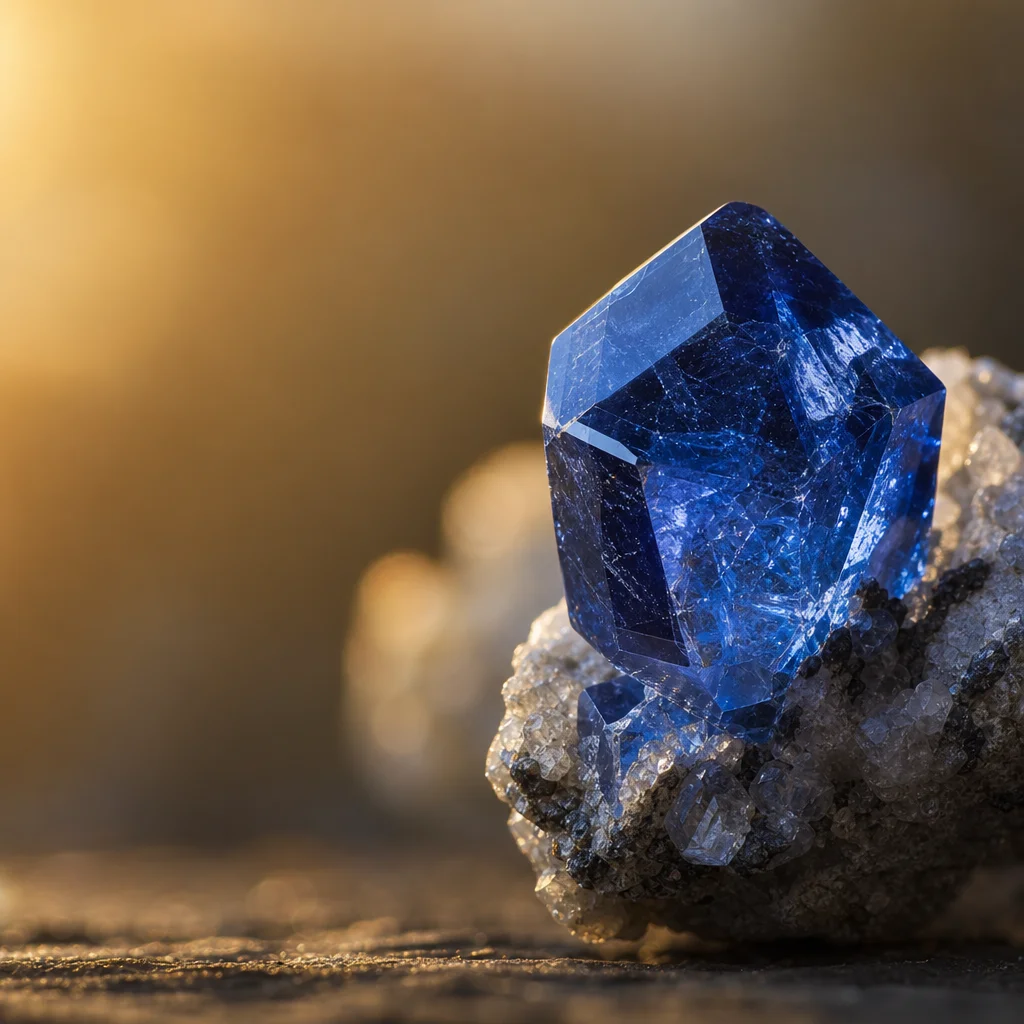
The Rarest Gemstone You've Never Heard Of
Benitoite is a barium titanium silicate mineral with the formula BaTiSi₃O₉. It's one of the rarest gemstones on Earth, mined commercially from exactly one location on the entire planet: the Diablo Range in San Benito County, California. No other deposit of gem-quality benitoite has ever been discovered, making it arguably the rarest geographically restricted gemstone in commercial use.
When benitoite was first discovered in 1907 by prospector James M. Couch, it was initially mistaken for sapphire. The blue color is similar enough that the confusion is understandable — both stones show rich blue hues that can look nearly identical in certain lighting. It wasn't until the material was sent to the University of California for analysis that its true identity as a previously unknown mineral was established. The name "benitoite" honors San Benito County, the site of its discovery.
The Crystal Structure: Trigonal Rarity
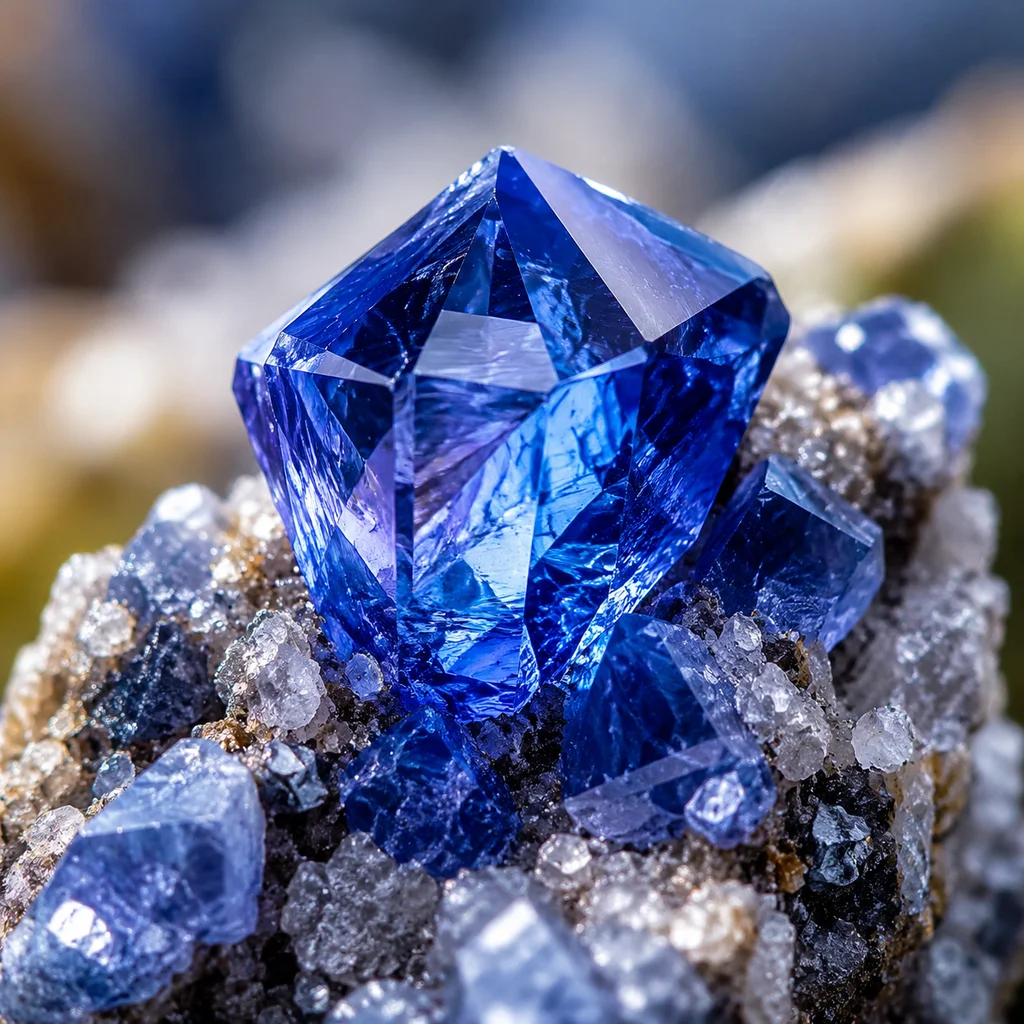
Benitoite crystallizes in the ditrigonal pyramidal crystal system, which is an extremely uncommon symmetry in minerals. This crystal system produces a distinctive triangular crystal habit — benitoite crystals are naturally triangular in cross-section, often showing flat, triangular faces at both termination and base. This triangular morphology is so characteristic that experienced collectors can identify benitoite from its crystal shape alone.
The symmetry also produces interesting optical effects. Benitoite is uniaxial positive with a refractive index of 1.757-1.804, which gives it reasonable brilliance when well-cut. The birefringence is 0.047, meaning some doubling of back facet edges is visible under magnification — a useful identification feature that distinguishes it from sapphire (birefringence 0.008, essentially no doubling).
The crystal habit is often described as "sapphire-like" because the triangular cross-section and occasional pyramidal terminations superficially resemble sapphire's hexagonal form. But the symmetry is fundamentally different: benitoite has three-fold rotational symmetry, while sapphire has six-fold symmetry. This is a subtle but definitive distinction visible under close examination.
The Signature Blue Fluorescence
If there's one diagnostic test for benitoite, it's the fluorescence. Under short-wave ultraviolet light (254nm), benitoite emits a vivid, intense blue fluorescence that's among the strongest of any gemstone. The fluorescence is so bright and distinctive that it's become benitoite's single most identifying characteristic — if you have a blue stone that glows intensely blue under short-wave UV, there's a very short list of candidates, and benitoite leads it.
This fluorescence is useful for identification because it distinguishes benitoite from both natural blue sapphire (which typically shows little to no fluorescence) and synthetic blue spinel (which fluoresces red). The combination of blue fluorescence + triangular crystal habit + high birefringence is essentially unique to benitoite.
Under long-wave UV (365nm), the fluorescence is weaker but still present. Some specimens show a slightly different hue under long-wave vs. short-wave — short-wave tends to be a brighter, more saturated blue.
Color Range and Quality
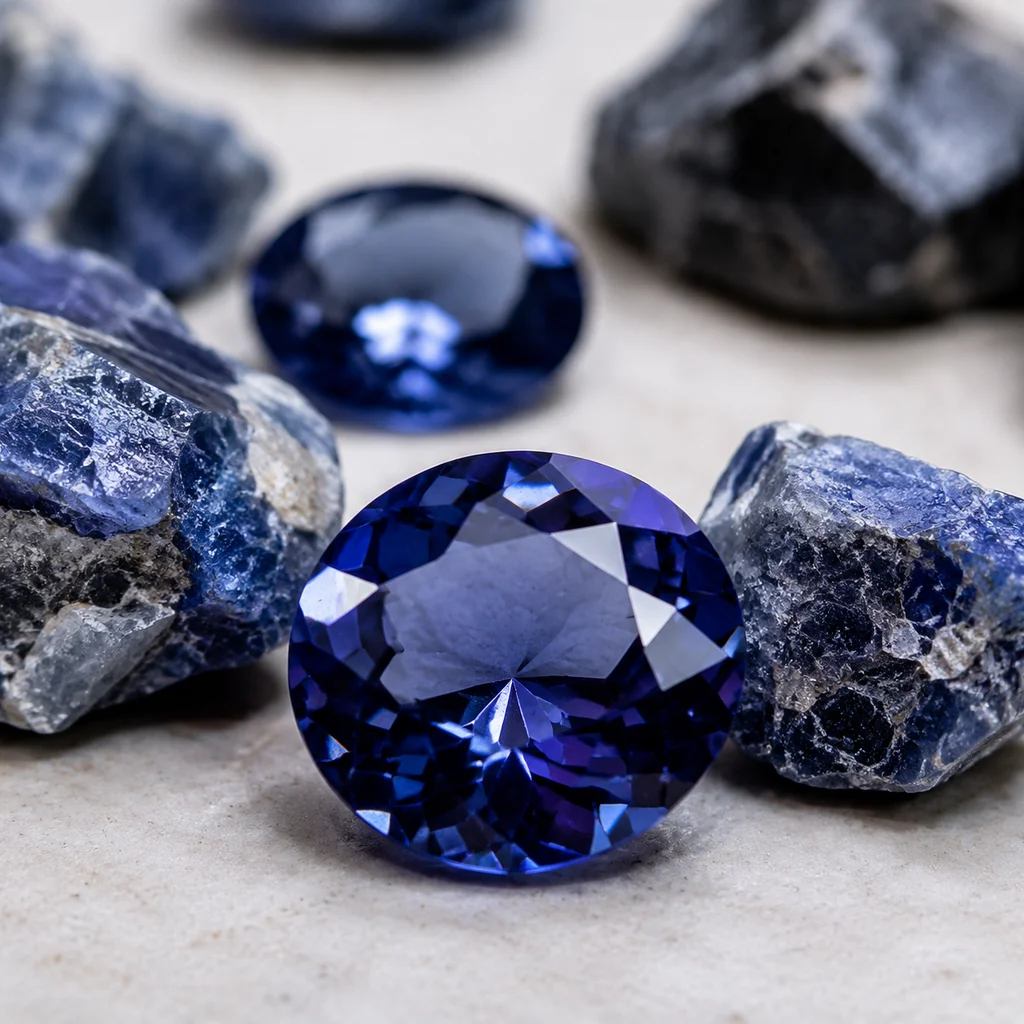
The finest benitoite shows a vivid sapphire-blue color that rivals the best Kashmir sapphires. Most gem-quality material falls in the medium blue to slightly violet-blue range. Pale blue specimens exist but are less commercially desirable. Colorless to white benitoite is rare and mainly of mineralogical interest.
Color in benitoite comes from trace amounts of iron in the crystal structure. The iron content is typically very low (a few hundred parts per million), but it's sufficient to produce the blue color through charge transfer mechanisms between iron and titanium — a similar process to what produces blue in sapphire, though the specific crystal chemistry differs.
The best blue benitoite shows reasonable color from all directions because its pleochroism, while present, isn't extreme. This is a practical advantage over some sapphires where the strongest color is visible only from one direction and the stone looks pale from others.
Benitoite vs. Sapphire: The Key Differences
The initial confusion between benitoite and sapphire is understandable given their similar blue color, but the two minerals differ in nearly every other physical property:
Hardness: Benitoite is 6-6.5 on the Mohs scale. Sapphire is 9. This is the most practically significant difference — benitoite is much softer and more susceptible to scratching in daily wear. Sapphire is suitable for daily-wear rings; benitoite is better reserved for pendants, earrings, and occasional-wear pieces.
Density: Benitoite has a specific gravity of 3.64-3.68. Sapphire is 3.98-4.05. A benitoite of the same visual size as a sapphire will weigh noticeably less — roughly 10% lighter. This is detectable with a precision scale and is a useful identification feature.
Crystal habit: Benitoite forms triangular cross-section crystals. Sapphire forms hexagonal cross-section crystals. This is definitive for loose or rough specimens.
Fluorescence: Benitoite glows blue under short-wave UV. Sapphire typically doesn't fluoresce.
Birefringence: Benitoite has strong birefringence (0.047), visible as doubling of facet junctions under magnification. Sapphire's birefringence is very weak (0.008) with no visible doubling.
The Dallas Gem Mine: The Only Source
All gem-quality benitoite has come from a small area near the headwaters of the San Benito River in central California. The primary deposit, known as the Dallas Gem Mine (or simply the Benitoite mine), has been the sole commercial source since the mineral's discovery in 1907. The mine has changed hands multiple times and has operated intermittently — periods of active mining have alternated with long closures due to economic conditions, access difficulties, and environmental regulations.
The geological setting is unusual: benitoite occurs in a glaucophane schist — a high-pressure, low-temperature metamorphic rock formed in a subduction zone. The specific conditions required for benitoite formation (barium and titanium-rich fluids at high pressure but relatively low temperature) explain why the mineral is so rare. These exact geochemical conditions simply don't occur in many places on Earth.
Attempts to find additional benitoite deposits elsewhere in California and in other parts of the world have been largely unsuccessful. Trace amounts of benitoite have been identified in a few other locations (Japan, Arkansas, and a few European localities), but never in gem-quality concentrations.
California State Gem
In 1985, California designated benitoite as the official state gemstone. The choice reflects both the mineral's exclusivity to California and its visual appeal. Benitoite joins a select group of state gemstones that are unique to their state — not all state gems have this distinction.
The California State Gem designation has raised awareness of benitoite among collectors and amateur geologists, but the stone remains relatively unknown to the general public. Most people, even within California, have never seen a benitoite specimen. This obscurity is partly due to scarcity and partly because the mine has produced limited quantities — annual production has always been small, and fine gem-quality material above 1 carat is genuinely rare.
Value and Market
Benitoite is expensive because of its rarity and the limited supply from a single source. Prices for faceted gems range from roughly $500-1,500 per carat for stones under 1 carat with good color, to $1,000-5,000+ per carat for larger stones with fine blue color and good clarity. Stones over 2 carats are quite rare and can command exceptional prices.
Mineral specimens with well-formed triangular crystals and associated minerals (neptunite, joaquinite — both also rare species found at the same locality) are also valuable, often selling for $200-2,000+ depending on crystal size and quality. The three-mineral association of benitoite + neptunite + joaquinite is one of the most prized assemblages among mineral collectors.
The benitoite market is thin — there aren't many buyers or sellers at any given time. This means prices can be volatile and finding specific qualities you want may take time. Building a benitoite collection requires patience and connections within the mineral dealer community.
Care and Wearing
With a hardness of 6-6.5, benitoite requires careful handling. It's harder than glass but softer than many common materials that could scratch it during daily wear. Pendants and earrings are ideal because they receive minimal impact. Rings should be set in protective mountings and worn for occasions rather than daily use.
Clean with warm, soapy water and a soft brush. Ultrasonic cleaners carry some risk because the stone may have internal inclusions or cleavage-related stress points. No harsh chemicals, no sudden temperature changes. Store separately from harder stones.
Frequently Asked Questions
Why isn't benitoite more famous?
Scarcity. With only one mine source, annual production has always been tiny compared to diamonds, sapphires, or even most semi-precious stones. Jewelers can't stock it because there isn't enough supply. The mineral collector market knows it well, but the gem-buying public has never had enough exposure for it to become mainstream. It's genuinely a collector's stone rather than a commercial gem.
Is the mine still active?
The mine has been intermittently active since 1907. As of recent years, production has been very limited. Access has been restricted by both private property concerns and environmental regulations. Some specimen collecting continues through authorized access, but commercial-scale mining for gem rough is essentially dormant. Most benitoite on the market comes from older production periods.
Can I find benitoite myself?
Occasionally, fee-digging opportunities have been available at the mine site, but access is currently very limited. The mine is on private property in a remote area of the Diablo Range, and unauthorized collecting is trespassing. Check with local rock and mineral clubs for the most current access information. When digging is permitted, finding benitoite requires screening and careful examination of concentrate — the crystals are small and easily overlooked.
Frequently Asked Questions
Can benitoite be worn as an everyday ring?
Benitoite rates between 6.0 and 6.5 on the Mohs hardness scale, making it softer than a traditional sapphire or diamond. While it makes a breathtaking engagement ring, it requires a protective setting, like a bezel, to keep the edges safe. We recommend removing your handcrafted benitoite jewelry before heavy tasks to preserve its brilliant fire.
Does benitoite actually glow under UV light?
Yes, one of the most magical traits of natural benitoite is its strong blue fluorescence under shortwave ultraviolet light. High-quality stones will actually glow in the dark. This rare optical
Comments