Art Deco Jewelry History: A Complete Guide to the Golden Age
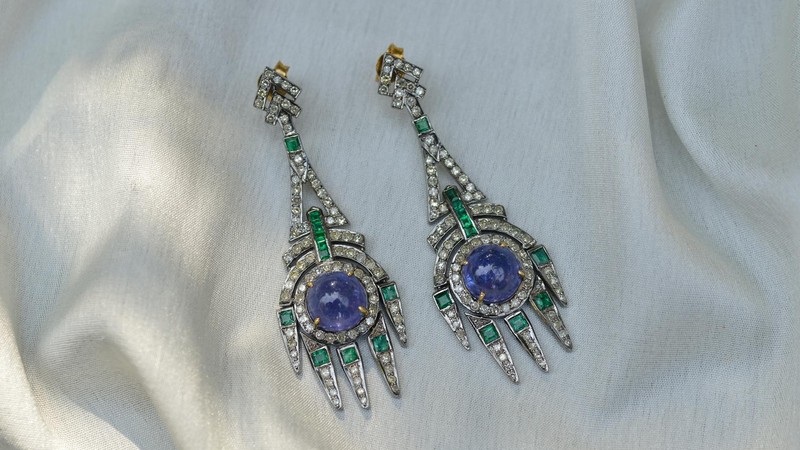
A few years back, I tagged along with a friend to a small auction house in lower Manhattan. I wasn't there for anything specific — just killing a Saturday afternoon. But when they brought out lot 47, a platinum bracelet circa 1925, I stopped scrolling through my phone and leaned forward. The thing was mesmerizing. Perfectly symmetrical geometric panels, each one set with alternating onyx and diamond triangles, connected by calibré-cut emerald links. It looked like someone had taken the skyline of a Chrysler Building and shrunk it down to wrist size. My friend, who'd been collecting for years, whispered, "That's peak Art Deco. You don't see craftsmanship like that anymore." He was right. I ended up spending the next three months down a rabbit hole, reading everything I could find about Art Deco jewelry history. Here's what I learned.
The World That Made Art Deco Jewelry (1920–1935)
Art Deco didn't just appear out of thin air. It was born from a very specific moment in history. World War I ended in 1918, and the world was ready to party. The 1920s brought unprecedented economic prosperity, at least in Western cities. Women had just won the right to vote in many countries. Hemlines were rising. Jazz was exploding. And the old Victorian aesthetic — all those frilly, nature-inspired, sentimental designs — felt like something from another century. Because it was.
The name "Art Deco" comes from the 1925 Exposition Internationale des Arts Décoratifs et Industriels Modernes in Paris, a massive design fair that showcased this new aesthetic to the world. But the style had been percolating since around 1910, influenced by Cubist painting, Egyptian art (Tutankhamun's tomb was discovered in 1922 and sent shockwaves through the design world), and the clean lines of modern machinery. People were obsessed with speed, technology, and the future. Jewelry reflected that. Where Victorian pieces whispered sentiment, Art Deco pieces shouted confidence.
The Golden Age of Art Deco jewelry ran roughly from 1920 to 1935. After that, the Great Depression and then World War II shifted priorities, and the style softened into what we now call Retro Moderne. But those fifteen years produced some of the most iconic jewelry ever made.
Victorian vs. Art Deco: A Complete Visual Breakdown
If you've ever tried to tell the difference between Victorian and Art Deco jewelry at a glance, here's the shortcut: Victorian is organic, Art Deco is geometric. Victorian pieces feature flowing curves, botanical motifs, and asymmetrical arrangements meant to look natural. Art Deco pieces feature straight lines, sharp angles, and perfect symmetry meant to look engineered.
But it goes deeper than shapes. Victorian jewelry was deeply personal and sentimental. Lockets held hair and miniature portraits. Rings were engraved with secret messages. Everything told a story, usually about love or loss. Art Deco jewelry, by contrast, was about style and modernity. A 1920s brooch wasn't meant to commemorate your grandmother — it was meant to make you look fabulous at a cocktail party. The shift was from emotional to aesthetic, from intimate to public.
Materials changed too. Victorian jewelry favored yellow gold, often alloyed to look rosy. Art Deco designers went hard on platinum and white gold, which gave their pieces a cooler, more contemporary feel. Color palettes shifted from the warm rainbow of garnets and amethysts to high-contrast combinations: black onyx against white diamonds, emerald green against platinum, sapphire blue against rock crystal. It was bold, dramatic, and unmistakably modern.
What Makes Art Deco Jewelry So Distinctive
Geometric Patterns and Perfect Symmetry
This is the hallmark. Circles, triangles, chevrons, hexagons, stepped pyramids, fan shapes — Art Deco jewelry is built on geometry. And not loose, organic geometry. We're talking mathematical precision. A properly made Art Deco piece is often perfectly symmetrical, mirror-image on both sides. This wasn't accidental. It reflected the era's fascination with order, technology, and the machine age. Designers thought of their jewelry almost like architecture you could wear.
High-Contrast Color Blocking
Art Deco designers loved contrast. The most iconic combination was black and white — onyx and diamond, or black enamel and platinum. But they also paired emeralds with rubies, sapphires with coral, and rock crystal with opaque stones. The effect was graphic and striking, almost like a painting by Mondrian translated into precious materials. Nothing was muted. Everything popped.
The Machine Aesthetic
This is harder to define but easy to feel. Art Deco jewelry has a mechanical quality — smooth surfaces, clean lines, industrial textures. Some pieces literally incorporated mechanical elements, like hidden watch faces or convertible brooches that could be worn as clips. The movement celebrated human engineering, and that pride shows up in the metalwork. Finishes were often mirror-polished or featured precise milgrain edges that looked almost machined.
Calibré Cuts and Unusual Gemstone Shapes
Before Art Deco, most gemstones were cut into rounds or ovals. The Art Deco era introduced calibré cutting — shaping stones specifically to fit together like tiles in a mosaic. You'll see long thin rectangles, trapezoids, triangles, and half-moons set seamlessly side by side. This technique allowed designers to create solid fields of color within geometric frameworks. It's incredibly labor-intensive and one of the reasons genuine Art Deco pieces are so valuable today.
Classic Art Deco Jewelry Pieces You Should Know
The Sautoir (Long Necklace)
If there's one piece that defines 1920s jewelry, it's the sautoir. These impossibly long necklaces — often reaching the waist — were designed to be worn with the flapper dresses of the era. They typically featured a tassel or pendant at the bottom and could be draped, doubled, or knotted. The best ones mixed pearls, onyx, and rock crystal in geometric patterns. Wearing a sautoir properly requires the kind of confidence that defined the whole decade.
Wide Bracelets and Cuff Bands
The bracelet I saw at that auction was a classic example. Art Deco bracelets tend to be wide — sometimes two or three inches across — and rigid. They're built around geometric panels connected by hidden hinges, covered in pavé diamonds and colored stones. The wider the bracelet, the more impressive the engineering, because platinum is hard to work with and the settings need to be both beautiful and durable enough for daily wear.
Double Clips and Dress Clips
Before the 1920s, brooches were mostly single pins. Art Deco introduced the double clip — two matching brooches that could be worn together as one large piece or separated and worn individually on lapels, collars, or hat brims. These clips were wildly popular and came in every shape imaginable: fans, circles, stylized flowers, and abstract geometric forms. Cartier's "Dress Clips" became status symbols.
Chandelier Earrings
With bobbed haircuts exposing the neck and ears, long dangling earrings suddenly made sense. Art Deco chandelier earrings feature cascading geometric elements — diamonds, emeralds, and sapphires set in articulated platinum frames that catch light with every movement. They're dramatic, theatrical, and unmistakably Art Deco.
Bandeaux and Hair Combs
The bobbed haircut also created demand for headpieces. Bandeaux — wide decorative bands worn across the forehead — and ornamental hair combs became essential accessories. These pieces often featured the same geometric patterns as the necklaces and bracelets, creating a coordinated look. Some bandeaus converted into chokers or bracelets, showing the clever versatility that Art Deco designers loved.
Materials: What Art Deco Jewelry Was Actually Made From
Platinum was the metal of choice, and it changed everything. Platinum is harder than gold, stronger than silver, and can be drawn into incredibly fine wires and sheets. This meant jewelers could create delicate, lacy-looking structures that were actually tough enough to hold heavy gemstones securely. White gold emerged during this period too, as a more affordable alternative. You'll see yellow gold in some late-period Art Deco pieces, but it's less common.
Diamonds were the foundation — always. But the way they were used changed. Instead of large solitaires, Art Deco designers favored many small diamonds set together to create sparkling surfaces. The old mine cut and European cut gave way to transitional cuts and eventually the modern brilliant cut, which maximized fire and brilliance under the new electric lighting that was transforming cities.
Colored gemstones became bolder. Onyx provided stark black contrast. Emeralds — especially Colombian emeralds — added rich green. Sapphires in deep blue and coral in vivid orange were popular. The 1922 discovery of Tutankhamun's tomb sparked an "Egyptian craze" that brought lapis lazuli, turquoise, and carnelian into high jewelry for the first time in decades. Jade also gained traction as trade with China increased.
New Materials: Rock Crystal and Enamel
Two materials deserve special mention. Rock crystal — natural clear quartz — was cut and polished to look like ice, and Art Deco jewelers used it everywhere, often carved into bold geometric forms or used as a diamond substitute in large-scale pieces. Black enamel was the other game-changer. Applied in precise geometric patterns, it created the sharp black lines and fields that make Art Deco jewelry instantly recognizable.
The Big Three: Maisons That Defined Art Deco Jewelry
Cartier
If one house could claim to have invented Art Deco jewelry, it's Cartier. Louis Cartier and his designers — particularly Charles Jacqueau — were at the forefront of the geometric revolution from the very beginning. Cartier's "Tutti Frutti" pieces, which combined carved Indian gemstones (emeralds, rubies, sapphires) with platinum and diamonds in Art Deco settings, remain some of the most sought-after antique jewelry in the world. Their Panthère motif, though it peaked later, has its roots in this era. Cartier also pioneered the use of platinum in high jewelry, setting a standard that everyone else followed.
Van Cleef & Arpels
Founded in 1896 but hitting their stride in the 1920s, Van Cleef & Arpels brought a slightly softer geometric sensibility to Art Deco. Their "Minaudière" — a small decorative case that held makeup, cigarettes, and a dance card — became the ultimate evening accessory. They were also famous for their "Serti Mystérieux" (Mystery Setting), an invisible setting technique where gemstones are mounted without any visible metal prongs. The effect is a seamless surface of color, and it's still one of the most technically impressive achievements in jewelry making.
Chaumet
Chaumet had been around since 1780 and had made jewelry for Napoleon's court, so they came into the Art Deco era with serious pedigree. Their contribution was a more refined, aristocratic take on the geometric style. Where Cartier was bold and Van Cleef was innovative, Chaumet was elegant. Their tiaras and headpieces from this period are museum-quality, featuring impossibly fine platinum work and perfectly graduated diamond settings. They also created some of the era's most beautiful sautoirs and transformable pieces.
How to Tell Real Art Deco Jewelry From Reproductions
With Art Deco's continuing popularity, the market is flooded with reproductions and "Art Deco-inspired" pieces. Here's what to look for if you want the real thing.
First, check the craftsmanship under magnification. Genuine Art Deco pieces were hand-finished, but the finishing was meticulous. Look for fine milgrain edges — tiny beaded borders along the metal — that show even spacing and consistent size. Machine-made milgrain from modern reproductions tends to be too uniform or too irregular. Hand-engraved patterns should show slight variation that reveals a human hand. The backs of pieces matter too: genuine Art Deco jewelry is often as well-finished on the back as the front, with polished metal and carefully set stones even in hidden areas.
Second, examine the gemstone cuts. Real Art Deco pieces will have period-appropriate cuts: old European cuts, transitional cuts, single cuts, and calibré-cut stones shaped to fit their settings. If you see modern brilliant cuts or laser-cut calibrated stones, it's likely a reproduction. The facet patterns on genuine old cuts are visibly different — slightly off-center, with smaller tables and higher crowns.
Third, look at the construction. Art Deco pieces from the 1920s used platinum almost exclusively, and the metalwork is often surprisingly light and delicate for its strength. Reproductions in white gold or modern platinum tend to be heavier and bulkier. Hinges, clasps, and safety catches should show period-appropriate design — box clasps with figure-eight safety catches for bracelets, threaded screw-backs for earrings (not posts), and double-pin mechanisms for brooches.
Modern Art Deco: How the Style Lives On
Art Deco jewelry never really went out of style. It went through phases — quiet in the 1940s and 50s, revived in the 1960s and 70s, respected in the 80s and 90s — but it's been consistently influential for a century now. Today's designers reference Art Deco constantly, though usually in simplified form.
Contemporary Art Deco-inspired pieces tend to keep the geometric shapes and high-contrast color schemes but simplify the craftsmanship. You'll find plenty of modern engagement rings with step-cut diamonds (emerald or Asscher cuts) in geometric halos that echo Art Deco aesthetics. Stackable rings with black and white patterns, geometric pendant necklaces, and angular ear cuffs all owe a debt to the 1920s. The difference is that modern pieces are usually mass-produced, whereas original Art Deco was handcrafted at enormous expense.
For collectors, the original pieces remain the gold standard. A signed Cartier bracelet from 1925 can sell for six or seven figures at auction. But you don't need that budget to appreciate the style. Even unsigned Art Deco brooches, dress clips, and rings are available at more accessible price points, and they carry a hundred years of history in every geometric angle. I still think about that bracelet from lot 47 sometimes. It sold for more than I could afford. But the shape of it — those alternating triangles, that confident symmetry — stayed with me. Once you really see Art Deco jewelry, you start noticing it everywhere.
Comments