Amethyst Crystal Guide: Meaning, Properties & How to Use It
What Makes Amethyst Purple?
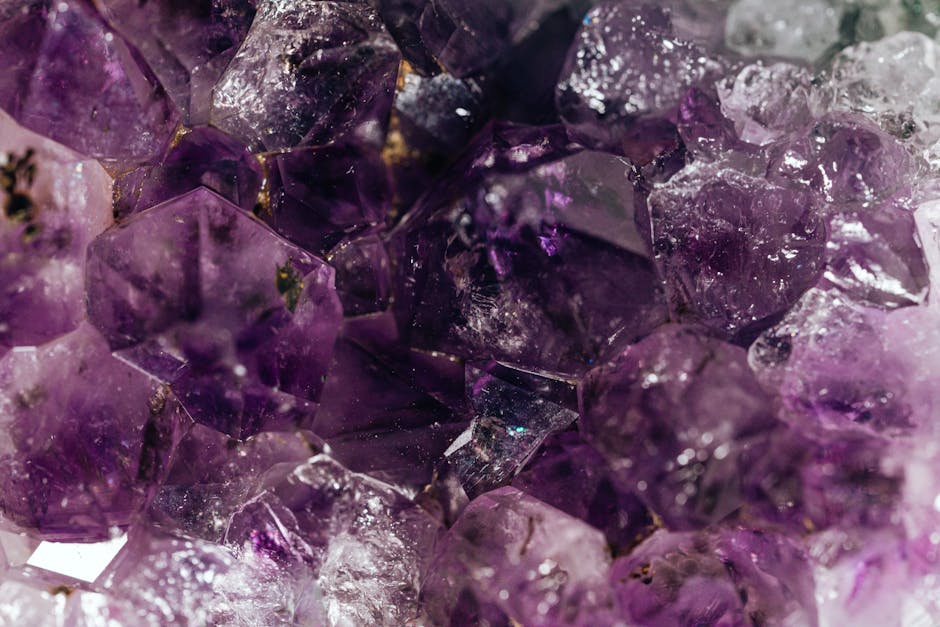
Amethyst is a purple variety of quartz (SiO₂), and its color comes from a combination of iron impurities and natural radiation. Here's the specific mechanism: trace amounts of iron (Fe³⁺) replace some silicon atoms in the quartz crystal lattice. On their own, these iron-bearing crystals are actually a pale yellow or colorless. The purple happens when natural radiation from surrounding rocks — primarily from potassium-40 in the Earth's crust — interacts with these iron atoms, oxidizing them to Fe⁴⁺ and creating color centers that absorb certain wavelengths of light. The light that passes through is what we perceive as purple.
The depth of the purple depends on how much iron is present and how much radiation exposure the crystal received during formation. More iron plus more radiation equals deeper purple. This is why amethyst from different locations has such dramatically different colors — the local geology determines both the iron content of the mineralizing fluids and the radiation environment during crystallization.
Heating amethyst reverses this process. At temperatures around 470-750°F (250-400°C), the color centers break down and the iron returns to its non-colored state. If the iron content is in the right range, the stone turns a yellow-to-orange color, which is sold as citrine. Most commercial citrine on the market is actually heat-treated amethyst — natural citrine is much rarer and has a different color profile (more pale yellow, less orange). If the heating is done precisely, you can even get a bicolored stone called ametrine, where part of the crystal was heated enough to turn yellow while the rest stayed purple.
Where the Best Amethyst Comes From
Amethyst is found worldwide, but three locations dominate the market, and each produces material with distinct characteristics.
Brazil: The Volume Leader
Brazil is the world's largest producer of amethyst by a wide margin. The state of Rio Grande do Sul in southern Brazil is the epicenter of commercial amethyst mining, particularly around the town of Ametista do Sul (literally "Amethyst of the South"). The geodes from this region are enormous — it's common to find cavities several feet across lined with thousands of crystals. These large geodes are what you see in museum displays and high-end mineral shops.
Brazilian amethyst tends toward medium purple with a slightly reddish or bluish undertone, depending on the specific mine. The color is usually fairly even within a single crystal but can vary significantly between different geodes from the same region. Brazilian material also tends to form in larger, more robust crystals, which makes it popular for both specimen collectors and gem cutters.
The mining operations in southern Brazil range from large commercial operations to small family-run mines. Much of the material is sold as geode halves, decorative clusters, and tumbled stones, with only the highest-quality material being cut into faceted gems.
Uruguay: The Color Champion
Uruguayan amethyst is widely considered the finest in the world for color. The mines in the Artigas department, near the Brazilian border, produce material with a deep, saturated purple that Brazilian stones rarely match. The best Uruguayan amethyst has an almost blue-purple color with excellent saturation — gemologists describe it as having a "grape jelly" or "Siberian" color, though the latter term is technically a misnomer since true Siberian amethyst from Russia is no longer commercially available.
Uruguayan geodes tend to be smaller than Brazilian ones, and the crystals often have better color zoning — you'll see sharp bands of deep purple alternating with clearer quartz within a single crystal. This zoning is actually a record of changing conditions during formation: variations in iron content and temperature that occurred as the crystal grew over thousands of years.
The trade-off is price. Uruguayan amethyst commands a premium over Brazilian material, sometimes 2-3 times the price per kilo for equivalent quality. For collectors and jewelry makers who prioritize color depth, the premium is generally considered worthwhile.
South Korea: The Collectible Rarity
South Korean amethyst is less common in the commercial market but highly valued by mineral collectors. The deposits around Seoul and in the Gyeonggi province produce small but intensely colored crystals with a distinctive deep purple that sometimes has a slight reddish flash. The crystals are typically smaller than South American material — often under 2 inches — but the color saturation can be exceptional.
Korean amethyst has been mined for centuries and holds cultural significance in East Asia. Historically, purple was associated with royalty and high status across much of East Asia, and amethyst was one of the few naturally purple materials available. Today, Korean amethyst is primarily a collector's mineral, and fine specimens can command high prices relative to their size.
Physical Properties That Matter
Understanding amethyst's physical properties helps you evaluate quality and care for your pieces properly.
Hardness and Durability
Like all quartz, amethyst scores 7 on the Mohs hardness scale. This puts it in the "good for everyday wear" category for jewelry — harder than steel, glass, and most household surfaces, but softer than topaz, sapphire, and diamond. An amethyst ring will last years with normal wear, but it will eventually accumulate small scratches. Pendants and earrings, which receive less contact, can last decades without visible wear.
The main vulnerability isn't scratching but chipping at facet junctions (the sharp edges where cut facets meet). These points are thin and can chip if the ring knocks against a hard surface. Protective settings (bezel settings or halo settings that surround the stone) help mitigate this.
Cleavage and Fracture
Amethyst has no cleavage, meaning it doesn't have natural planes of weakness where it prefers to break. It fractures conchoidally — like thick glass — which is actually beneficial for durability. Stones with strong cleavage (like diamond or kunzite) can split along their cleavage planes if hit at the right angle. Amethyst doesn't have this weakness, so it's less prone to catastrophic breakage from accidental impact.
Pleochroism
Amethyst is weakly pleochroic, meaning it shows slightly different colors when viewed from different angles. You might notice a subtle shift between reddish purple and bluish purple as you rotate the stone. This is a genuine property of the crystal structure, not an optical illusion, and it's one of the characteristics that gemologists use to distinguish natural amethyst from some synthetic alternatives.
Color Quality: How to Evaluate Amethyst
Color is the single most important factor in amethyst value. Here's how to evaluate it:
Depth of color: Deep, saturated purple is the most valued. Pale lavender material is common and inexpensive. The ideal is a rich, medium-dark purple that's still transparent enough to see into the stone. Material so dark that it appears nearly black is less desirable because the stone loses its liveliness.
Color consistency: Even color throughout the stone is generally preferred, especially in faceted gems. However, some color zoning — bands or patches of different purple intensity — can be attractive in larger stones and is often considered a feature rather than a flaw in specimen-grade material.
Color tone: The "best" tone is subjective, but most gemologists favor a primary purple with a slight reddish or bluish secondary tone. Pure purple without obvious undertones is also highly valued. Material that looks more pink or more blue than purple is less typical and often less expensive.
Color change under different light: Amethyst can look different under incandescent light (warm, slightly redder) versus fluorescent or daylight (cooler, slightly bluer). High-quality material maintains attractive color under both lighting conditions.
How Heat Treatment Changes Amethyst
Heat treatment is one of the most important processes in the commercial amethyst market, and understanding it helps you make informed buying decisions.
When amethyst is heated to approximately 470-750°F (250-400°C), the color centers that create the purple color break down. If the stone has the right iron content, it turns yellow to orange-brown — becoming what the trade calls "citrine." If heated more gently or for a shorter time, the purple can lighten without fully converting to yellow, producing a paler purple material. If only part of the crystal is heated (or if temperature gradients exist within a large crystal during heating), you get ametrine — a stone that's part purple and part yellow.
The key point: most of the "citrine" and "ametrine" on the market started as amethyst. Natural citrine exists but is relatively rare and has a paler, more subtle color than heat-treated material. Natural ametrine comes primarily from one mine in Bolivia (the Anahí mine), and genuine Bolivian ametrine has characteristic zoning patterns that are difficult to replicate with artificial heating.
Heat treatment is permanent and stable — the color won't revert to purple under normal conditions. It's also widely accepted in the trade and generally disclosed by reputable dealers. However, if you're specifically seeking natural (unheated) amethyst, ask the seller and look for certification from a gemological laboratory.
Light Sensitivity and Fading
Unlike many gemstones, amethyst can fade with prolonged exposure to strong light. The UV component of sunlight is primarily responsible — it gradually breaks down the same color centers that give the stone its purple color. This is a slow process under normal wear conditions, but amethyst left in a sunny windowsill for months will noticeably lose color intensity.
Deep-colored material is somewhat more resistant to fading than pale material, though no amethyst is completely immune. The practical implication: store amethyst jewelry in a dark place when you're not wearing it. A jewelry box, drawer, or opaque pouch is fine. Avoid display cases in direct sunlight for valuable specimens.
Artificial light sources with strong UV output (tanning beds, certain types of UV sterilizers) can accelerate fading. Normal indoor lighting — LED, fluorescent, incandescent — won't cause significant fading over the lifetime of the stone.
Care and Cleaning
Amethyst is straightforward to maintain. Warm water, mild soap, and a soft brush or cloth for regular cleaning. The stone is hard enough that normal washing won't damage it, and it's chemically inert enough that mild soap won't affect the surface.
Avoid ultrasonic cleaners. While amethyst is hard enough to survive the vibrations, internal inclusions and fractures (common in larger specimens) can worsen or propagate under ultrasonic stress. The risk is low for small, clean stones but significant for larger pieces with visible inclusions. Steam cleaning carries similar risks from thermal shock.
Avoid sudden temperature changes. Going from a hot environment (like a sauna or hot car) to cold water can cause thermal shock fracturing in any stone, including amethyst. This is uncommon in normal jewelry wear but worth knowing if you're handling raw specimens or large decorative pieces.
How to Spot Fake or Synthetic Amethyst
Synthetic amethyst exists and is chemically identical to natural material, but it can be identified by a trained gemologist. The main clues are growth patterns visible under magnification — synthetic amethyst often shows characteristic curved growth lines (like the curved layers of an onion) rather than the straight or angular growth zoning of natural crystals. Synthetic material also tends to have fewer inclusions and more uniform color, which can actually look "too perfect" to an experienced eye.
More common than synthetic amethyst is dyed quartz or glass sold as amethyst. Dyed material often shows color concentration in surface-reaching fractures, and the color may rub off on a cotton swab dampened with acetone or nail polish remover. Glass will feel warmer to the touch than quartz, may contain gas bubbles, and won't have the characteristic conchoidal fracture of real quartz.
What Is Amethyst Worth?
Amethyst is one of the most affordable gemstones, which is part of why it's so popular. Rough material and tumbled stones cost a few dollars per piece. Faceted gems in common sizes (1-5 carats) range from $10 to $80 per carat, depending on color quality, cut, and origin. Specimen-grade clusters and geodes range from $20 for small pieces to thousands for museum-quality specimens.
Several factors can push prices higher: exceptionally deep color (especially Uruguayan material), large crystal size, attractive mineral associations (amethyst on matrix, amethyst with calcite), and historical or provenance significance. The most expensive amethyst specimens — large geodes with deep color and excellent crystal formation — can sell for tens of thousands of dollars to collectors and museums.
For everyday jewelry buyers, amethyst remains one of the best values in the gemstone world. You get a genuine, natural stone with beautiful color, good durability, and a rich geological story — all at a price that's accessible for most budgets.
Comments