A Swordsmith's Daughter Becomes a Jeweler
A Swordsmith's Daughter Becomes a Jeweler
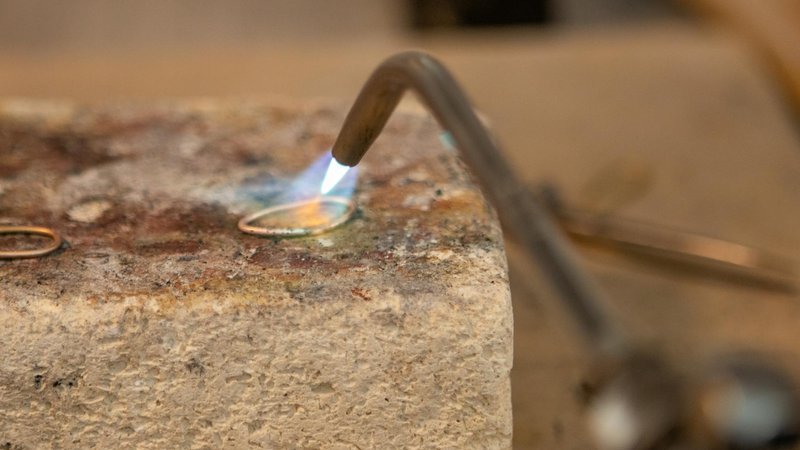
In a small workshop in Tsubame-Sanjo, a city in Niigata Prefecture known for its metalworking traditions stretching back four centuries, a woman named Yumi Nakamura shapes silver into rings that weigh less than five grams. Her grandfather forged katanas. Her father made high-end kitchen knives. Yumi chose jewelry — a decision that, in her family, was not entirely uncontroversial.
"My grandfather said I was wasting the technique," she told me through a translator when I visited her studio in 2023. "He said making small things for decoration was beneath someone who had been taught to work steel. My father was more understanding. He said the hand skills are the same whether you're making a blade or a brooch. The scale is different. The patience is the same."
That conversation stuck with me, because it gets at something fundamental about Japanese metalworking: the techniques developed over centuries for making swords and armor didn't disappear when swords were banned. They evolved, fragmented, and found new applications — from kitchen knives to hair ornaments to the tiny clasps and settings of contemporary jewelry. The story of Japanese metalworking is, in many ways, a story of adaptation.
The Sword: Where It All Started
Japanese sword-making, or tosho, is one of the most technically sophisticated metalworking traditions in human history. A traditional Japanese sword blade is made from multiple layers of steel with different carbon contents, folded and forge-welded together dozens of times to create a composite material that's simultaneously hard enough to hold a razor edge and flexible enough to absorb impact without snapping. The process takes weeks, sometimes months, for a single blade.
The key techniques — differential hardening (creating a hard edge and a softer spine in the same blade), folding (welding the steel back on itself to purify and homogenize it), and clay tempering (coating the blade in clay of varying thickness before quenching to control the cooling rate) — required an intimate understanding of metallurgy that was empirical, not theoretical. Japanese swordsmiths didn't have thermometers or spectrographs. They judged steel temperature by color and sound. They evaluated carbon content by the way a piece broke when struck. This knowledge was passed from master to apprentice across generations, with each swordsmith adding refinements and innovations.
The aesthetic dimension was equally sophisticated. The grain pattern on a finished blade (called hada), the temper line (hamon), and the polish that reveals these features are not decorative afterthoughts — they're the visible record of the forging process, and they're considered integral to the blade's value and beauty. A swordsmith who could produce a beautiful hamon was respected as much for artistry as for technical skill.
Then, in 1876, the Haitorei edict banned the wearing of swords in public. Almost overnight, the primary market for swordsmiths disappeared. The tradition didn't die — it continued at a reduced pace for military and ceremonial purposes — but the economic foundation crumbled. Swordsmiths and their apprentices had to find other work. Many turned to the metalworking skills they already possessed and applied them to new objects.
Mokume-Gane: The Technique That Crossed Over
Perhaps no Japanese metalworking technique has made a more successful transition from sword fittings to jewelry than mokume-gane. The name translates roughly to "wood grain metal," and the technique involves laminating thin sheets of different colored metals — typically gold, silver, copper, and various alloys — and then pattern-cutting, forging, and carving the laminated block to reveal the layered grain pattern. The result looks like wood grain, or sometimes like topographic contours, with swirling patterns of different metallic colors.
Mokume-gane was developed in the 17th century by Denbei Shoami, a swordsmith who applied it to tsuba — the hand guards fitted between a sword's blade and its grip. Sword fittings were one of the few areas where decorative metalwork was encouraged, and tsuba makers competed to produce the most intricate and beautiful designs. Mokume-gane was one of their signature techniques.
When the sword market collapsed, mokume-gane survived because it was inherently beautiful and applicable to non-weapon objects. In the 20th century, Western metalsmiths discovered the technique and began using it for jewelry — wedding bands, pendants, earrings. Today, mokume-gane is one of the most recognizable decorative metal techniques in contemporary jewelry, and many of the world's best practitioners are Japanese or Japanese-trained.
The technique itself is demanding. Each layer of metal must be meticulously cleaned and stacked. The stack is heated in a kiln to just below the melting point of the lowest-melting alloy, held there until diffusion bonding occurs, then removed and forged. One mistake — a bit of oxidation on a surface, a temperature fluctuation of a few degrees — and the layers delaminate, ruining hours of work. The failure rate for beginners is high, which is why competent mokume-gane work commands premium prices.
Tsuba to Brooch: The Transition
The transition from sword fittings to jewelry wasn't just about mokume-gane. Many of the decorative techniques used in tsuba-making — inlay (zogan), carving (bori), chasing and repoussé (uchidashi and osidashi) — translated directly to jewelry-scale work. The skills were the same. Only the scale and context changed.
In the late 19th and early 20th centuries, as Japan opened to Western trade and influence, a market developed for Japanese decorative metalwork among Western collectors and consumers. Sword fittings, hair ornaments (kanzashi), and small decorative objects became export commodities. Japanese makers adapted their traditional techniques to produce objects that appealed to Western tastes — smaller, more wearable, less overtly martial.
This period produced some extraordinary work. The Meiji era (1868-1912) saw Japanese metalworkers creating pieces that combined traditional techniques with Western forms: cigarette cases, brooches, cufflinks, and belt buckles decorated with lacquer, enamel, and metal inlay. These pieces are now collectible and sell for significant sums at auction.
Post-War: The Studio Jewelry Movement
After World War II, Japan's metalworking traditions faced another existential threat. The war had devastated infrastructure, and the occupation period brought Western cultural influence that devalued traditional crafts. Young people wanted modern, Western goods. Traditional metalworking — whether swords, knives, or decorative objects — seemed old-fashioned and irrelevant.
But a few practitioners persisted, and in the 1960s and 70s, a studio jewelry movement emerged in Japan that combined traditional metalworking techniques with contemporary design sensibilities. This wasn't a revival of old styles — it was a genuine synthesis, taking the hand skills developed over centuries and applying them to new forms and concepts.
Key figures in this movement include Morihiro Hosoe, who combined traditional Japanese metalworking with modernist design; Yasuki Hiramatsu, who studied in Germany and brought European jewelry sensibilities back to Japan; and Kōji Iwatani, whose work explored the boundaries between jewelry and sculpture. These makers trained the next generation, and their influence is visible in the work of contemporary Japanese jewelers.
The Tsubame-Sanjo Connection
Modern Japanese jewelry metalworking isn't concentrated in one place, but the Tsubame-Sanjo area in Niigata Prefecture deserves special mention. This region has been a metalworking center since the Edo period (1603-1868), when it produced nails, needles, and other hardware for the growing city of Edo (now Tokyo). Over time, the region developed specializations in various metalworking trades — forging, casting, polishing, plating — that together formed a complete ecosystem for metal production.
Today, Tsubame-Sanjo is known for both industrial metal products and handcrafted items. The region produces a significant portion of Japan's high-end kitchen knives, metal tableware, and — increasingly — jewelry and accessories. The concentration of specialized workshops means a jeweler in Tsubame-Sanjo can have their casting done by one shop, their polishing done by another, their plating by a third, and their finishing by a fourth, all within a few kilometers. This division of labor allows for a level of specialization and quality that's hard to achieve in a solo studio.
The region also has a strong apprenticeship culture. Many of the workshops are family-operated, with techniques passed from parent to child over generations. This creates a deep, embodied knowledge of metalworking that goes beyond what can be learned from books or videos. A third-generation polisher in Tsubame-Sanjo has an intuitive understanding of how different alloys respond to different abrasives and compounds — knowledge accumulated over decades of daily practice.
Techniques You'll See in Japanese Jewelry Today
Chasing and Repoussé
These are complementary techniques for creating three-dimensional relief in sheet metal. Repoussé involves pushing the metal outward from the back using blunt punches and hammers. Chasing involves refining the detail from the front with sharper tools. Japanese metalworkers are known for the precision and depth of their chasing work — some pieces have relief so fine it looks like it was cast rather than hand-worked.
Engraving (Horikomi)
Japanese engraving is done with hand-pushed gravers, not pneumatic tools. The cuts are incredibly precise, with clean lines and consistent depth. Some Japanese engravers specialize in nanako, a pattern of tiny raised dots that covers a surface with a textured, almost granular appearance. This technique originated in sword fittings and is still used in contemporary jewelry for its visual and tactile appeal.
Patination
Japanese metalworkers use a wider range of metal alloys than many Western jewelers, and this is partly because they've developed sophisticated patination techniques that produce specific colors on specific alloys. Shakudo (a copper-gold alloy) produces a deep blue-black patina. Shibuichi (copper-silver) produces a range of grays and soft blues. These colored alloys, combined with gold, silver, and copper, give Japanese jewelry a distinctive palette that's hard to replicate with other metals.
Folding and Forging
The same folding techniques used in sword-making appear in contemporary Japanese jewelry on a smaller scale. Some makers fold thin sheets of silver or gold multiple times to create patterned surfaces with visible grain, similar to Damascus steel. Others forge wire and sheet by hand to create textures that machine-rolling can't produce. The result is jewelry with a tactile quality that invites handling.
What Western Jewelers Can Learn
You don't have to be Japanese to benefit from these traditions. Several techniques and principles from Japanese metalworking are worth studying regardless of your background.
The emphasis on process over product is fundamental. In Japanese metalworking tradition, the way something is made matters as much as what it looks like. A well-executed technique is valued even if the result is subtle or understated. This runs counter to a market that often prioritizes visual impact over craftsmanship, but it produces work that rewards close examination and ages well.
Material knowledge — understanding not just what a metal is but how it behaves when heated, hammered, stretched, and polished — is another takeaway. Japanese metalworkers spend years developing this understanding through daily practice with specific alloys and specific tools. The depth of knowledge shows in the finished work.
Patience is the most obvious lesson, and the hardest to apply. Traditional Japanese metalworking is slow. A single piece can take weeks or months to complete. In a market that rewards fast production and constant content creation, this pace is difficult to sustain. But the pieces that come out of it have a quality that can't be rushed.
The Living Tradition
Japanese metalworking isn't a museum piece. It's a living tradition that continues to evolve. Young makers are combining inherited techniques with contemporary design, digital tools, and global influences. Some are using 3D printing for initial forms and finishing by hand. Others are applying traditional patination techniques to non-traditional materials. The boundaries of what counts as "Japanese metalworking" are expanding, and that's healthy.
Yumi Nakamura, the jeweler in Tsubame-Sanjo whose grandfather made swords, told me she sometimes thinks about her grandfather's hands when she's working. "The way he held the hammer," she said. "The way he listened to the steel. I don't make swords, but I hold my tools the same way. I listen to the metal the same way. That's the connection. Not the object. The attention."
That attention — to material, to process, to the small details that most people will never notice — is what separates Japanese metalworking, whether applied to a katana or a five-gram silver ring, from ordinary craft. It's not about the technique itself. It's about the relationship between the maker's hands and the material they're working with.
That relationship, developed over centuries and passed down through generations, is worth studying, worth preserving, and worth carrying forward into whatever form the next generation chooses to give it.
Comments