A Civilization Defined by Its Adornments
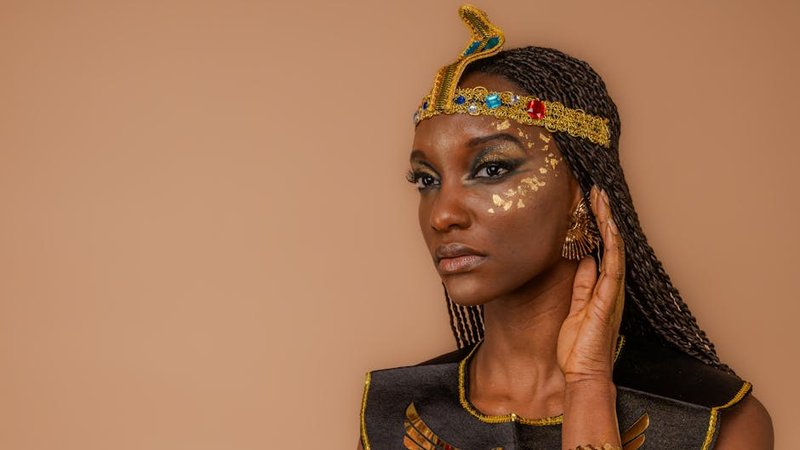
Standing inside the Temple of Karnak in Luxor, I craned my neck toward a wall relief showing a pharaoh draped in layers of gold and lapis lazuli. The detail was insane — every symbol, every bead, every feather carved into stone with a precision that made the gold collar around the figure's neck look almost alive. Our guide mentioned, almost casually, that what we were seeing was a simplified version of what the real piece probably looked like. The actual jewelry — the stuff buried with Tutankhamun, the pieces recovered from queens' tombs — was even more elaborate. I bought a cheap scarab pendant in the gift shop that afternoon, brought it home, and spent the next three weeks reading everything I could find about ancient Egyptian jewelry. What I discovered was a world far more complex and fascinating than any souvenir could capture.
A Civilization Defined by Its Adornments
Ancient Egypt spans roughly three thousand years of dynastic history, from around 3100 BCE to the death of Cleopatra in 30 BCE. Throughout that enormous stretch of time, jewelry wasn't just decoration — it was communication. Every piece told a story about the wearer's social status, religious beliefs, political power, and even their journey into the afterlife. When archaeologists open a tomb, the jewelry is often the most revealing artifact they find, because unlike stone carvings that were commissioned for public display, personal jewelry was chosen by the wearer and reflected genuine individual taste and belief.
The scale of production was staggering. Tomb paintings show entire workshops dedicated to metalwork, stone cutting, and bead making. The Egyptians weren't making a few special pieces for royalty — they were producing jewelry at an industrial scale, with pieces ranging from simple faience beads worn by common farmers to spectacular gold collars reserved for the pharaoh himself.
The Craftsmen Behind the Gold
One thing that surprised me during my research was the social status of jewelry makers. These weren't slaves or lowly laborers — at least, not always. The craftsmen who worked in royal workshops were highly skilled professionals who lived in dedicated villages near the tombs and temples they served. The village of Deir el-Medina, home to the workers who built the Valley of the Kings, also housed goldsmiths, lapidaries, and bead makers who crafted funerary jewelry for the pharaohs. They were paid in rations of grain, beer, and meat, and some accumulated enough wealth to commission their own tombs — complete with jewelry.
Apprenticeships typically started young, around age ten or twelve, and lasted years. A master goldsmith would teach a student how to smelt gold, hammer sheet metal, solder tiny components together, cut semi-precious stones, and string beads in complex patterns. The level of skill required is genuinely remarkable when you consider the tools they had — stone hammers, copper chisels, bow drills, and simple bellows. No electricity, no magnification, no modern polishing equipment. And yet some of the granulation and filigree work they produced would be difficult to replicate even with today's technology.
Design Elements: The Symbolic Language of Egyptian Jewelry
Every element in ancient Egyptian jewelry carried meaning. Nothing was purely decorative. A flower wasn't just a flower — it was the lotus, symbolizing creation and rebirth. A bird wasn't just a bird — it was the falcon of Horus, representing kingship and protection. Understanding the symbols is the key to understanding the jewelry itself.
The Scarab (Khepri)
The dung beetle was sacred to the Egyptians because they observed it rolling balls of earth — which they interpreted as the sun god rolling the sun across the sky. Scarab amulets are among the most common jewelry finds in Egyptian tombs, and they were worn by everyone from pharaohs to peasants. The flat underside of a scarab was often inscribed with the owner's name, a prayer, or a magical spell. Heart scarabs, placed over the deceased's heart during mummification, were believed to prevent the heart from testifying against the soul during the judgment of the dead. I find it fascinating that something so small could carry so much theological weight.
The Lotus
The blue lotus (Nymphaea caerulea) appears everywhere in Egyptian art and jewelry. It symbolized the sun, creation, and rebirth because the flower closes at night and sinks beneath the water, then reopens at dawn. Lotus motifs were rendered in gold, faience, and carved stone, and appeared on necklaces, diadems, earrings, and pendants. The flower was also associated with perfume and pleasure — tomb paintings frequently show banquet guests wearing lotus garlands and inhaling the fragrance.
The Eye of Horus (Wadjet)
Perhaps the most recognizable Egyptian symbol, the Eye of Horus represents healing, protection, and restoration. According to mythology, Horus lost his left eye in a battle with Set, and it was magically restored by Thoth. As a jewelry element, the Eye of Horus was believed to ward off evil and protect the wearer from harm. It appears on amulets, rings, and pendants spanning the entire history of ancient Egypt. The proportions of the eye were even used as a system of measurement — each part of the symbol corresponded to a fraction, which is a remarkable intersection of mathematics and mysticism.
The Feather of Ma'at
Ma'at was the concept of truth, balance, and cosmic order — essentially the force that kept the universe functioning. She was personified as a goddess with an ostrich feather on her head. In the afterlife, the deceased's heart was weighed against the Feather of Ma'at. If the heart was lighter than or equal to the feather, the soul passed into the afterlife. If it was heavier — weighed down by sin — it was devoured by Ammit, a terrifying creature with the head of a crocodile, the body of a lion, and the hindquarters of a hippopotamus. Feather-shaped amulets were popular jewelry items, serving as a daily reminder to live a righteous life.
The Ankh (Key of Life)
The ankh is the hieroglyphic symbol for "life" and appears in virtually every context of Egyptian culture. Gods are frequently depicted holding an ankh to the pharaoh's lips, symbolizing the breath of life. As jewelry, ankh pendants and amulets were believed to confer vitality and eternal life upon the wearer. It's one of the few Egyptian symbols that remained in continuous use from the earliest dynasties through the Coptic Christian period, where it was adopted as the crux ansata — the handled cross.
Materials: From River Mud to Royal Gold
The materials used in Egyptian jewelry evolved significantly over three millennia, but a few staples remained constant throughout.
Gold
Gold was associated with the sun god Ra and was considered the flesh of the gods. Egypt had substantial gold deposits in the Eastern Desert and Nubia, and pharaohs sent expeditions to mine it as early as the Old Kingdom. Egyptian goldsmiths developed sophisticated techniques including hammering, casting, alloying, granulation (decorating surfaces with tiny gold beads), and cloisonné (creating compartments filled with colored stones or enamel). The famous death mask of Tutankhamun — not technically jewelry, but made with identical techniques — contains over 22 pounds of gold and demonstrates the extraordinary skill of New Kingdom craftsmen.
Lapis Lazuli
Egypt had no natural deposits of lapis lazuli. Every single piece had to be imported from Afghanistan — a journey of over 2,500 miles through some of the most difficult terrain on earth. The fact that the Egyptians went to such enormous effort to obtain this deep blue stone tells you how highly they valued it. Lapis was associated with the night sky, the divine, and the primordial waters from which creation emerged. In jewelry, it was used for inlay work, beads, and carved amulets. The most prized pieces had visible flecks of golden pyrite within the blue matrix — the Egyptians saw these as stars embedded in the night sky.
Carnelian
This orange-red semi-precious stone was abundant in the Eastern Desert and was one of the most commonly used materials in Egyptian jewelry. It symbolized blood, energy, and the power of the sun. Carnelian beads have been found in Egyptian graves dating back to the predynastic period — before Egypt was even unified under a single ruler. The stone was relatively easy to work with and affordable enough that even non-royal Egyptians could own carnelian jewelry.
Faience
Egyptian faience is a ceramic material made from crushed quartz or sand, with a glassy alkaline glaze that gives it a bright, colorful surface. It was used for beads, amulets, inlay, and small decorative elements. Turquoise-blue faience was particularly popular because it imitated the much more expensive turquoise stone. Faience was essentially the ancient Egyptian version of costume jewelry — it allowed ordinary people to wear colorful, symbolically meaningful pieces at a fraction of the cost of gold and semi-precious stones.
Iconic Jewelry Forms
The Usekh Collar
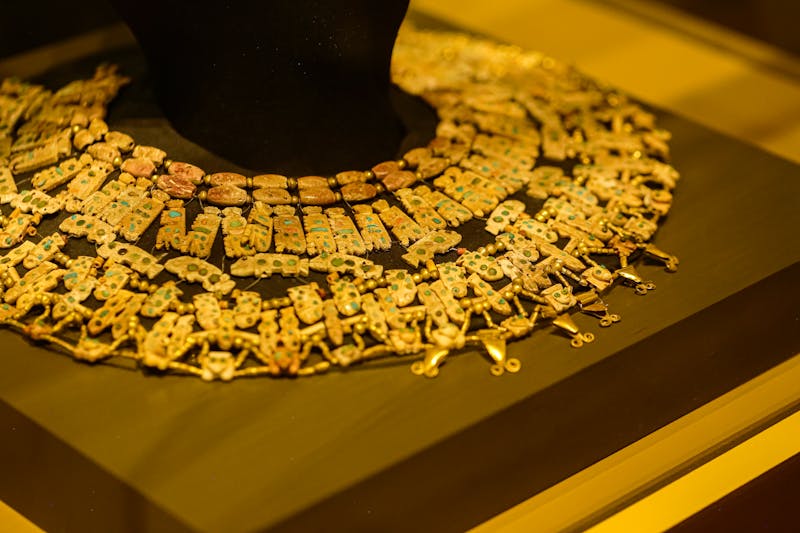
The usekh is a wide, flat collar necklace that rests on the chest and shoulders. It's probably the most iconic piece of Egyptian jewelry, recognizable from countless tomb paintings and museum displays. These collars were made of rows of beads strung in patterns — typically with a wider section at the center that tapered toward the shoulders. They could be made from gold, faience, glass, or any combination of materials. Some were incredibly elaborate: the usekh collar found on Tutankhamun's mummy consists of over 300 individual faience beads arranged in a complex geometric pattern. Even commoners wore simplified versions made of inexpensive materials.
Pectorals
A pectoral is a large, decorative chest ornament, typically worn suspended from a chain or cord around the neck. Royal pectorals were masterpieces of goldwork and inlay, often depicting deities, protective symbols, or scenes from mythology. They were ceremonial pieces, worn during important rituals and festivals, and were considered among the most prestigious items in a pharaoh's collection. The pectoral of Tutankhamun depicting the pharaoh between the god Amun and his wife Ankhesenamun is one of the most famous pieces of Egyptian jewelry in existence.
Diadems and Headbands
Royal headwear was an important category of personal adornment. Gold diadems, often decorated with uraeus (rearing cobra) symbols and lotus flowers, were worn by pharaohs and queens. Simpler headbands made of cloth, leather, or metal were worn by people of lower status. Hair rings — small coils of gold or faience worn woven into the hair — were popular among women of all classes.
Amulets
Amulets were small charms worn for protection, healing, or to attract specific benefits like fertility, strength, or wisdom. They were by far the most common type of jewelry in ancient Egypt, worn by everyone from newborns to pharaohs. Common shapes included scarabs, ankh crosses, djed pillars (representing stability), and tyet knots (representing the goddess Isis's blood and magical protection). People were buried with dozens or even hundreds of amulets, strategically placed on different parts of the body to protect specific organs and ensure a successful journey through the afterlife.
Pharaoh vs. Peasant: The Jewelry Divide
The gap between royal and common jewelry was enormous but not absolute. Pharaohs wore pieces made of solid gold, inset with lapis lazuli, turquoise, and other imported gemstones, crafted by the finest artisans in the kingdom. A single royal necklace could represent months of skilled labor and materials worth a small fortune.
Common Egyptians, by contrast, wore jewelry made of faience, shell, bone, and locally available stones like carnelian and jasper. Their pieces were simpler in design but still carried the same symbolic weight — a farmer's scarab amulet addressed the same god as a pharaoh's gold scarab pendant. The difference was in materials and craftsmanship, not meaning.
There was also a substantial middle class of officials, priests, and military officers who could afford well-made but non-royal jewelry — pieces of gold with semi-precious stones, but without the extraordinary complexity of royal work. This class of jewelry is actually among the most interesting to study because it shows what people chose to wear for themselves, rather than what was dictated by court protocol.
What the Symbols Really Meant
I've mentioned individual symbols throughout this article, but it's worth understanding them as a system. Egyptian jewelry wasn't random — it was a carefully constructed web of meaning. A typical necklace might combine a scarab (rebirth) with an ankh (life) and an Eye of Horus (protection), creating a piece that functioned as a portable prayer for safety, longevity, and renewal. The specific combination of symbols could be customized to the wearer's needs — a soldier might favor protective symbols, a pregnant woman might wear amulets associated with safe childbirth, an elderly person might emphasize symbols of renewal and afterlife preparation.
This is what makes ancient Egyptian jewelry so different from most modern jewelry. We tend to choose pieces primarily for aesthetics — we like how they look, they match our outfit, they make us feel attractive. The Egyptians certainly cared about beauty, but for them, every piece was also a functional spiritual tool. Wearing jewelry was an active, daily engagement with the divine.
Egyptian Revival in Modern Jewelry Design
The influence of ancient Egyptian jewelry on modern design is hard to overstate. The "Egyptomania" that followed Napoleon's Egyptian campaign in 1798 sparked the first major wave of Egypt-inspired European jewelry, and the discovery of Tutankhamun's tomb in 1922 touched off an even bigger one. Art Deco designers incorporated scarabs, lotus motifs, and geometric patterns directly borrowed from Egyptian sources. Designers like Cartier, Boucheron, and Van Cleef & Arpels created spectacular Egyptian-inspired pieces that are now collector's items in their own right.
Contemporary jewelry designers continue to draw on Egyptian symbolism. You'll find scarab pendants, ankh earrings, and Eye of Horus rings in shops ranging from high-end boutiques to online marketplaces. Some designers work with traditional materials — gold, lapis lazuli, carnelian — while others interpret the symbols in modern materials like resin, stainless steel, and recycled metals.
What I find most compelling about this ongoing influence is that the meaning hasn't entirely been lost. When someone today wears a scarab pendant because they like the design, they're participating — however loosely — in a tradition of personal adornment that stretches back over five thousand years. The beetle on their necklace is still, at some level, a symbol of transformation and renewal. That continuity, across millennia and cultures, is pretty extraordinary when you think about it.
Comments